


 Francais
 Deutsch
 Italiano
Refine Your Search
Waltham Massachusetts 1932 stock footage and images
- Showing 37 to 42 of 893 results more
more Hide
Hide
Rocket motor designs by International scientists and inventors, reflecting early work by German rocket researchers
Designs by various international scientists and inventors who have contributed to solving the problems of rocket motor development, based on the German preparatory work. Their combustion chamber designs owe much to the German pioneers in the field. Shown are design sketches by Russian scientist, Konstantin Tsiolkovsky (Ziolkowsky) in 1914; French inventor Henri Melot, in 1920; German Friedrich Zander, in 1931; Bull, 1932; The American Rocket Society, with several designs from 1932; and The Cleveland Rocket Society. Views of rocket combustion research activity by Ernst Loebell of the Cleveland Rocket Society in 1933. He is seen outdoors in the snow with his apparatus. View of Loebell's test firing stand, and a picture of an actual test firing, outdoors. Ernst Loebell with model and rocket motor from his spaceship projects of 1934 and at the International Exposition dedicated to Art and Technology in Modern Life held in Paris, 1937. Cutaway views of the spaceship. The rocket motor wrapped in cooling coils. Rocket motor design by John Shesta of the American Rocket Society, from 1934. Design by Rene Armengaud of France, in 1934 and Deich in 1935.

Workers work at Los Angeles stadium during preparation of 1984 summer Olympics in Los Angeles.
Preparation for 1984 summer Olympics in Los Angeles. The opening scene is a flashback of footage from the 1932 summer Olympics in Los Angeles. A group of men play long horn bugles. Olympic competitors walking on stadium track during opening or closing ceremony of the 1932 Olympics. Scene changes to modern day 1983 views of the Los Angeles Memorial Coliseum (3911 S Figueroa St, Los Angeles, CA 90037, USA). The entrance door reads 'Los Angeles Memorial Coliseum'. A truck picks up cylindrical containers from the grounds. The truck spreads red paint on the floor and the workers work by the side. Red stone gravels. A worker sprays water on the ground. A stone fence reads 'University of Southern California'. Men stand near an Olympic swimming pool. A crane digs mud. Men work at the construction site.
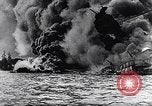
Japanese attack on Pearl Harbor in presaged by a decade of Japanese military aggression in China (WW2)
Opening scene shows the famous image of American battleship USS Arizona as attacked by Japanese forces in Pearl Harbor on December 7, 1941 in World War II. The ship is engulfed in black smoke, and listing. Change of scene to a waterfront in Japan during 1938, where numerous Japanese soldiers board troop ships bound for Manchuria, China. Next, are scenes of Japanese troops marching as they occupy Manchuria. Closeups of some Japanese soldiers. Scene shifts to a train moving on the South Manchurian railway, at a station showing a sign reading,"Chin Hsien." View of steam locomotive pulling a train away from the camera position. (Narrator states that a Japanese train, on the South Manchurian Railway, had been dynamited) This incident triggered a Japanese attack on Mukden, Manchuria. Japanese infantry are seen placing numerous bundles of reeds as a bridge across a wide, shallow, stream and proceeding to cross on their way to invade Mukden. Military supplies are carried on pack animals. In the air, overhead Japanese Mitsubishi G3M Type 96 land-based attack aircraft are seen flying in precision "V" formation. On the ground, Chinese civilians run for cover in the City of Mukden. (The date is September 18, 1931.) Glimpse of Chinese civilians looking at bombing victims on street of Mukden. Brief view of Geneva Switzerland, where League of Nations was housed. A memorial stone monument in that city to Woodrow Wilson, President of the United States and founder of the League of Nations. An entrance to the League of Nations headquarters in the Palais Wilson in Geneva, Switzerland. League delegates in session inside the Palais Wilson. A Japanese Naval Fleet, under command of Admiral Kichisaburō Nomura, is seen steaming toward the Chinese coast and begin a naval bombardment, firing their guns, 15 miles from Shanghai. Japanese Naval biplanes are seen in flight overhead. Japanese troops marching in the streets of Shanghai, as sidewalks of onlookers wave Japanese flags. Next, Japanese troops are seen marching out of Shanghai, at the insistence of the League of Nations. (Narrator states Japan signed a truce with China on May 4th, 1932.) View of Japanese troops entering further, into Mongolia. Japanese soldiers waving flag celebrating formation of the Puppet State of Manchuko in Northeast China and Inner Mongolia, in 1932. Japanese statesmen leaving the League of Nations headquarters, after Japan resigned from the League on February 24, 1933. Japanese infantry moving further into China supported by field artillery fire. Explosions from artillery and damaged buildings, as Japanese troops advance in China. Invaders using tall ladders to scale walls of a damaged fortress in China. Japanese pilots receiving briefing and boarding their Mitsubishi Ki-30 single engine light bomber aircraft at an airfield. View of them taking off and inflight, dropping bombs on Chinese targets. Aerial views of bombs exploding on ground below. Retreating Chinese army marching along the Great Wall of China. Chinese people and military forces moving their military and civilian resources deep into the Chinese interior.
Newsreel restrospective produced following the death of President Franklin D. Roosevelt (WW2)
Opening scene shows the White House in Washington, DC. Scene shifts to President Roosevelt seated, ready to address the Nation by radio. View of the statue of Abraham Lincoln in the Lincoln Memorial in Washington, DC. FDR with his entire family posing, in front of the family home "Springwood" at Hyde Park, New York. Roosevelt, when Governor of New York, seen in a sail boat, in 1929. FDR in his car at his Institute for Rehabilitation in Warm Springs, Georgia. He is speaking with a man associated with the Institute, who then greets several polio victims in wheel chairs there. Crowds celebrating Roosevelt's election, in Times Square, Manhattan, New York City, in 1932. Roosevelt, at the Democratic Headquarters at the Biltmore Hotel on November 8, 1932. He is standing, supported by his son James, as he remarks: "It looks my friends like a real landslide this time." Aerial view of the U.S. Capitol. FDR taking the oath of office on March 4, 1933. Brief view of New York Stock Exchange trading floor. A man looking at stock market ticker tape. A group of people raising a National Recovery Administration member flag. Glimpse of "Springwood" and then view of President Roosevelt sitting next to his mother, Sara Ann Delano Roosevelt. Next, as Franklin and Eleanor Roosevelt sit in the garden, their grandchildren, Anna Eleanor Dall ("Sistie") and Curtis Roosevelt Dall ("Buzzie") come past riding horses, with granddaughter Sara, behind them on a pony. FDR pets the pony and talks with Sara. FDR being nominated for a second term as President, in the 1936 Democratic National Convention in Philadelphia, Pennsylvania. President Roosevelt, riding in an inaugural motorcade as he begins an unprecedented 4th term as President in 1941. Glimpse of President and Mrs. Roosevelt in an open car. West point cadets marching in the inaugural parade. Military trucks towing artillery pieces in the parade. President Roosevelt speaking at the dinner of the White House Correspondents' Association at the Willard hotel in Washington, DC, March 15, 1941. He extols the virtues of Winston Churchill and the British people. And he promises that America will supply them with the war materiel they need in World War II (This is known as the Lend Lease Speech.)
Liquid rocket research and development, led by Robert H. Goddard, in America
Robert H. Goddard with the first flight of a liquid fuel rocket on March 16, 1926, in Auburn, Massachussets. He stands next to the rocket perched high on a launching frame. Goddard uses a long pole and can of benzene to fuel the rocket. Photogaph of his camera and barograph used on July 17, 1929. An 18 meter tower being prepared. A 6 meter high test stand. The barrel could be filled with water and serve as ballast. Picture of a Performance recording device. A man in a protective bunker 15 meters from the launch point for tests in New Mexico. A man using a telescope to observe from a shed 900 meters from the launch point. Another with a telescope and recording device on a tripod. Pictures from the first gyro-controlled rocket flight on April 19, 1932
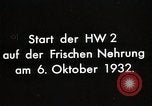
Johannes Winkler and test of liquid fuel HW-2 rocket on beach near Danzig
Dr.Johannes Winkler, rocket pioneer and his HW2 liquid fueled rocket. Winkler and his staff standing in front of the Hw2 rocket, conversing, at the Konigsberg fairgrounds in 1932. Dr. Winkler explaining his rocket to interested visitors at the fairgrounds. Closeup of Dr. Winkler as he speaks. View of the launch site where spectators are gathered at the Vistula Spit near Danzig (Gdansk) Poland, on the Baltic Sea. Winkler and his assistant on the sand beach,fueling the rocket with liquid methane. The rocket team checks meteorlogical conditions. Winkler being interviewed by a reporter. while Winkler continues the interview, his assistant, on a ladder, begins fueling the rocket with liquid oxygen. Winkler inspects it after fueling. The staff places the nose cone over the rocket. Technician in white coat checks ignition, as German naval officers and other officers and officials stand nearby. Winkler opens flush door in rocket and places something inside. German still camera men and a cinematographer, wearing army helmets, prepare to record the event. Another photographer takes refuge in a trench on the sands. At launch, the rocket lurches upward, and falls to the ground, where it burns. Winkler's staff throw sand on it to put out the fire. Winkler and staff examining the wreckage to determine the reason for the explosion (rather than smooth burning of fuel). Dr.Winkler making notes. Winkler and assistant examining fuel containers and ignition wires.