


 Francais
 Deutsch
 Italiano

Refine Your Search
Wiesbaden Germany 1945 stock footage and images
- Showing 337 to 342 of 10473 results more
 Hide
Color Sound
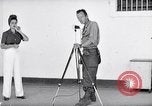
Interview with liberated female internee Georgette Kramer from the Los Banos camp in Manila, World War 2
Interview in Manila with freed female internee Georgette Kramer from the Japanese operated Los Baños internment camp (liberated 13 days before the interview). A microphone is set on a tripod stand for the interview. Ms. Kramer relates how she was wounded by a stray Japanese bullet during the February 23, 1945 liberation operation. During the firefight with Allied forces a bullet went through her mother's arm, through Ms. Kramer's abdominal wall, and into her friend's hand. Wounded, they were rushed to a tank. She says one other internee was also shot through the hip. When asked what she wants to do now that she is free she says she is not sure. A young girl, Ms. Kramer's sister, Aoife Kramer, runs up to the camera and says she wants to say something too. The interviewer lifts up the child in his arms. The girl says she wants to go to the United States. (World War II period).
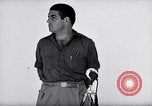
Three sisters, liberated prisoners of the Japanese Los Banos intermenent camp, sing during a post-liberation interview
Three women prisoners released from Japanese-operated Los Baños internment camp being interviewed two weeks after the February 23, 1945 liberation by U.S. and Filipino forces in World War 2. The three Fernando sisters sing while a microphone is kept on a tripod in front of them. Their song about the "Three Little Sisters" tells the story of their internment and their expectant waiting for liberation by the U.S. armed forces which was finally realized.
Montage of scenes related to 1942 Fall of Corregidor, the Bataan Death March, POWs and destruction of manila, in World War II
World War 2 scenes related to the Philippines. Opening shot shows Japanese troops unceremoniously taking down American flag in 1942, followed by superimposed images of Japanese soldiers boots trampling over U.S. flags. Next, U.S. Lieutenant General Jonathan Wainwright with members of his staff, are seen seated at a table in the Japanese headquarters building on Bataan to discuss surrender with General Masaharu Homma, Commander of the 14th Japanese Imperial Army. Homma has General Wachi at his left and Colonel Nakayama to his right. Repetition of the superimposed Japanese army boots trampling American flags. Next, U.S. defenders of Corregidor are seen surrendering to Japanese troops in 1942, and then being marched under guard to Mariveles, where the infamous Death March commenced. Several views of the American and Filipino prisoners marching under guard. Glimpse of American combat helmets piled up in a heap. Views of the POWs without helmets, using white cloths over their heads to protect from the sun. Huge numbers of POWs held in an open area for the night, and then marching again during the day. One who had fainted is carried in a blanket by several others. Illustrations of POWs being tortured by Japanese soldiers. Views of two POWs, who died during the march, lying on the ground. Next scene shows emaciated Allied POWs in 1945 being freed by American soldiers from a Japanese prison camp. American soldiers speaking with another group is a section of prison behind a sign reading: "Dysentary, Keep Out." Undernourished former prisoners of war eating a meal. One smoking a cigarette. Aerial view showing large swaths of Manila, Philippines, destroyed by Japanese forces retreating from advancing American forces. Smoke rising along a line of destruction in the background. Bodies of numerous Filipinos lying amid rubble in the streets of Manila. Many have hands tied behind their backs. Glimpse of dead children. Cadres of Japanese soldiers raising victory cheers. New Japanese conscripts in large formations during military training for new recruits following draft. Japanese naval trainees in white uniforms, waving their hats. Huge crowd of Japanese people cheering, followed by view of Emperor Hirohito, in Army uniform, saluting as he stands on a balcony. Cheering Japanese people, at a rally in a stadium.
United States fighter aircrafts F6F Hellcat and F4U Corsair on aircraft carrier USS Essex (CV-9); point of view approach from SBD Dauntless.
Aircraft of Carrier Air Group 9 (CVG-9), embarked aboard the USS ESSEX (CV-9), operating with Task Force 58, are seen returning from a strike over Tokyo, Japan, in February, 1945, during World War 2. They display the white double-diamond tail design of aircraft assigned to the USS Essex. F4U Corsair makes an arrested landing. Unusual point of view shot from rear seat, left side, of a Douglas SBD Dauntless aircraft as it approaches aircraft carrier, turns, and comes in for landing on the carrier deck. F4U Corsair taxiing to deck edge elevator and lowered to hangar below. F6F Hellcat touchdown for an arrested landing. Pilots seen in the cockpit.
U.S. Marine Corps raise American flag on Mount Suribachi in Iwo Jima during World War II; and original statue unveiling at Quantico in 1951.
A film titled 'Uncommon Valor' about the raising of the U.S. flag by U.S. Marines on Iwo Jima, Japan during World War II. United States naval fleet underway off the coast of Iwo Jima. U.S. Army Air Forces aircraft in flight. U.S. 4th and 5th Division Marines disembark from a ship and get onto landing crafts as they head towards the Iwo Jima shoreline. Marines land ashore and advance inland. They raise the American flag on Mount Suribachi. A newspaper boy sells newspapers on a street in the United States. A picture of the raising of the flag on Mount Suribachi. View of sculptor Felix De Weldon as he carves a sculpture of the flag raising event. Scenes from the unveiling and dedication ceremony of the original limestone statue on November 10, 1951, at the Marine Corps base in Quantico, Virginia, for the 176th anniversary of the founding of the Marine Corps. (The version of the statue seen in this footage had been placed in front of the Navy Department Building at the intersection of Constitution Avenue and 19th Street Northwest, Washington, D.C on 10 November 1945. It features 9 foot figures at 1.5 times life size scale. This sculpture was moved to Quantico Marine Base on 17 November 1947. It had been originally constructed by De Weldon of Indiana limestone, cement, and sand due to a lack of bronze during the war. At the time of its move to Quantico in 1947, the statue had deteriorated due to weather. Also, coats of paint to give the look of bronze had hidden much of the detail and had to be removed. Felix de Weldon supervised the repairs at Quantico before the statue was officially dedicated at the main entrance of Quantico on 10 November 1951, as seen in this ceremony). Officers lined up at the ceremony and many guests in the audience. A parking lot seen in the distance behind the assembled crowd. Cover sheets being removed as the war memorial is unveiled at Quantico.
1st Allied Airborne Army troops take off from a field in the European Theater during Operation Varsity of World War II.
A film titled 'First Allied Airborne Army in Operation Varsity, 24 March 1945' about the successful airborne crossing of the Rhine river by the 1st Allied Airborne troops during World War II. Aerial views of aircraft and gliders on ground in areas the narrator describes as East Anglia (England, United Kingdom) and in the Paris, France area. U.S. Army Air Forces C-46, C-47 aircraft and CG-4 gliders on a field. British Halifax and Sterling bomber aircraft. A glider with nose art name, "Texarkana Belle." U.S. Army soldiers of the U.S. 17th Airborne Division near the glider aircraft. Soldiers load equipment into gliders and aircraft. Jeeps, vehicles and other equipment loaded onto gliders. Airborne troops waiting near the aircraft, smoking cigarettes and talking as they await takeoff time. Aircraft lined up on a field. Troops put on gear and board the gliders and towing C-47 Skytrain aircraft. Propellers turn as towing aircraft prepare to take off. Men ensure slack lines are taken up properly and engage the gliders being towed. Aircraft tow gliders as they take off. Gliders and aircraft in flight and ground crews waving to the aircraft in the sky.
CRITICALPAST.COM: About Us | Contact Us | FAQs - How to Order | License Agreement | My Account | My Lightboxes | Shopping Cart | Advanced Search | Featured Collections | Website Terms & Conditions | Privacy Policy ©2026 CriticalPast LLC.
License Agreement |
Terms & Conditions |
Privacy Policy
©2026 CriticalPast LLC.