


 Francais
 Deutsch
 Italiano

Refine Your Search
Wiesbaden Germany 1945 stock footage and images
- Showing 4261 to 4266 of 10473 results more
 Hide
Color Sound

In Germany, a Hellmuth Walter 109-509 bipropellant rocket motor which was used by the Nazis during World War II.
Picture of a Hellmuth Walter 109-509 bipropellant rocket motor. The motor mounted in a test stand, next to an observation bunker with a slit viewing port. The rocket engine starts. Smoke comes out.

Rocket cars developed at the German Heylandt factory in Berlin-Britz, Germany
Momentary opening slate (in German) cites a new rocket car, the largest in the world, designed by German chief engineer Alfons Pietsch. Closeup of the liquid-fueled rocket car at the Heylandt factory in Berlin-Britz (Heylandt-Gesellschaft für Apparatebau mbH). The rocket engine is ignited and creates a huge flame behind the car. It travels for a while in the industrial yard of the Heylandt factory until the flame dies. (Note: At the beginning of 1930, rocket engineer Max Valier was given the opportunity to develop a liquid rocket engine at Heylandt in Britz. He was assisted by the Heylandt development engineers Alfons Pietsch, Walter Riedel and Arthur Rudolph, who built the rocket motor in a test vehicle called "hellhound" after Valier's accidental death in May, 1930.) Change of scene shows a rocket car of Max Dalier being refueled from a liquid oxygen tank. Next, the car, with "Heylandt" painted on its side, is seen with Max Valier at the controls, driving about the Heylandt factory grounds, propelled by a moderate thrust from its liquid fueled engine. It circles about the yard several times.
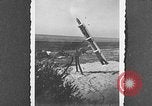
Rocket testing by German rocket pioneer, Reinhold Tilling, at the lake lake Dümmersee in Germany
Still pictures of early German rockets on tripod launchers. A number of small rockets laying on the ground partially covered with a tarpaulin. Several men on a hillside with a rocket launcher pointed horizontally. Fleeting glimpse of the work shop of German rocket pioneer, Reinhold Tilling, followed by views of several men holding a Tilling postal rocket nose down with its wings folded. They are standing in tall marsh grass near lake Dümmersee. Next, Reinhold Tilling is seen with his assistant, Angela Buddenboehmer, and his mechanic Friedrich Kuhr, making adjustments to a rocket, with its wings open. Men carry the rocket with its wings folded and place it on a tall pole. Next, the rocket launches straight into the air. Men maneuver in a sailboat and other boats in the Dümmersee, preparing to retrieve a Tilling rocket. Closeup of the men in the sailboat. Several men in a long boat near marsh grass where a Tilling rocket has landed.
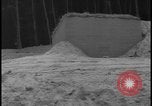
Bunkers and farmlands, with aerial view, along Nazi Siegfried Line in western Germany
View of a semi-underground bunker located in the western Nazi German defense fortification line called the “Siegfried Line” before World War 2. View of farmlands near the Siegfried Line. Snow covered bunkers and pillboxes in the Siegfried Line as seen in aerial view.

V-1 rocket launch from catapult ramp in Germany (WW2)
Title card says “Flakzielgerät 76 V 102 Schnittautnahmen 17.8.1943” (“Anti-aircraft target device 76 V 102 cut recordings 08/17/1943” in English). World War II V-1 glide bomb launches after Argus engine start. View of exit point of Walter catapult. Entire launch ramp shown as camera pans to surface of launch ramp.

V-1 flying bomb hits ground and explodes in Germany (WW2)
Title card says “Geheime Kommandosache” (“Secret commando operation” in English). “Erprobungsstelle der Luftwaffe Karlshagen” (“Test site of the Air Force Karlshagen” in English). Information on “Flakzielgerät 76 Ohne Zünder” (“Flak target device 76 No Detonator” in English). View of V-1 flying bomb without wings attached and no engine running being released at an altitude of 2000 meters. Unstable V-1 buzz bomb falls to ground and explodes during World War II.
CRITICALPAST.COM: About Us | Contact Us | FAQs - How to Order | License Agreement | My Account | My Lightboxes | Shopping Cart | Advanced Search | Featured Collections | Website Terms & Conditions | Privacy Policy ©2026 CriticalPast LLC.
License Agreement |
Terms & Conditions |
Privacy Policy
©2026 CriticalPast LLC.