


 Francais
 Deutsch
 Italiano
Refine Your Search
Worms Germany 1945 stock footage and images
- Showing 613 to 618 of 10469 results more
more Hide
Hide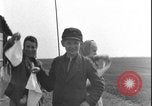
Street battles, German civilians wave white handkerchiefs, German prisoners-of-war line up by US Army soldiers in Halle, Germany in WW2
German women and a child wave white handkerchief during World War 2. Sign for Zscherben, a village near Halle, Germany. A Sherman tank with United States soldiers rolls past Zscherben signage. United States soldiers crouch near bricked wall in Halle, Germany. United States soldiers advance on the streets of Halle. United States soldiers crouching near white building. United States soldier crouches in front of Sherman tank. German prisoners-of-war line up facing fence with hands raised by United States soldiers. Bespectacled German woman, uncomfortably smiling, holds a plaid dishcloth, perhaps as sign of surrender.
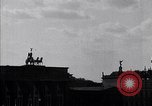
Scenes of Berlin, and its statuary during the Weimar Republic period in Germany, following World War I.
Silhouette of the Quadriga statue atop the Brandenburg Gate (Brandenburger Tor, Pariser Platz, 10117 Berlin, Germany) and the Victory Column (Siegessäule, Großer Stern, 10557 Berlin, Germany) in Berlin, Germany. Then pedestrians and vehicles are seen around the Statue of Frederick the Great along Unter den Linden boulevard. Also seen is statue in Siegesallee created by sculptor Reinhold Begas (and likely August Krauss) in 1900, commemorating German Emperor William I. Bust on the left of the William I statue commemorates Helmuth von Moltke the Elder, and the bust on the right is of Otto von Bismarck. Next, is shown the National Kaiser Wilhelm Monument (Kaiser-Wilhelm-Nationaldenkmal) an equestrian statue of the first German Emperor Wilhelm I, on the west side of the Berlin City Palace (Schloßpl., 10178 Berlin, Germany). View from a camera moving away from the Victory Column on the Königsplatz across from the Reichstag. Final image is an iron Statue of Paul von Hindenburg in front of the Victory Column.
Steel mill operations and output in Germany, and bridges, ships, buildings and industry created with steel
Hot molten steel in a steel mill in Germany. Hot steel rods in process at the factory. Men work outside welding steel girders and beams to create a large steel frame or building structure. Men stand on the skeletons of buildings. Manufacture and launch of a giant German ship involving steel. Various ships and scaffolding at the shipyard. Tall steel girder bridges in Germany are shown. Various views of the Tagblatt-Turm (Tagblatt Tower) building in Stuttgart Germany just a few years after its completion -- an example of early modernism and in stark contrast to other older buildings in the area. A high rise building seen behind an old stone gate structure in Germany. Buildings and houses in the area.
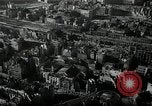
Aerial views of war damage in Berlin, Germany.
War damage in Berlin, Germany as seen from the air. Various buildings destroyed in the Berlin Mitte district. Aerial view of the Potsdamer Platz, the Reich Chancellery (Reichskanzlei Wilhelmstraße 77 Berlin, Germany), and the Reichstag building (Platz der Republik 1, 11011 Berlin, Germany), showing further damage caused by bombing. Aerial view of Mitte district, with heavy damage from bombing. View of the Ministry of Aviation building (now known as the Detlev-Rohwedder-Haus Wilhelmstraße 97, 10117 Berlin, Germany).
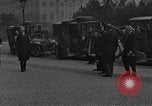
Kaiser Wilhelm II and wife, Augusta Victoria, visit Royal Library in Berlin, Germany
Three motorcars are parked behind one another at a curb, in Kaiser-Franz-Josef-Platz, Berlin, Germany. Two are completely enclosed sedans. But one is a Saloon-landoulet, with open seat in the rear. Kaiser Wilhelm II of Germany, and his wife, Augusta Victoria of Schleswig-Holstein-Sonderburg-Augustenburg, walk from that car, toward the entrance of the Königliche Bibliothek (Bebelpl. 2, 10117 Berlin, Germany) accompanied by two civilian officials. Later, Empress Augusta Victoria and Kaiser Wilhelm II emerge from its doorway. They proceed toward their motorcar. The Humboldt University building (Unter den Linden 6, 10117 Berlin, Germany) along Unter den Linden is visible in the background, with a statue of Wilhelm von Humboldt in front of it.
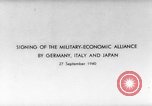
Adolf Hitler, Galeazzo Ciano and Saburo Kurusu sign the Military-Economic Alliance Pact in Berlin, Germany.
The signing of the Military-Economic Alliance or Tripartite Pact by Germany, Italy and Japan in the Reich Chancellery in Berlin, Germany on September 27, 1940, during World War II. Hitler welcomes delegates at the signing of the Germany-Italy-Japan alliance. A group of diplomats led by Foreign Minister of Germany Joachim von Ribbentrop, Italian Minster of Foreign Affairs Count Galeazzo Ciano and Japanese delegates strides down a long, wide corridor. Same men come into a conference room. Ciano stands at a conference table. The others file in. A close of German officers. German Chancellor Adolf Hitler comes into the room, salutes and is saluted. Hitler approaches Ciano, shakes hand, then approaches Japanese delegates. Hitler, Ciano and Japanese career diplomat Saburo Kurusu at the table with their aides standing behind the envoys. Ribbentrop signs the document followed by Ciano and Kurusu. Hitler and the delegates leave the table. Hitler at the Reich Chancellery window receives cheers of a crowd. Hitler salutes at the window and leaves the balcony.
CRITICALPAST.COM: About Us | Contact Us | FAQs - How to Order | License Agreement | My Account | My Lightboxes | Shopping Cart | Advanced Search | Featured Collections | Website Terms & Conditions | Privacy Policy ©2026 CriticalPast LLC.
License Agreement |
Terms & Conditions |
Privacy Policy
©2026 CriticalPast LLC.