


 Francais
 Deutsch
 Italiano
Refine Your Search
Worms Germany 1945 stock footage and images
- Showing 625 to 630 of 10469 results more
more Hide
Hide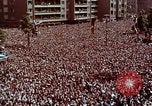
U.S. president John F Kennedy visits Berlin Germany and gives "Ich Bin Ein Berliner" speech
A crowd of 300, 000 West Germans cheering for United States President John F. Kennedy before delivering a speech in West Berlin. At a podium flanked by American and Berlin City flags, Kennedy begins his speech referring to ancient Roman declaration: "cīvis rōmānus sum" ( I am (a) Roman citizen). President Kennedy goes on to say that today the best boast is: "Ich bin ein Berliner." Crowded streets of West Berlin during President John F Kennedy's visit. Music played by the band as song lyrics contain name of President Kennedy (his Presidential campaign song). Presidential motorcade on the outskirts of West Berlin. Enthusiasm shown by West Berlin people is more than that shown by the people of Frankfurt, Cologne and Bonn. Robert Kennedy and Vice President Johnson were prior visitors to West Berlin after the Wall was built in 1961. Large crowds cheering for Kennedy along the Kurfurstendamm, the main shopping boulevard of West Berlin. The Kaiser Wilhelm Memorial Church (Breitscheidplatz, 10789 Berlin, Germany) can be seen on the background. Boys and girls ride scooters and bicycles trying to keep pace with the entourage. Bricked up windows in buildings from East Berlin as seen from West Berlin in the Bernauer Straße. A woman walks her dog along the Berlin Wall. Two women stop to reflect at a memorial for Ida Siekmann, the first victim killed by East German police while trying to cross over "no man's land" between the two sides. Views of the Berlin Wall and surrounding anti-tank barriers and barbed wire in no man's land. The Quadriga on the Brandenburger Tor as seen from West Berlin. Street sign “Straße des 17. Juni”. Presidential motorcade turns to onto 17th June Street. President Kennedy takes a look at East Berlin side. Red flags draped on the Brandenbuger Tor by East German police. Communists display anti-American propaganda in English facing West Berlin. English propaganda by East Germany says “These pledges have been fulfilled in the German Democratic Republic. When will these pledges be fulfilled in West Germany and West Berlin, President Kennedy?”, pertaining to the Yalta and Potsdam Agreements from World War 2. East Germans set up a camera facing West Berlin. East German photographer capturing President Kennedy’s visit on film. President Kennedy stands before the Wall accompanied by Chancellor of West Germany Konrad Adenauer. Motorcade leaves Brandenburg Gate and crosses 17th June Street. President's car is preceded by a truck with American and German photographers. President Kennedy’s entourage pass by the Berlin Victory Column (Siegessäule, Großer Stern, 10557 Berlin, Germany). Street signs saying “Friedrichstraße” and “Zimmerstr.”. The entourage stops at the Allied Checkpoint Charlie. President John F. Kennedy views the East German side from a platform near Checkpoint Charlie with German Chancellor Konrad Adenauer.
Passengers aboard a Rhine River steamer in Germany.
Passengers aboard a Rhine River steamer in Germany. Tourists watch the scenes along the Rhine River. Passengers dining onboard. View of the Wertheim Castle (Schloßgasse 11, 97877 Wertheim, Germany) in Baden-Württemberg. Ferry transport carries men and vehicles across the lake. Ship captain steers ship’s wheel. Passenger ships underway in the Rhine. A town near Lake Constance in Germany. A train heading for Scandinavia leaves Lake Constance. A Seedienst Ostpreußen ferry sailing the Baltic Sea to the German exclave of East Prussia.
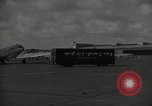
Operation Kinderlift , run by U.S. Air Forces Europe and Red Cross, flies children from Berlin to West Germany for vacations
Operation Kinderlift, of United States Air Forces Europe (USAFE) and the Red Cross, that flies German children from Berlin for summer vacations in West Germany (Federal Republic of Germany). U.S. military buses arrive at Tempelhof airdrome, Berlin, carrying children and their parents. They leave buses and assemble to hear remarks from John J. McCloy, United States High Commissioner for Germany, and from USAF Colonel Joseph G. Manyo, Director of Kinderlift II. Each child wears an identification tag reading: "Kinderluftbrucke." They are escorted to C-47 transport aircraft by U.S. Air Force and Red Cross personnel. Their parents and relatives wave goodbye to them. View showing children seated inside a C-47 airplane. The aircraft arriving at Rhein Main Air field, Frankfurt, and Red Cross personnel and U.S. airmen, helping children off the airplane. Children running from a bus, and then in a dining hall, having a snack, including Pepsi Cola, in bottles. Children walking into a camp, carrying their luggage. A sign at the entrance reads: " JUGENDLAGER, KLEIN-BERLIN, HERZUCH WILLKOMMEN." Children eating dinner in dining hall at the camp.
Germany in years leading up to World War 1 and during World War I
Traces events leading up to and through World War I. Portrait of German emperor Kaiser Wilhelm II. Wilhelm II riding on horseback. He starts the preparations for war. Views of German military officials including Helmuth von Moltke the Younger. Newspaper headlines of assassination of Austrian Archduke. Celebrations on streets of Germany at start of World War I including views of German soldiers and citizens preparing for war. Germany launch war on Serbia, France and England. German infantry and u-boat submarines target enemy positions. U.S. President Woodrow Wilson in his office . U.S. declares war on Germany. U.S. forces departing from American cities and arriving in Europe; moving toward battle. Scenes from trench warfare of World War I in France. Soldiers going up "over the top" out of trenches during offensive operations and into "no man's land". Retreat of Germans, views of General von Luddendorff, the German Chief of Staff. Armistice declared after secret message sent to German government by Luddendorff. Cheering people celebrate the end of World War 1 after armistice. Views of United States General Pershing.
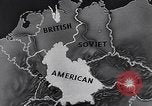
Military and German Police try to stop gun runners and black marketing and conduct free elections in Germany after World War 2
A map shows the United States, British and Soviet occupied zones in Germany after World War II. American and French police checks papers and belongings of Germans entering their zone. They chase and capture a gun runner car and remove a weapon from the back seat. Scene in a building depicts young Nazi die hard followers in a "werewolf gang" meeting in secret to plot how to continue Nazi Germany. German civilians gathered exchanging items in black market activity. U.S. occupation soldiers sell cigarettes in black market to German civilians. German police raid a black market exchange area and arrest many German citizens, rounding them up and loading them onto a truck. A captured German woman cyring. German de-nazification trials at a court in session. At a news conference, U.S. Army General Lucius D. Clay speaks about measures to build democratic processes in Germany, starting with local elections. A leader speaks at a political party meeting. German civilians vote at first free elections after World War II. A German man acts with servility before a U.S. officer and looks vindictively in direction of officer after leaving his room. Narrator describes German people post-war as egotistical people.
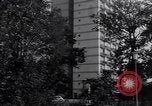
View of busy stores and shops in streets in West Berlin, Germany
Huge buildings and skyscrapers seen in restored postwar West Berlin, Germany. A street sign reads 'John-Foster-Dulles-Allee'. Pedestrians and traffic on busy streets. Preserved bombed-out Kaiser Wilhelm Gedächtniskirche (Kaiser Wilhelm Memorial Church, Breitscheidplatz, 10789 Berlin, Germany), Berlin. A car entering a parking multi-story car park. U.S. Army Soldiers seen shopping. People shopping at Kaufhaus des Westens (KaDeWe, Tauentzienstraße 21-24, 10789 Berlin, Germany). Some shops names read 'Peek & Coppenberg', 'Kaffee Hag' and 'Odol'.
CRITICALPAST.COM: About Us | Contact Us | FAQs - How to Order | License Agreement | My Account | My Lightboxes | Shopping Cart | Advanced Search | Featured Collections | Website Terms & Conditions | Privacy Policy ©2026 CriticalPast LLC.
License Agreement |
Terms & Conditions |
Privacy Policy
©2026 CriticalPast LLC.