


 Francais
 Deutsch
 Italiano

Refine Your Search
Worms Germany 1945 stock footage and images
- Showing 67 to 72 of 10479 results more
 Hide
Color Sound

British Wartime General Election gives control to the Labor party in 1945
Opening slate of this film reads" Churchill Defeated." It goes on to show Winston Churchill attending his last meeting with wartime allied leaders at Podsdam, Germany in July, 1945. He shakes hands with Soviet Foreign Minister Vyacheslav Molotov. His replacement, Clement Attlee who is also there. View from above of Soviet leader, Joseph Stalin greeting the new British Prime Minister, Clement Attlee, who is accompanied by Foreign Secretary Anthony Eden and U.S. President Harry Truman, accompanied by Secretary of State James F. Byrnes. The wartime leaders gather around a large round table. Closeup of Marshal Stalin and Soviet Foreign Minister Molotov. Closeup of U.S. President Harry S. Truman at the conference table. View from above of the principals at the table. Film shifts to scenes of Major Attlee campaigning for votes. People in street listening to Ernest Bevin campaigning. Views of Winston Churchill being given a hearty farewell by a crowd, as he rides through on an open vehicle. Closeups of him he picks up a microphone to address the throng. Scene shifts to views of British voters casting their ballots. King George VI strolls with new Prime Minister Attlee and Winston Churchill. He poses with the new Prime Minister (Attlee) and Ernest Bevin on his right. At his left is Winston Churchill and Anthony Eden. Closeups of Clement Attlee.
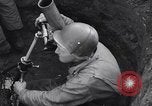
United States 81 mm mortar crews fire shells at enemy targets in Germany during World War II
American soldiers in fortified position firing 81mm mortar in support of U.S. infantry in Germany during final months of World War 2, in Europe. Early in February,1945, U.S. soldiers of Company M, 3rd Battalion, 313th Regiment, 79th Division, are seen supplementing their ammunition with captured German 80mm mortar shells. Closeup of the U.S. 81mm mortar shell next to a German 80mm shell. M Company soldiers firing the German shells from their 81mm mortars at German targets across the Mulde River. They are operating amongst homes in a residential area. Explosions in distance from the mortar shells.
Crash landed USAAF P-47D Thunderbolt at Eschborn Airfield, Germany, near the end of World War II in Europe
Germany about a month before the end of World War 2 in Europe. A crash landed United States Army Air Force Republic P-47D Thunderbolt aircraft, nicknamed "Mom's Irish Mick." It was assigned to the 404th Fighter Squadron, 371st fighter Group, and crash landed on Advanced Landing Ground Y-74 Frankfurt/Eschborn that had been seized by advancing U.S. forces, in 1945. The aircraft carries tail number 44-33253 and was piloted by Charles T. Martin III. Officers retrieve ammunition from the wing gun. Crane brought in to lift the fighter plane also known as the Jug. Crane pulls the P-47 off field. The hulk of a Gotha 242 transport glider stands next to the American flag at half mast with air field tents in the background. A formation of P-47s flies over the flag. Four P-47s buzz and pull up with the flag in foreground. P-47s flying in 'V' formation with American flag in foreground and officers on the ground. Four P-47s circle for landing. A North American T-6 Texan training plane, a.k.a. Harvard, with occupants in both cockpits, taking off and pulling up.
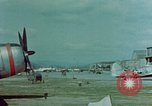
American P-47 aircraft at an Allied occupied airfield in Germany.
Aircraft P-47s parked around hangars at Allied occupied airfield in Germany in 1945. P-47aircraft taxiing and taking off. 'Chick' written on side of one airplane. (World War II period).
Aircraft strafing industrial targets in Germany near end of World War II in Europe
Aircraft strafing a factory. Dark view of strafing railroad. Aircraft industrial targets in Germany in 1945, near the end of World War Two in Europe.
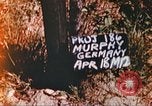
Views of captured Me 262 factory at Walpersberg, Kahla, Germany, near the end of World War 2
Scenes of captured site where Me 262 jet aircraft were assembled by Flugzeugwerke Reichsmarschall Hermann Göring (or Goering) (REIMAHG) in an old porcelain sand mine in the Walpersberg mountain, near Kahla. Germany. (The secret project was codenamed "Lachs" or Salmon). View of a tunnel entrance, from inside. .A partial Me 262 with wings, is silhouetted against tunnel entrance and several in stages of assembly can be seen darkly inside.a bombproof bunker. A middle/rear fuselage of an Me 262 is seen on a wagon outside the bunker buildings. Two bombproof bunker buildings are seen on their own. A tall derrick crane is seen moving objects from the facility. (Existing mining tunnels within the Walpersberg razorback mountain were expanded for production and bombproof buildings were constructed around its perimeter. An inclined lift was used to raise Me 262's from the perimeter building area to the top of the mountain, where a takeoff strip had been created for delivery of the aircraft to the Luftwaffe. The U.S. Army occupied the site on April 12th 1945, and reportedly removed enough partial assemblies and parts to produce five Me 262s for testing and research.)
CRITICALPAST.COM: About Us | Contact Us | FAQs - How to Order | License Agreement | My Account | My Lightboxes | Shopping Cart | Advanced Search | Featured Collections | Website Terms & Conditions | Privacy Policy ©2026 CriticalPast LLC.
License Agreement |
Terms & Conditions |
Privacy Policy
©2026 CriticalPast LLC.