


 Francais
 Deutsch
 Italiano
Refine Your Search
Worms Germany 1945 stock footage and images
- Showing 121 to 126 of 10469 results more
more Hide
Hide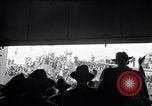
Steamship passengers, including many Displaced Persons and former prisoners of Nazi concentration camps, arrive in New York
The steamship, "SS Marine Flasher," arrives in the port of New York, after steaming from Bremen, Germany. In addition to U.S. citizens, her passengers include many refugees, and former prisoners of Nazi concentration camps, who benefited from President Truman's directive of December 22, 1945, giving preference to Displaced Persons in obtaining visas. Views among the crowds gathered at the dock to welcome loved ones. People waving and smiling. One woman angrily shouting at a guard. Men, women, and children aboard the ship, many wearing identification ribbons. Passengers enter the dock area. Their relatives and friends greet them warmly. A man kisses a woman and weeps. Two men embrace. (World War II period).
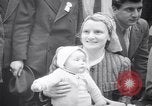
Displaced Persons, refugees, and former prisoners of Nazi concentration camps arrive by ship in New York City
Views of men, women, and children aboard the steamship "SS "Marine Flasher" docked at a pier in New York harbor after a voyage from Bremen, Germany. Her passengers include many refugees and former prisoners of Nazi concentration camps. Many benefited from U.S. Presidential Directive No. 29, issued on December 22, 1945, giving preference to Displaced Persons in obtaining visas. A woman with her child smiles. A boy waves at friends and relatives on shore. A young brother and sister in the ship. An older and younger woman, likely mother and daughter, show the prisoner number tattooed by Nazis on their arms. The tattoos are sequentially numbered, A-26587 and A-26588. Reuniting people hold each other with warmth and weep. A family of 7 children spanning a range of ages, with no parents evident. (Note: this is the Weber family ranging in age from 4-18. In order of age from oldest to youngest they are Alfons, Senta, Ruth, Gertrude, Renee, Judith, and Virginia (Ginger) nee Bela. The family settled in Chicago. All married and had 24 children and now numerous grandchildren. The children and grandchildren live in across the U.S. in Chicago, Maryland, Texas, Alabama, California, Virginia, Minnesota and in London, England. This Information provided in 2014, by Lynn Chapman daughter of Gertrude.) (World War II period).
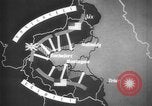
U.S. C-47s drop supplies to troops at Bastogne. General Taylor congratulates General McAuliffe for his defense of Bastogne
Map shows Allied army drives toward Germany in World War 2, and Battle of the bulge counter attack by Germans. Smoke rising from ruins. An American Army engineer douses a fire. In the ruins of Malmedy, Belgium, a sign reads: "Tower Room Malamedy, Protestant Church." Map shows Bastogne. Some of 400 C-47 transport aircraft resupply flights are seen in the air after weather clears. They airdrop food and ammunition to U.S Army troops who had been holding their position and preventing Germans from overtaking in the snow at Bastogne. U.S. gliders, that brought medical assistance, are seen on the snow-covered ground. Aerial view snow covered town. View of food bundles and supplies. Elements of General Patton's 3rd Army arriving to break through German lines and reach the embattled 101st Airborne at Bastogne. Dead and captured German soldier prisoners of war (POW). Destroyed tanks and equipment. Later (January, 1945) Commander of the 101st Airborne Division, Major General Maxwell Davenport Taylor congratulates Brigadier General Anthony McAuliffe for his defense of Bastogne. American troops in Bastogne find time to rest up and smile for the camera after enduring difficult battle.
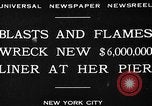
Fire consumes large North German Lloyd ocean liner Munchen (later Steuben) docked in New York Harbor, New York City
Clear aerial views of midtown and lower Manhattan, New York City 1930, but with smoke coming from Hudson River pier of New York Harbor where the North German Lloyd liner Munchen (sometimes Muenchen or München) is seen on fire, shortly after docking in New York after the voyage from Bremen, Germany. Ship emits smoke and fire at the pier. Firefighters spray water to extinguish fire. Views of the piers and slips and dock areas on the Hudson River at New York City and close up views of the firefighters battling the blaze on the Muenchen. The ship subsequently sank at dock. She was raised later in 1930, repaired in dry dock, and returned to service under the new name SS General von Steuben. The ship was sunk in 1945 by the S-13 submarine of the Soviet Union.
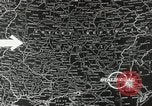
Post-World War II scenes in Communist occupied areas of Europe and Asia
Animated map shows thrust of German forces during invasion of Soviet Russia in World War 2. Stalingrad is highlighted as a turning point. Another animated map shows Soviet territorial gains at the end of the war, as narrator discusses the disposition of those places and their respective populations, as in Latvia, Lithuania, and Estonia. He also discusses Soviet zones of occupation. Animated map shows "Iron Curtain." Soviet troops on parade. Soviet ZSU-57-2 self-propelled anti-aircraft guns (SPAAG) on display during a parade in 1945. A stadium filled with people in Soviet-occupied East Germany, in 1949. Friedrich Wilhelm Reinhold Pieck, the first President of the German Democratic Republic, is seen in the stands. Young East German women parade in traditional costumes, clapping their hands, in the stadium. Waterfront scenes show Soviet trade activities with post-war occupied entities. Scenes of conflict as Chinese communist forces expel Chiang Kai-shek's Nationalist Chinese forces (ROC) from mainland China to Formosa (Taiwan), in 1949. A litter-borne casualty and a refugee mother and small girl are seen as they evacuate.

Japan's possible shortages of material for clothing in World War 2. Japanese domestic production of cotton, wool, and silk
Illustrated discussion of Japan's limitations in natural resources prior to World War II. Workers shown in textile mills which employed more than half of Japan's factory workers prior to the war, satisfying domestic and export needs. Analysis of the natural resources. Cotton thread is rolled on the spindles in the Textile mills in Japan. Textile mills produce fabric in Japan. Japanese women work in the textile mills. Bales of raw cotton imported from Japanese possessions in Korea and Formosa, and from the United States,India, Brazil and China. They are transported via horse carts and manually pushed on small rail carts to storage buildings for stockpiling. People cultivating some of the small amount of cotton grown in Japan. Horses and cattle used to pull plows in rice paddies. Pigs used as scavengers. Woolen fabric is produced from wool. Some of Japan's very few sheep being sheared for wool. Women working in fields of mulberry trees where silk worms flourish on their leaves. Views of the silk being spun onto spindles in a factory. Silk fabrics being stacked. Illustrated summary highlights Japanese domestic shortages of cotton, wool, and leather needed for clothing.
CRITICALPAST.COM: About Us | Contact Us | FAQs - How to Order | License Agreement | My Account | My Lightboxes | Shopping Cart | Advanced Search | Featured Collections | Website Terms & Conditions | Privacy Policy ©2026 CriticalPast LLC.
License Agreement |
Terms & Conditions |
Privacy Policy
©2026 CriticalPast LLC.