


 Francais
 Deutsch
 Italiano
Refine Your Search
Worms Germany 1945 stock footage and images
- Showing 373 to 378 of 10469 results more
more Hide
Hide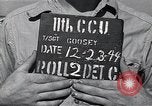
Officer paints nose art on B-29 bomber Deaner Boy of U.S. Army Air Force at their base on Tinian, Mariana Islands during World War II
United States Army Air Force crew at their base in the Tinian, Mariana Islands during World War II. A Army Air Force officer stands on a hoist near the cockpit of a B-29 bomber paints a picture on it. Picture of a baby wearing boxing gloves. Officer paints the baby's diaper with white paint. Soldier looks at nose art painting on the B-29 nose with written wording "Deaner Boy" on it. Another soldier walks up and looks at the nose art painting. (Note: Painter might be Lieutenant Dean C. Forburger, based on examination of image reflected back from aircraft body. Forburger was a B-29 pilot stationed at Tinian at the time, and images exist of him standing beneath this nose art. Forburger was not a member of the crew on Deaner Boy when it perished in a mid-air collision accident in February 1945. The Deaner Boy nose art was painted at least twice on this aircraft, as there are also other images of it in existence with a side-facing baby and cursive lettering for "Deaner Boy").
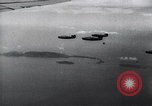
American and Japanese aircraft attack each others airfields in World War II. B-24 and B-29 heavy bombers strike Japanese targets
Formation of U.S Army Air Forces B-24 Liberator bombers, flying over Iwo Jima during World War 2. View from one of the aircraft of Japanese air field below. Nightime view of American anti-aircraft fire directed at Japanese bombers attacking Saipan. Explosions and fire silhouetting American aircraft on Saipan's Isely field during Japanese air raid. Burning U.S. B-29 bombers. Scene changes to Japanese aircraft destroyed on the ground at the air base on Iwo Jima. Bodies of dead Japanese airmen on the air field. Later view of P-51Ds from the 21st Fighter Group at Central Field on Iwo Jima, in the summer of 1945,after the field had been substantially upgraded to allow B-29 operations. A B-29 is seen displaying an "F" tail code. A formation of B-24 Liberator bombers in flight on a bombing raid. Waist gunner inside a B-24 firing at attacking Japanese fighter aircraft. A Japanese fighter going down in flames at night. View from a B-24 of another, off its left wing, flying in formation with its number 3 engine shutdown and propeller feathered. View from B-24 bombing oil facilities at Balikpapan, Borneo. Bombs bursting on the ground. Glimpse of B-24s in formation. Aerial views of bomb bursts carpeting target areas below. Aerial view of B-24s flying above smoke rising rapidly from bombs bursting below. View of bomb craters left below (probably from later reconnaissance flight).
U.S. orientation film for Allied occupation forces, to provide background for understanding Japanese and their society
Background information for United States occupation forces in Japan after end of World War II. At start, the film shows sky filled with U.S. Navy airplanes flying in formations. They include Vought F4U Corsair aircraft, among others, and are seen overhead above the Battleship USS Missouri (BBB-63). Closeup of the USS Missouri with her crew in formation on deck wearing dress whites. Next, General Douglas MacArthur is seen and heard speaking from a podium on the Missouri's deck. He invites the representatives of the Emperor of Japan, and the Japanese Government, and the Japanese Imperial headquarters, to sign the instrument of surrender. The date is September 2, 1945, just after the end of World War 2. Closeups of the Japanese delegation, which includes envoys Foreign Minister Mamora Shigemitsu and General Yoshijiro Umezu, and of MacArthur. Japanese Foreign Minister Mamora Shigemitsu sits at a table. Closeups of him signing the surrender document. Change of scene to Japan, where camera pans over many thousands of Japanese people assembled to learn of their fate. Closeups of Japanese soldiers and family members, as Narrator asks how should the U.S. occupying force treat them. View of soldiers in plain non-military uniforms. Views of Japanese responding en masse to a leader, during World War 2. Views of child victims of the war. Closeup of Japanese soldier firing a short barrel light machine gun. Views of Japanese pedestrians including families, most in western dress. Japanese workers in an office. Film shows artists view of one worker's brain, and then many brains, as Narrator refers to need for reorienting Japanese thinking. View of learned wise Japanese leader at a podium. View of a Japanese soldier posed with his sword above the head of a war prisoner. Japanese mother feeding her baby. Closeups of Japanese babies. Closeups of Japanese school age children, in a group, and some doing things in school, and some at a playground. Group of uniformed Japanese students studying the art of Japanese calligraphy. Students doing artwork, studying nature outdoors, and paying attention to a teacher using a black board to explain how to calculate volumes of different shaped vessels. Students in classes of Geography and of geology. Japanese chemists, architects, and lawyers at work. Telephone switchboard operators at work. Electrified train moving on a track.
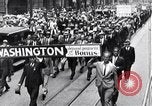
The 1930s Great Depression and the administrations of Presidents Herbert Hoover and Franklin Roosevelt, in the United States
Hard times in the Great Depression led to formation of The Bonus Army. American veterans of World War 1 march on streets of Washington DC, carrying a large poster demanding immediate cash redemption their "bonus" service certificates awarded by Congress in 1924 (but not lawfully payable until 1945). Army Chief of Staff, General Douglas MacArthur, ordered by President Hoover, to clear the Bonus Army encampments, is seen standing in a street surrounded by several U.S. Army troops. People watch from sidewalks as a contingent of U.S. Army cavalry rides down the street. U.S. Army M-1917 tanks roll down Pennsylvania Avenue in July 1932. Bonus marchers and others watch from Lafayette Park in background. Scene shifts to the 1932 Democratic Party Convention in Chicago Stadium, Chicago, where delegates cheer after nominating Franklin D. Roosevelt as their Presidential candidate. Roosevelt seen waving from the podium. Migrant farm workers seen at temporary, dilapidated dwellings in close quarters, and sitting at a campfire, some with sad and desperate faces. Migrant farm workers' cars on the road, piled high with family belongings during westward migration. Migrants riding atop an open railroad freight car. Two men share a copy of the "Epic News" newspaper (published by supporters of Upton Sinclair and the End Poverty Movement in Los Angeles and central California). Narrator describes programs of the Works Progress Administration (WPA) and the Civilian Conservation Corps (CCC). Construction workers ignite demolition charges during construction of Boulder Dam (aka Hoover Dam and officially so-named in 1947). Glimpse of President Roosevelt at the site in an open car, for its dedication on September 30, 1935. Construction workers engaged in building the dam. Another shot of President Roosevelt in his open car. Towers being erected to carry electric power from the dam's hydroelectric generators. President Franklin D. Roosevelt smiling broadly at the formal dedication ceremony, September 30, 1935. Controlled discharges of water through the dam. Views of the Boulder Dam hydroelectric generating station. Oil well rigs or oil derricks at work during construction at night. People at work in fabric mills or textile mills, and in a print shop
Judge Louis E. Goodman dismisses Justice Department's civil action to denaturalize ILWU President, Harry Bridgers.
Opening scene shows dimly lit hallway of Federal District Court building in San Francisco. Camera focuses on a courtroom door inscribed as " U.S. District Court, 258, Louis E. Goodman." Officials are seen escorting International Longshoreman's Union (ILWU) President, Harry Bridgers, along a hallway, accompanied by many photographers. Bridger's lawyer, Carol Weiss King and her co-counsel, wearing dark rimmed glasses, are seen standing in the hallway. Closeup of them. He holds up a copy of legal papers. View from further down the hall as Bridgers stops briefly to converse with them. Another closeup of Bridger's lawyers. (Note: Harry Bridgers was prosecuted for his labor organizing and supposed subversive status by the Justice Department in the 1930s, 1940s, and 1950s, with the goal of deportation. This was never achieved. Bridges became a naturalized citizen in 1945. A final effort by the Justice Dept. to deport Bridges ended in 1955 when Judge Louis E. Goodman dismissed the department's civil action to denaturalize him)
Worldwide operations of United States Coast Guard in World War 2
Overseas activities of United States Coast Guard in World War II. U.S. Landing Craft Infantry, LCI(L) 617, part of LCI Flotilla 22 in World War 2. She is seen underway in rough waters of the Pacific ocean during 1945. Coast Guardsman ordered to Battle stations. A Coast Guardsman observes approaching enemy aircraft through binoculars. Coast guard gunner fires Antiaircraft guns using foot trigger. Enemy aircraft crashes in ocean. A Coast Guardsman signals using semaphore flags. Beachhead supply operations. Coast Guard Picket Boat, CG-42022, seen patrolling around U.S. transport ships in a Persian port, while they carry lend lease supplies to the Soviet Union. Coast Guard combat patrol in jungle using canines (dogs). The Cactus (A) Class 180 foot buoy tender, USCGC Tupelo placing a buoy at sea. Releasing a weather balloon. A Coast Guard wooden 83 foot cutter ("83 footer"). Loading a Coast Guard B-24 aircraft on Guam. The plane takes off. Invasion task force of U.S. warships underway. Coast Guard crews at various duty stations aboard their ships during the war. The former luxury ocean liner, SS Manhattan underway, her decks crowded with troops, following her conversion into the U.S.Coast Guard-manned USS Wakefield (AP-21). U.S. Navy attack transport USS Arthur Middleton (APA-25) at sea in the Pacific. Coast Guard operating transport ships unloading cargo for Allied invasion forces and running inter-island shipping service in the Pacific, during World War II.Landing Ship Tank (LST-788) arriving at the beach next to Landing Ship Medium, LSM-242, on Iwo Jima. A Landing Vehicle Tracked (LVT) being driven off LST-760. USS LCI(L)-87, Flagship of LCI Flotilla 10. Her Captain, M. E. Imlay, USCG, is seen on her bridge, before departing from England for the Normandy invasion. U.S. Landing Craft Infantry, LCI(L)-668 at beach and troops wading ashore.
CRITICALPAST.COM: About Us | Contact Us | FAQs - How to Order | License Agreement | My Account | My Lightboxes | Shopping Cart | Advanced Search | Featured Collections | Website Terms & Conditions | Privacy Policy ©2026 CriticalPast LLC.
License Agreement |
Terms & Conditions |
Privacy Policy
©2026 CriticalPast LLC.