


 Francais
 Deutsch
 Italiano

Refine Your Search
Worms Germany 1945 stock footage and images
- Showing 379 to 384 of 10479 results more
 Hide
Color Sound

Devastation from atomic bomb dropped on Hiroshima Japan in World War II
U.S. War Department film showing devastation from atomic bomb dropped on Hiroshima, Japan, during World War 2. Opening scene is darkness of predawn in Alamogordo, New Mexico, on 16, July, 1945, at 5:29:45 AM. Suddenly, a huge explosion lights up the sky. A fireball and mushroom shaped cloud form. Closer view of the explosion from another camera. Following the initial explosion, the ensuing sound is a continuous roar. Another view is shown, from a third camera location. It highlights the boiling fire and smoke of the explosion. These scenes document the first successful test of a nuclear weapon, code named "Trinity". Change of scene shows glimpse of the Manhattan Project B Reactor site at Hanford, Washington, as viewed from a car driving past. Closeup of the facility, from right up against a boundary fence. Glimpses of other Manhattan Project facilities in New Mexico, Oak Ridge, Tennessee, and another view of the Hanford, Washington facility. Next, a rough topographical map of Japan is shown. Closeup of elevated railroad train traveling in Hiroshima, Japan. Imperial Japanese Army motorized vehicles are shown on parade, including fully tracked open personnel carriers with soldiers aboard and Type 94 Tankettes being driven by individual soldiers. Japanese infantry marching in full field gear including shouldered rifles with fixed bayonets. Closeup of a Japanese Army officer. Glimpse of Japanese support troops, such as quartermaster elements, in black uniforms. Japanese technicians in white lab coats at a wartime facility. Japanese Navy Warships being launched from Hiroshima ship yards. A lone B-29 bomber seen in flight over clouds. Its tail number, 42-63735 is clearly seen. It displays a large "05" on it upper tail. (This is not the "Enola Gay" whose tail number was 44-86292.) Closeup of one of the aircraft's engines with propeller turning. Glimpse upward from interior of the aircraft. Scene shifts to aerial photograph of Hiroshima with overlay depicting the bomb strike zone. Animated map showing explosion and precise point ot detonation above the junction of the Motoyasu and Ota Rivers. A view at the ground of destruction from the atomic explosion. An American soldier stands in the midst of the destruction. Slabs of heavy concrete are destroyed. View looking East from ground zero, past a burned tree trunk in the foreground, where the shells of several stronger buildings still stand amidst a sea of rubble. To the South, hardly anything is left standing. Looking West, everything is essentially leveled.
Scenes of various atomic bomb tests conducted by America during a course of time.
Scenes of various atomic bomb tests conducted by America during a course of time. Shows the atomic bomb test in Alamogordo, New Mexico(1945). Nuclear weapons tests for shot Able and shot Baker, tested at Bikini Atoll in the Marshall Islands as part of Operation Crossroads(1946). Close -up view of massive nuclear explosion at sea seen from shore with blast wave approaching unmanned ships near harbor and a palm tree on shore seen waving dramatically. Atomic bomb tests at the Enewetak Atoll (sometimes spelled Eniwetok or Eniewetok) In the Marshall Island as part of Operation Sandstone (1948). (World War II period).
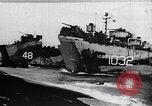
U.S. Coast Guard combat cameramen capture CG and Navy Landing Craft at the Iwo Jima beachhead.
1945: United States Coast Guard and Navy Landing Ships at the Iwo Jima beachhead. Soldiers on the beach. Military vehicles and tanks unloaded from the crafts. Coast Guard and Navy Landing Craft smashed by the hidden guns of Mount Suribachi. Waves lash against the shattered boats. Soldiers salvage parts. Soldiers and military vehicles on the beach. Half-tracks and tanks. Soldiers carry supplies. Landing Craft off shore. (World War II period).
Views of the United States. Farms, cities, highways, and beaches. Destruction in Japan by atomic bomb. U.S. infantry in combat
Farmers harvesting grain and corn with machinery on American farms with a narrow tractor harvester. Steel mills and heavy industry and cargo railroads in the United States. Industrial views with smokestacks releasing much smoke and smog (also pollution scenes). Scenes of New York City with busy streets filled with cars, buses, and truck traffic, together with pedestrians. Many varied 1940s and 1950s cars on the roads. Elevated and also aerial views of U.S. highway networks busy with 1940s and 1950s cars. Views of Jones Beach, on Long Island, New York. Scenes of destruction in Japan from the atomic bomb, with sweeping views of destroyed city in Hiroshima or Nagasaki circa 1945 or 1946. U.S. Army infantrymen engaged in house-to-house fighting in Europe during World War II, firing rifles and moving between points of cover in a city filled with rubble.
USAAF XX Bomber Command B-29s attack Japanese positions on Formosa in World War II
U.S. Army Air Forces XX Bomber Command Operations during World War 2. A Boeing B-29-10-BW Superfortress, number 42-6347, named "King Size," of the 462nd Bombardment Group, 769th Bombardment Squadron. It is seen here, at their forward operating base on Kiunglai Airfield, China. Tents are seen near the flight line. Numerous bombs are lined up on the ground ready to be loaded aboard the bomber. A B-29 taking off at nightfall. A formation of B-29s in flight. Bombs being dropped over Japanese installations at Hatto, Formosa (aka Taiwan). View of B-29 landing after the mission. (Note. Formosa was a Japanese colonial territory from 1895 to 1945.)
German prisoner, Otto Richard Struller, is transferred by jeep from Béverce near Malmedy, Belgium during World War II.
A U.S. Military policeman leans against his jeep in front of a small building in Béverce near Malmedy, Belgium during World War 2. Two German prisoners emerge from the building escorted by an armed American soldier. A military photographer passes to the left, in front of them, as two American military policemen escort another German prisoner (Otto Richard Struller) from the building. They each hold one of his arms. The prisoner is bareheaded. They pause and pose for a photographer (unseen). Closeup of the prisoner with MPs at his sides. Camera zooms in on prisoner, Struller. The MPs direct him to a waiting jeep. They all get in and drive away. Closeup of the jeep passing the camera. It drives away along a muddy road, past an overturned vehicle. (Note: The principal prisoner in this film, is Otto Richard Struller, a ballet dancer, who during the war served as a corporal with Panzerbrigade 150 unit Stielau/Stab solar, where he masqueraded as an American soldier behind the lines. He was executed, as a spy, on January 13, 1945 at the Palace of Justice in Huy, Belgium)
CRITICALPAST.COM: About Us | Contact Us | FAQs - How to Order | License Agreement | My Account | My Lightboxes | Shopping Cart | Advanced Search | Featured Collections | Website Terms & Conditions | Privacy Policy ©2026 CriticalPast LLC.
License Agreement |
Terms & Conditions |
Privacy Policy
©2026 CriticalPast LLC.