


 Francais
 Deutsch
 Italiano
Refine Your Search
Worms Germany 1945 stock footage and images
- Showing 4117 to 4122 of 10470 results more
more Hide
Hide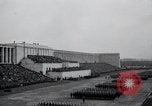
Adolf Hitler reviews a parade on Zeppelin Field at the Nazi party rally grounds in Nuremberg.
Adolf Hitler reviews a parade in Nuremberg. Many Nazi Stormtroopers (Sturmabteilung) and SS (Schutzstaffel) gathered for the parade on Zeppelin Field (Zeppelinstraße, 90471 Nürnberg, Germany) at the Nazi Party Rally Grounds. Troopers march and give the Nazi salute. Hitler reviews the parade and assembly. He walks up a path towards a monument. Troops on either side. He gives the Nazi salute before the monument. SS (Schutzstaffel) soldiers march with 'Germany Awake' flags.
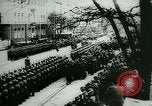
German Colonel General Heinz Wilhelm Guderian is celebrated following his appointment as Army Chief of Staff, in July, 1944, during World War II
Film opens showing German Colonel General Heinz Wilhelm Guderian, who was appointed Chief of Staff of the Army, by Adolf Hitler, on 21 July 1944, in World War 2. He is being feted as the New Army Chief. He reviews a large Honor Guard of German troops who line both sides of a street, in Germany. Local people cheer him from the sidewalks, and he is greeted by several German Youth girls. He steps into a building where other officers greet him and present him with a scale model of what appears to be a Panther Ausf. G tank. He looks closely as another officer points out the model's features. He then writes his name in the city's book of distinguished visitors. Complete change of scene shows General Guderian visiting members of his family, who greet him with kisses at the entrance to their house in Goslar, Germany. Inside their home Guderian shares coffee and cake with them at their dining room table. He and family members then look together through albums of photographs and memorabilia, of his career in the military, including one photograph of General Guderian with Adolf Hitler.
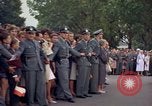
U.S. President John F. Kennedy going through parade route and spectators in Wiesbaden.
Motorcycle police escorting President John F. Kennedy's motorcade through parade route in Wiesbaden. People wave small flags of West Germany and U.S. Police controls crowd. View of the Wiesbaden Kurhaus (Kurhauspl. 1, 65189 Wiesbaden, Germany) with "Aquis Mattiacis" inscribed on building facade.
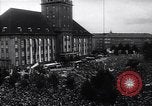
Berlin Crisis: The Western Powers respond to threats from the Soviet Union
Opening scene shows the Rathaus Schöneberg (John-F.-Kennedy-Platz, 10825 Berlin, Germany) where Mayor of Berlin Willy Brandt addresses a large crowd of West Berlin citizens, concerned about the building of the Berlin Wall by the Soviet Union. Many carry placards and signs, including some in English, reading: "We trust Kennedy, Pay any price, Bear any burden, for survival of Liberty" and "Millions behind the Iron Curtain ask for help." Scene shifts to a limousine driving into the center of a crowd. United States Vice President Lyndon B. Johnson steps from the car, accompanied by General Lucius D. Clay, who is seen next, with arm raised, acknowledging the crowd, while standing with Johnson and Brandt, at a podium cluttered with microphones. (Narrator refers to him as "Father of the Airlift.") The next day, British and American soldiers are seen driving in jeeps and trucks and M59 Armored Personnel Carriers, through cheering crowds, as they arrive to reinforce their Berlin garrisons. Closeup of cheering Berliners, waving handkerchiefs. Change of scene shows animated map of Europe illustrating the Westward expansion and growth of Soviet Communist occupation through World War II and the postwar era, concluding with East Berlin, in 1962. The threat to other Nations and regions is also illustrated. Legislators are seen in session in the plenary chamber of the German Bundestag in Bonn. Chancellor Konrad Adenauer is addressing the assembly. He states that Germany does not stand alone in the world. In France, Prime Minister Georges Pompidou addresses the National Assembly, regarding the Berlin Wall. In London, Prime Minister Harold Macmillan addresses Parliament. In the United States, on September 25, 1961, President John F. Kennedy, is addressing the UN General Assembly, in New York, about the dangerous crisis in Berlin. Scenes of the Berlin wall and Checkpoint Charlie. Memorials to persons killed attempting to escape East Berlin, are seen along the wall.
World tensions after World War II. The Baruch Plan. The Berlin Airlift. The Korean War. The Cold War. The Atomic age. Ballistic Missiles
Speaking before United Nations Atomic Energy Commission (UNAEC) in its first meeting in June 1946, Bernard Baruch proposes international control of all atomic energy -- the so-called Baruch Plan. Low level aerial view of ruined post World War 2 European city. Goods including heavy equipment, locomotives, being loaded aboard ships to aid in the postwar recovery of Europe (The Marshall Plan). Workers in Western Europe making use of Marshall Plan materials to rebuild their national infrastructures. West European farmers restoring agriculture. View from overflying light airplane of parts of postwar Berlin in 1948. Blocked roads and empty railroad tracks leading from East Germany to West Germany, blocked by the Soviet Union. Barge traffic at standstill due to Soviet actions. U.S. C-54 transport aircraft flying supplies into West Berlin (The Berlin Airlift) during the Soviet blockade of that city. West Berlin citizens watching U.S. transport aircraft bringing fuel, food and other essentials into the isolated city. A C-54 flying low over empty railroad lines, as it prepares to land in West Berlin. Supplies offloaded from a DC-3 ( AKA C-47 or British Dakota) equipped with unusual set of rear cargo doors. Supplies being moved on Tegel Airport with many C-54 aircraft in the background. Numerous C-47 aircraft operating at Tempelhof airport. An East German official opening a barricade as Soviet blockade of West Berlin ends on May 12, 1949, and supply trucks begin to move over roads again. Flags of Western nations flying on high flagpoles. Glimpse of Allied warships underway during the Cold War. Formation of P-38 Lightning aircraft in flight overhead. NATO troops marching and NATO armor on parade. Flashes of heavy artillery firing at night. Korean refugees moving South in 1950 with the outbreak of the Korean War. View of UN Security Council meeting in the absence of Soviet representative. U.S. tanks firing guns and American infantrymen in conflict with North Korea in Korean War. American wounded on stretchers.Delegates of both North and South Korea signing the Korean Armistice Agreement in P'anmunjŏm, on July 27, 1953. A rocket is launched. Images of earth from inside a space craft in orbit. Narrator mentions the first satellite to circle the earth, the soviet Sputnik 1 in 1957. View of Soviet pilots in low pressure altitude chamber. A test subject in an aircraft making a maneuver that allows him to experience "weightlessness." Objects in his cockpit float about. A military rocket launch monitored by arrays of radar. An object being retrieved from space by means of a parachute. A nuclear powered submarine. Rockets on display during a military parade in Red Square, Moscow, the Soviet Union. A U.S. Air Force B-52 bomber taxiing. More views of rockets seen during a Soviet military parade in Red Square, Moscow.
A torch light ceremony outside Hitler's apartments in the Deutscher Hof Hotel, during Nazi 6th Party Congress in Nuremberg
Groups of torches being lit as trumpets sound in the night. Drums are heard, as Helmeted Nazi German troops sound trumpets. Sturmabteilung (SA) maintaining crowd control. Nighttime view outside Adolf Hitler's apartments in the Deutscher Hof Hotel, Nuremberg, where a banner reading: "Heil Hitler," is displayed, flanked by two Nazi banners. Band leader and musicians seen dimly in torchlight. Crowds surging forward. Camera pans over groups further away, carrying torches and holding elaborate banners. View from the hotel, showing a giant illuminated swastika on the roof. Closer view of hotel and Hitler apartments showing the "Heil Hitler" sign, now also illuminated. Semi dark closeup of the band conductor, in torchlight. Torchlight view of banners lined up in front of the St. Sebaldus Church (Winklerstraße 26, 90403 Nürnberg, Germany). German soldiers in helmets silhouetted in the light of bonfires. View from above (possibly from the church) as camera pans over banners, torch bearers, and bonfires below. Camera focuses again on the Deutscher Hof hotel (Frauentorgraben 29, 90443 Nürnberg, Germany).
CRITICALPAST.COM: About Us | Contact Us | FAQs - How to Order | License Agreement | My Account | My Lightboxes | Shopping Cart | Advanced Search | Featured Collections | Website Terms & Conditions | Privacy Policy ©2026 CriticalPast LLC.
License Agreement |
Terms & Conditions |
Privacy Policy
©2026 CriticalPast LLC.