


 Francais
 Deutsch
 Italiano
Refine Your Search
Worms Germany 1945 stock footage and images
- Showing 4783 to 4788 of 10470 results more
more Hide
Hide
M A. Musmanno calls three defendants for trial and B. Ferencz makes his opening speech at The Einsatzgruppen Case in Nuremberg.
The Einsatzgruppen Case in Nuremberg, Germany war crimes trials after World War 2. Judge Michael A. Musmanno announces that three defendants are to be arraigned separately because they were ill when the remainder of the prisoners were arraigned. The prosecutor, Ben Ferencz, makes his opening speech in which he says that the court is not looking for vengeance but rather a plea of humanity to law.
General Telford Taylor in courtroom and prosecution reads, the crimes done by the Einsatzgruppen, during a trial in Nuremberg.
The Einsatzgruppen Case in Nuremberg, Germany. General Telford Taylor in a courtroom. A member of the prosecution reads in part the description of the mass murders committed by the Einsatzgruppen. He also describes how the displaced persons, or DPs, were put into a van and gassed to death. One Einsatzgruppen detachment while making a report states that 121, 817 Jews were killed and that at one place they arrested all Jews over 16 and with an exception of the doctors and the elders all of them were executed. The leader of Einsatzgruppen reports that 15,000 Jews were executed in Schrewindt.
James E. Heath questions Otto Ohlendorf and Michael A Mussmanno makes a statement in the Einsatzgruppen Case, Nuremberg.
The Einsatzgruppen Case in Nuremberg, Germany, following World War 2. The chief defendant in trial in the case, Otto Ohlendorf, tells his story on the witness stand, relating that the records indicate where his Nazi German death squad group put to death more than 90,00 persons. Mr. James E Heath, prosecution lawyer questions Otto Ohlendorf about the 90,000 killings by Einsatzgruppen. Judge Michael A. Mussmanno makes a statement related to the above talks.
Otto Ohlendorf, the Einsatzgruppen leader, talks about the corpses and killing of Jews during War Crimes Trials in Nuremberg.
The Einsatzgruppen Case in Nuremberg, Germany. The member of prosecution reads the indictment. Prisoner Otto Ohlendorf gives reports that the group of corpses were first buried in the snow and then later buried by the Army. Einsatzgruppen Case reports the extermination of Jews by the death squad after the capture of Kiev. Report goes on to say that not only the Jews were considered politically dangerous but others such as Russians, Georgians, Poles etc. were also considered to have Bolshevistic tendencies. Otto Ohlendorf, the commander of the Einsatzgruppen death squad unit destroyed over 90,000 Jews. One Einsatzgruppen killed 700 people.
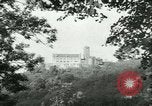
Reich Minister of Public Enlightenment and Propaganda Joseph Goebbels addresses German writers and artists in Weimar.
Weimar, Germany during World War 2. The Wartburg Castle atop a hill an hour from Weimar, Thuringia. Officials and dignitaries visit the Wartburg Castle (Wartburg-Stiftung Auf der Wartburg 1 99817 Eisenach). They take a tour through the hallways. Elderly men explore the castle. Pillars, arches, and other characteristic Romanesque style architecture. A garden at the castle. Reich Minister of Public Enlightenment and Propaganda Joseph Goebbels addresses German writers and artists in Weimar. The guests seated in a hall hear his speech. The German Swastika symbol on stage.
Adolf Hitler greets dignitaries and is cheered by German civilians in Berlin during World War II.
Fuhrer Adolf Hitler in Germany during World War II. A building in Berlin. Parades and celebrations in the city. Me and women march towards the building. Civilians and soldiers pass under German Nazi banners and symbols. Hitler and his men ride through Berlin in a convertible. People greet him with the Nazi salute. Hitler reaches the destination and greets the waiting dignitaries. Hitler then salutes and greets the crowd as he enters the building and acknowledges the crowds from a balcony. Germans cheer and hail Hitler.
CRITICALPAST.COM: About Us | Contact Us | FAQs - How to Order | License Agreement | My Account | My Lightboxes | Shopping Cart | Advanced Search | Featured Collections | Website Terms & Conditions | Privacy Policy ©2026 CriticalPast LLC.
License Agreement |
Terms & Conditions |
Privacy Policy
©2026 CriticalPast LLC.