


 Francais
 Deutsch
 Italiano

Refine Your Search
Worms Germany 1945 stock footage and images
- Showing 4789 to 4794 of 10479 results more
 Hide
Color Sound
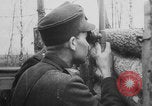
German Artillerymen train at established facility in German forest during World War II
Film begins showing two German soldiers in an established log lined firing position at an artillery training facility in Germany during World War 2. One is using a periscopic telescope. Closeup of a soldier hurrying along a log-lined trench toward a communication center. He picks up a field telephone that is next seen ringing and picked up at another communication center manned by several German officers. One takes the phone call. Scene shifts to an artillery crew at a log-lined gun emplacement where they attend to a 10.5cm artillery piece. Closeup of soldier signalling for guns to fire. Shells exploding in the distance. Crew at another gun emplacement hold their ears as their gun fires. Many more views of guns firing and smoke filling the air.

Fuhrer Adolf Hitler greets Mohammad Amin al-Husseini, the Grand Mufti of Jerusalem, in the Reich Chancellery in Berlin.
Nazi Fuhrer Adolf Hitler of Germany greets Mohammed Amin al-Husseini, the Palestinian Arab Grand Mufti of Jerusalem, mandatory Palestine, in the Reich Chancellery in Berlin. German officers also present. The two leaders shake hands and take their seats. They begin the talks. (World War 2 period.)
M A. Musmanno calls three defendants for trial and B. Ferencz makes his opening speech at The Einsatzgruppen Case in Nuremberg.
The Einsatzgruppen Case in Nuremberg, Germany war crimes trials after World War 2. Judge Michael A. Musmanno announces that three defendants are to be arraigned separately because they were ill when the remainder of the prisoners were arraigned. The prosecutor, Ben Ferencz, makes his opening speech in which he says that the court is not looking for vengeance but rather a plea of humanity to law.
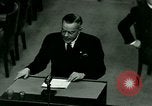
General Telford Taylor in courtroom and prosecution reads, the crimes done by the Einsatzgruppen, during a trial in Nuremberg.
The Einsatzgruppen Case in Nuremberg, Germany. General Telford Taylor in a courtroom. A member of the prosecution reads in part the description of the mass murders committed by the Einsatzgruppen. He also describes how the displaced persons, or DPs, were put into a van and gassed to death. One Einsatzgruppen detachment while making a report states that 121, 817 Jews were killed and that at one place they arrested all Jews over 16 and with an exception of the doctors and the elders all of them were executed. The leader of Einsatzgruppen reports that 15,000 Jews were executed in Schrewindt.
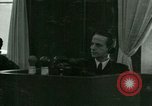
James E. Heath questions Otto Ohlendorf and Michael A Mussmanno makes a statement in the Einsatzgruppen Case, Nuremberg.
The Einsatzgruppen Case in Nuremberg, Germany, following World War 2. The chief defendant in trial in the case, Otto Ohlendorf, tells his story on the witness stand, relating that the records indicate where his Nazi German death squad group put to death more than 90,00 persons. Mr. James E Heath, prosecution lawyer questions Otto Ohlendorf about the 90,000 killings by Einsatzgruppen. Judge Michael A. Mussmanno makes a statement related to the above talks.
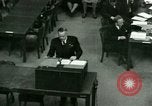
Otto Ohlendorf, the Einsatzgruppen leader, talks about the corpses and killing of Jews during War Crimes Trials in Nuremberg.
The Einsatzgruppen Case in Nuremberg, Germany. The member of prosecution reads the indictment. Prisoner Otto Ohlendorf gives reports that the group of corpses were first buried in the snow and then later buried by the Army. Einsatzgruppen Case reports the extermination of Jews by the death squad after the capture of Kiev. Report goes on to say that not only the Jews were considered politically dangerous but others such as Russians, Georgians, Poles etc. were also considered to have Bolshevistic tendencies. Otto Ohlendorf, the commander of the Einsatzgruppen death squad unit destroyed over 90,000 Jews. One Einsatzgruppen killed 700 people.
CRITICALPAST.COM: About Us | Contact Us | FAQs - How to Order | License Agreement | My Account | My Lightboxes | Shopping Cart | Advanced Search | Featured Collections | Website Terms & Conditions | Privacy Policy ©2026 CriticalPast LLC.
License Agreement |
Terms & Conditions |
Privacy Policy
©2026 CriticalPast LLC.