


 Francais
 Deutsch
 Italiano
Refine Your Search
Yokohama Japan 1945 stock footage and images
- Showing 2191 to 2196 of 7988 results more
more Hide
Hide
A Japanese officer briefs Japanese pilots before the take off for the air attack on Pearl Harbor in Hawaii.
Japanese air attacks over Pearl Harbor, Hawaii during World War II. A relief map shows Japan, China, the U.S. and the Philippine Islands. An arrow on the relief map point from Japan to the Hawaiian Islands. Two Japanese aircraft carriers underway in the Pacific Ocean. A section of the deck of a Japanese ship. Anti-aircraft guns on the side of the flight deck of an aircraft carrier. Two Japanese officers conversing. Sailors in the background. Japanese pilots being orientated by a Japanese officer. A group of Japanese pilots around the officer. Japanese Navy Nakajima B5N 'Kates' aircraft engines are warming up. The pilots stand in a semi-circle around a senior officer. The sailors remove chucks from under the wheels of 'Kates'. A sailor waves a white flag. Japanese Navy Aichi D3A 'Vals' aircraft take off in formation. An aerial formation of the 'Vals'. A flag fluttering on the mast of a Japanese ship. Clouds in the sky. An aerial formation of 'Kates'. Japanese insignia on a Japanese plane. Airplanes in flight over Wheeler Army Airfield in Hawaii. Bombs explode on a runway of the airfield. Smoke rises from a hangar and the runway. Smoke rises from the docks at Pearl Harbor due to bombardment by the Japanese airplanes. Several Japanese destroyers underway.
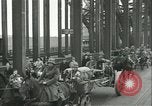
German and Japanese forces capture towns; Allied workers make ammunitions in factories (WW2)
German forces during remilitarization of the Rhineland: German Army supply wagons and German soldiers cross Hohenzollern Bridge in Cologne, Germany, to reoccupy Cologne and the Rhineland on March 7, 1936. Change of scene to Japan in late 1930s. Emperor Hirohito of Japan inspects troops on his white horse, Shirayuki. Japanese soldiers bow in front of the Imperial Palace in Tokyo. Japanese men holding banners. Japanese soldiers and cavalry advance. Japanese soldiers stand in formation and march on a street. Japanese Navy officers view a map or chart and discuss their plans and strategies for attack. Japanese soldiers fire artillery and other weapons in battle. Japanese war production worker in munitions plant making shells. Change of scene to American workers in war production factories in the United States making shells, bullets, and various munitions during World War 2. Elevated view of large American tank factory floor with many Army tanks being assembled. War production workers building Army trucks and new trucks being driven off of assembly line. Rows of U.S. Army tanks and artillery on the ground. U.S. Army soldiers board a troop transport ship. A submarine is spotted by a sailor. A hand presses a button to launch torpedoes to attack a ship. View through periscope as torpedo moves just below water surface toward target. View in open water of torpedo moving through water. Torpedo strikes a ship and explosion rocks ship. Formation of torpedo aircraft and dive bombers in flight over an area. Ships on fire with black clouds of smoke rising above. British navy sailors firing anti aircraft guns from a British ship. Sailors and officers aboard ships watch enemy airplanes through binoculars. U.S. Navy sailor manning a machine gun aboard ship watches the skies overhead.
Tuna fish being tested and soldiers confronted with simulated atomic bomb explosions in the United States
Atomic and hydrogen bomb tests' effects in Japan and the United States. Japan: Newsmen and cameramen stand in the Tokyo Medical University hospital. Head of the hospital Doctor Suzuki greets Chief of the Hiroshima atom casualty commission John Morton. The doctors examine the fishermen burned during the Enewetak (sometimes spelled Eniwetok or Eniewetok) hydrogen bomb tests. San Francisco: A crane lowers net of Tuna fish in San Francisco. An official wears belt with a Geiger counter. Food and drug officials check the fishes for radioactive contamination. Fort Devens Massachusetts: The members of the 1st Army Chemical Defense school are confronted with simulated atomic bomb explosions. Soldiers advance through the smoke of explosion.
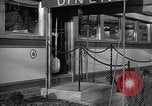
Various jobs in the United States Navy are shown, including mechanic, pilot, administrative staff, medical staff, and sailor.
Recruitment advertisement for the United States Navy within the U.S. military. Teenage boy exits diner and sweeps stoop of diner with broom. Aerial view of Grumman F9 Cougar jet aircraft flying in formation. Mechanics on aircraft carrier examine Grumman F9 jet. Sailors in Japan at the Imperial Palace in Tokyo, Japan. Sailor typing message on typewriter while wearing headphones. Flight director in aircraft carrier guiding Grumman F9 aircraft. Nurse and doctor confer with patient in bed in hospital. Sailor operates signal light. Grumman F9 Panther jets taking off from aircraft carrier. Narrator urges viewer to "see your Navy recruiter today."
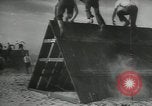
Training of American draftees before World War II; also Japanese attack on Pearl Harbor and Roosevelt's request for declaration of war.
United States soldiers and new recruits at a camp in the U.S. before outbreak of World War II. New recruits and U.S. Army soldiers in training run obstacle course. Soldiers in their uniforms march through the camp area. Tents in the background. Newly drafted U.S Army soldiers learn to fire weapons on firing range using artificial wooden rifles. U.S. soldiers seen training with wooden replica machine guns and using empty Adelphi beer cans as substitute artillery ammunition for training purposes. Teams of soldiers compete in moving a giant ball. They compete in blindfolded boxing on their knees. Lacking adequate war materiel for training, they make do by pretending that trucks are tanks and labeling them with such signs. They pretend with wooden guns and throw flour sacks instead of grenades. Scenes of the Pearl Harbor raid by the Empire of Japan on December 7, 1941. Views of the USS Arizona being hit and various ships on fire soon after the attack. United States President Franklin D. Roosevelt is seen addressing Congress, where he asks for a declaration of war against Japan.
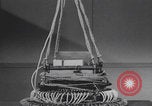
Man demonstrates the parts of the battery and aneroid of a Japanese Fu-Go paper balloon bomb (WW2)
A video explaining the components of the “Brain Center” of the Japanese Fu-Go paper balloon bomb- a weapon launched by Japan to drop bombs on the United States during World War 2. Man holds the ballast of the paper balloon bomb. Man pulls out fuse of demolition block. The plug from the battery to the barometer box is disconnected. Man lifts out the demolition box and battery box from the “Brain Center”. Man demonstrates the battery box and demolition box of the Fu-Go balloon bomb. Man takes out the demolition box. Man opens the battery case. Man takes out the middle box containing a solution of calcium chloride (acting as a thermal overcoat). Man points to a rubber plug in the middle box. Man takes out the battery of the middle box. Man reattaches the battery back to the middle box and returns the middle box to the battery box. Man puts back the lid of the battery box. The barometer (Aneroid) plate is taken out. Man demonstrates the aneroid board of the Fu-Go balloon bomb. Man takes off the lid of the main aneroid. Man points to the aneroid bellows, post, arm, clutch using a pencil. Man demonstrates two aneroid boards. Man points to aneroid before dismantling them. Man touches the contact rod of the aneroid. Man demonstrates pulling a plug on the “Brain Center” of the paper balloon bomb from Japan.
CRITICALPAST.COM: About Us | Contact Us | FAQs - How to Order | License Agreement | My Account | My Lightboxes | Shopping Cart | Advanced Search | Featured Collections | Website Terms & Conditions | Privacy Policy ©2026 CriticalPast LLC.
License Agreement |
Terms & Conditions |
Privacy Policy
©2026 CriticalPast LLC.