


 Francais
 Deutsch
 Italiano
Refine Your Search
Belsen stock footage and images
- Showing 19 to 24 of 25 results more
more Hide
Hide
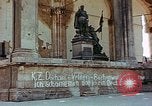
People gather outside Feldherrnhalle (Field Marshal's Hall) in Munich, Germany (WWII)
People gather outside the Feldherrnhalle (Residenzstraße 1, 80333 München, Germany) in Munich, Germany near the end of World War II. On the Feldherrnhalle, carefully painted in giant letters in German: "Dachau, Velden, Buchenwald - I am ashamed to be a German." A poster pasted on the wall of the hall. German civilians look at the poster with heading: "Wessen Schuld?" ("Who's to blame?" in English). Names of concentration camps where atrocities took place - Dachau, Velden (likely Belsen), Buchenwald- chalked alongside the poster.
Feldherrnhalle, the Odeonsplatz, Hitler's house and Munich buildings damaged by Allied bombers (WW2)
The Feldherrnhalle (Residenzstraße 1, 80333 München, Germany) in Munich, Germany shortly after end of World War II in Europe. Statues of emperors and warriors. White lettering in German, on side of the building saying 'Concentration Camp Dachau - Belsen - Buchenwald. I am ashamed that I am a German.' Nazi swastika symbol and a statue in front of a building destroyed by Allied bombers. Adolf Hitler's original Brown House (NS-Dokumentationszentrum München, Max-Mannheimer-Platz 1, 80333 München, Germany) in ruins from bombing of the Allied bombers. Damage done nearby Odeonsplatz (Odeonspl. 1, 80539 München, Germany). Women on bicycles pass by the Feldherrnhalle.
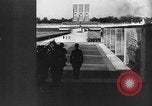
Nazi Party ceremonial grandeur is contrasted to the horrors perpetrated under the 3rd Reich
6th Nazi Party Congress at Nuremberg, in 1934, featuring a "Totenehrung" ceremony, honouring dead. Nazi SA ( Sturmabteilung) and SS (Schutzstaffel) troops in precise formations fill the Zeppelin Field Luitpold Arena, leaving only a wide pathway to the Ehrenhalle war memorial. View from behind honor guard standing at the Ahrenhalle, as Adolf Hitler, flanked by SS leader, Heinrich Himmler (in Black) and Viktor Lutze, head of the Sturmabteilung (SA), approach. Three huge banners with swastikas are seen in the far background. Scene shifts to 1945. American troops are now assembled at the main grandstand (Ehrentribüne) of Zeppelin Field. The American flag covers the wreathed swastika sculpture at the top of the Grandstand. View of German soldiers, who have been mustered out, mingling with civilians in a town. Some speak with an American soldier, who is part of the U.S. occupying force. Scene shifts to the Yalta conference in February, 1945. Winston Churchill, Franklin D. Roosevelt, and Joseph Stalin are seen seated while their most senior military staff members stand in the background. Allied leaders sit around a large conference table. U.S. Secretary of State James F. Byrnes, sits near Prime Minister Winston Churchill. Scene shifts back to Nazi era. Joseph Goebbels, Reichminister of Propaganda is speaking and haranguing a crowd. In contrast, German soldiers are seen conversing with occupying American soldiers. This is contrasted with more scenes of Nazi leaders giving impassioned speeches to a hall filled with Nazi faithful. German soldiers, prisoners of war are seen directed by U.S. military police, behind a barbed wire enclosure. Large numbers of German prisoners of war in an open holding area. Closeups of some. Bucolic scenes of farmers working in fields and herds of sheep and cattle. Hitler speaking in a forceful, animated way and haranguing an audience of rapt listeners. German civilians standing quietly in a group. (Narrator refers them being the people of Beethoven, Goethe, and Martin Luther, as statues of those iconic Germans are shown.) In dramatic contrast, numerous dead bodies of victims are being shown to German citizens by American troops, at Nordhausen, Buchenwald, and Bergen-Belsen concentration camps. This is contrasted against views of German people folk dancing in traditional costumes, German contributions to science (view of Albert Einstein speaking) and industry (view of professional glass blowers at work). Glaring contrast shows German civilians moving the body of a concentration camp victim; several civilians being shot dead by a firing squad (unseen); Rudolf Himmler; and an image Germany being destroyed, as result of the Nazis. American soldiers are loosely assembled in an open field. by the Elbe River at Torgau, Germany on 26 April 1945. American and Russian officers greet each other at the site, where their armies have met in World War 2. American and Russian soldiers mingle and greet one another. Views of Allied forces entering Germany. Another scene of victims' bodies stacked at a concentration camp. French soldiers examine stake where prisoners were tied and executed in the Gestapo headquarters on Paris France. Other views of the Gestapo prison, where victims were buried. Examples of torture devices used to coerce information from prisoners. More views of stacked bodies of victims. Germans carrying bodies from a concentration camp. General Dwight Eisenhower and General George Patton visiting the Ohrdruf Concentration Camp. Burned remains of victims. Closeup of General Patton. German officials and citizens confronting horror as they are compelled to walk through the camp. A huge wagon loaded with bodies of the dead. German women appalled and repelled by the sights. Countless numbers of dead victims covering a large courtyard. German citizens compelled to carry body of a victim from the yard. Others carrying bodies of victims. Large numbers of German citizens, seemingly shamed and remorseful at the revelations. A group of German men carrying shovels and others carrying crosses to commence burying the victims appropriately. Men carrying victims bodies in open wooden caskets along a road lined with spectators. Coffins of victims laid out in a cemetery. (Narrator alludes to them never forgetting.) German men gently place covered coffins in a long mass grave.
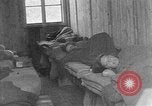
Views of emaciated survivors and victims from a variety of German concentration camps immediately after their liberation
During World War II, scene of a few women with terrible wounds at a German concentration camp near Ramsdorf after being liberated. Physicians attend to the atrocity victims. View of children who managed to survive at Auschwitz camp even after losing their families. The children show their tattoos on their hands that are marks for their identification. Two men who were survivors, one man whose eyes were gouged out by his captors. Men behind barbed wires. Inmate victims who could not walk or crawl being helped by soldiers. Nude men who were starved stand in a group at Ebensee Concentration Camp. Man helps a starved, emaciated man to walk. A man crawls. Bodies of prisoners who died without getting medical aid. Officials beside the bodies. Scenes are from a variety of camps including Ramsdorf, Auschwitz, Aschaffenburg, Bergen-Belsen, and some others that are not clear from the narration.
German war criminals are executed by Allied occupying forces in 1945, in World War 2
View from above, of the surrounding walls and courtyard of a prison in Rheinbach, Germany. Ground view inside the prison yard, where German civilian Matthias Gierens is being escorted to the gallows by U.S. military police, and accompanied by a German Catholic priest, on June 29, 1945. They ascend the gallows and final charges and sentence are read to Gierens. Next scene shows bodies stacked up at the Bergen-Belsen concentration camp operated by Nazi Germany. Scene returns to the gallows, and a hood is placed over Gierens' head. View of Allied army officer witnesses, in formation, at parade rest. Noose is placed over Gierens' hood. View of a a bird flying overhead, trapdoor opens, Gierens drops, and noose tightens. Next is an unrelated scene of several German soldiers being executed. They are seen hanging from four gallows in a line in a public square while a large crowd, possibly Soviet citizens, looks on. (Notes: Regarding the execution of Gierens in the opening scene: German civilian Matthias Gierens was a 37 year old railroad worker. He was executed for the August 15, 1944, murder near Priest, Germany, of a downed American airman, who was later identified as U.S. Army Air Forces 2nd Lieutenant Lester E. Reuss. Gierens and three other German civilians, Peter Kohn, Peter Back, and Matthias Krein, were convicted on June 2, 1945 in Ahrweiler, Germany, of the murder. Their trial was the first Allied trial in Germany of civilians charged with a war crime.)
Operation of the International military criminal justice system in its trials of Axis war criminals following World War II
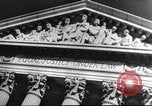
Preparations made for prosecution of war criminals following World War 2. Exterior of building of U.S. Supreme Court. 'Equal Justice Under Law' written on building. Animation shows three types of trials. The first kind is the one in which the criminals are returned to the countries they betrayed. Minister-President of Norway Vidkun Quisling being tried in Norway. The second kind is one in which the criminals who committed crimes in specific localities are on trial in those countries. Germans being tried in a country. Offenders charged with killing U.S. soldiers are tried by American Army Corps. An officer speaks about the trials. A chart depicts kinds of trials. The National Traitor Trials, the Local Minor Trials, the U.S. Military Trials and the Trials of the Major War Criminals conducted by the International Military Tribunal. View of Hitler and Nazi leadership walking up aisle in crowded building with German soldiers and officers on either side saluting. Rudolf Hess delivering a speech and shouting emphatically, followed by views of other German leaders (later Nuremberg defendents) delivering speeches. Goebbels in dress uniform. U.S. Justice Robert H Jackson, being appointed by President Truman for the U.S. as Chief of Counsel for the tribunals, and also General William J. Donovan. Tribunal legal staff in front of U.S. Army Air Forces Air Transport Service terminal at Washington National Airport, and then boarding a DC-4 aircraft. DC-4 takes off, with the Washington Monument and Jefferson Memorial seen in the background. Mussolini addressing a crowd from an elevated balcony. View of book Mein Kampf with image of Adolf Hitler on front cover. German SS Schutzstaffel division marching in formation on a German street. Josef Kramer under armed guard, after being captured in his role as Commandant of Bergen-Belsen concentration camp. SS Commander Heinrich Himmler talking to a German officer. Dead Concentration Camp victim and living camp victims beside barb wire (Buchenwald).