


 Francais
 Deutsch
 Italiano
Refine Your Search
Fort-monroe stock footage and images
- Showing 469 to 474 of 771 results more
more Hide
Hide
The Battle of Netherlands and the invasion of Belgium by the Germans during World War II.
The first phase of German assault on France and the Low Countries during World War II. An animated map depicts the German campaign to capture Liege (Luttich) and Fort Eben-Emael in Belgium. German troops invade Holland. Soldiers in trucks. Germans cross the Meuse (Maas) in boats. A collapsed bridge over the river. Armed German soldiers on bicycles cycle through a village. Soldiers drag a boat on the road. The Germans capture Fort Eben-Emael using flamethrowers. Soldiers fire guns during street fights. A soldier wades through shallow water while others cross a field amidst explosions. Bomb explosions and bomb damaged buildings. Soldiers take cover in a field. German troops cross the Albert Canal in Belgium. Troops in boats make their way across. They advance with tanks. Soldiers dig fox holes and eat. Soldiers man tanks and fire artillery. German aircraft bomb Allied positions. Massive explosion at Werk 4 fortification bunker of Fort Eben-Emael. Bomb damaged buildings and ruins. Black smoke arises due to explosions. German soldiers march Belgian and Dutch prisoners of war on a street.
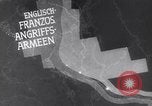
The Maginot Line and its inner workings. Allied forces marshaling to confront Nazi Germany early in World War II
Film opens with animated map showing the Maginot Line and attacks along it by Britiish and French and French Armies. Then it shows German Armies breaking through the line. Camera focuses along lines of steel post antitank barriers extending out of sight. Map illustrates fortifications in area labeled Maginot Line and shows vertical cross-section cutaway view of the Maginot Line fortifications. A French soldier is seen tending to an engine running deep inside the fortifications. French officers are seen near a large electric generator and large ducts for ventilation to the soldiers underground. French soldiers at a switch board in a communications center. French troops are seen double-time marching out from their quarters at the Maginot Line. Next they enter forts in the line. Closeup of soldiers' feet as they board narrow-gauge train to take them to their respective battle stations in the Maginot complex. View of the train carrying passengers through its tunnels. A French soldier moving large steel containers suspended on overhead trolleys. They appear to contain ammunition. A cook at work in a kitchen within the fort. French soldiers entertaining themselves, singing and clapping as one of them dances. A slate in the film reads:"Nous Vaincrons parce que nous sommes les plus forts" (We win because we are the strongest.) French troops marching to war. Animated map shows Areas under French control, including Colonial Africa, together with German-occupied areas. It shows other forces building up including those from British colonies and Canada and Australia. Closeup of French Colonial soldiers. French allied troops from various regions in the world marching. Massive parade of troops along the The Avenue des Champs-Élysées, in Paris, with the Arc de Triomphe behind them.
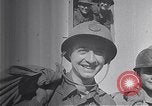
French officer inspecting machete of Senegalese trooper in North Africa.
French troops at attention in North Africa. French officer inspecting machete of Senegalese trooper. American forces camped outside bombed desert fort. Two American soldiers guarding fort. American flag atop desert fort. (World War II period).
United States Army soldiers being trained at various training centers in United States
Statue of U.S. Army infantryman (called "Follow Me.") is seen at opening of film. Closeups of some trainees crawling under barbed wire as trainers observe them. Others are seen running and jumping obstacles. Trainees on a firing range training with rifles and M60 machine guns. Glimpse of soldier placing a large round into a mortal tube. Soldier firing an M40 106mm recoilless rifle. Infantry advancing across a field. An M48 Patton tank maneuvering. An M109 155mm self-propelled Howitzer. An M113 tracked Armored Personnel Carrier (APC) moving in wooded area. View of Infantry Hall at the U.S. Army Infantry School in Fort Benning, Georgia. The statue of an infantryman, called "Follow Me," stands in front of the building. Infantry training in a rugged area. They wear elements of natural camouflage. A 175mm M107 Self Propelled Gun. Scene changes to U.S. Army Armor Center Headquarters, also at Fort Benning. Tanks are seen maneuvering and raising dust in a lightly wooded area. An M60 tank maneuvering and firing its gun. A 175mm M107 Self Propelled Long Tom gun firing. A Pershing missile slowly being raised toward firing position. Gun crew firing an 8-inch howitzer at zero elevation. Shell exploding in distance. Views of elaborate radar antenna system and of Army technicians monitoring instruments and printers in a control center. Green Berets at the the John F. Kennedy Center for Special Warfare at Fort Bragg, North Carolina. They tend to a wounded Special Forces soldier in a primitive shelter. Others are seen reading instructions as they sit in foliage. Some maneuver aboard rubber rafts in a river. Two Green Berets set a demolition charge on a rail line. Soldiers engage in unarmed combat practice. Others train surviving off the land. An instructor lectures an audience of officers and men in an outdoor setting. Soldiers in a parachute shop with parachutes of various colors opened for inspection. Lines of parked Army trucks. Jeeps and trucks undergoing routine inspection and maintenance Doctors and nurses tending sick and wounded soldiers.
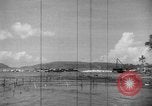
Japanese occupy Corregidor during World War II
Japanese forces occupying Corregidor fortress following a siege that effectively cut off water,food and ammunition from its U.S. and Filipino defenders. during in World War 2. Camera pans across the waterfront of Corregidor Island as Japanese forces occupy it.Japanese boats at their beachhead. American soldiers standing at attention around bunkers as Japanese officers ascend side of hill toward them. Americans being marched down the hill under guard. Japanese officers look at destroyed buildings and inspect the rest of the Corregidor fortifications, including its 12 inch guns at Batteries Hern and Smith. Small and medium U.S. arms and ammunition in a pile. Views of rail cars at tunnel entrance and views inside the tunnels of the Fort. Desks of U.S. officers inside the Fort. One is identified by name plate reading "Major F.F. Kriwanek." Several U.S. officers seen sitting in another office. View from defensive position in the fort.

Jews reading from Torah in Jerusalem; Islamic principles of design from mosques in Jerusalem, India, and Tunisia.
Slate notes Muhammad's respect for ideas of Christians and Jews. Jews are seen reading from the Torah and in prayer. A Jewish Rabbi leads a prayer. View of Dome of the Rock at Temple Mount, Jerusalem. Other Muslim mosques: the Moti Masjid (Pearl Mosque, M64V+P7J, Lal Qila, Old Delhi, New Delhi, Delhi 110006, India), seen from the Diwan-e-Khas or Red Fort of Delhi, India. in the Lahore Fort or Shahi Qila (H8Q7+56P, Fort Rd, Walled City of Lahore, Lahore, Punjab, Pakistan), Punjab, British India. View of the courtyard of the Grand Mosque of Kairouan (M4J3+GMR, Rue de La Kasbah, Kairouan, Tunisia) in Tunis, Tunisia. Slate states that Islamic decoration is confined to Arabic script and geometric or floral designs. Architecture of a mosque shows columns, pillars, and arches at the side of a courtyard. As previously noted, the columns and the roof of the mosque are decorated only with Arabic script, floral and geometric designs. A decorative grill in a mosque.