


 Francais
 Deutsch
 Italiano
Refine Your Search
Fort-monroe stock footage and images
- Showing 475 to 480 of 771 results more
more Hide
Hide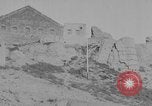
City of Yerevan, Armenia, and environs, photographed during visit by U.S. Military Mission in 1919
Scenes in and around Yerevan, Armenia, photographed during visit of the U.S. Military Mission to Turkey and Armenia, in 1919. Camera pans across imposing old forts that overlook the area. View shifts to position upon wall of a fort, where the camera pans across forest at the base of the fort and the city of Yerevan spread out below. Final sequence shows local Armenian people going about their ordinary activities. Some walk along a dirt road, next to masonry buildings. A man and woman sit in the shade of a stone wall, with a young child seen crouched between them.
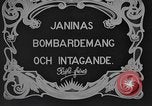
Greek soldiers fire artillery and transport wounded Turks following Battle of Bizani; Greek soldiers march in Ioannina.
Greek soldiers in the First Balkan War battle against Turkish forces for control of the forts of Bizani on the approach to Ioannina. The Greek soldiers under the command of Crown Prince Constantine fire artillery cannons at Turkish positions holding the Fort. Smoke rises up due to explosions. Tents are erected in the far background. The Greek soldiers march along a road leading into the Fort. The Greek soldiers transport the wounded and dead Turks following the battle. Stretchers with wounded are carried by hand, and horse carts carrying dead Turkish soldiers. The Greek soldiers marching on streets in Janina, Greece (Ioannina Greece; and also called Jannena). Greek soldiers carry rifles with fixed bayonets as they march following the battle.
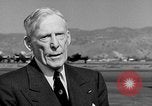
Former U.S. Army Lieutenants Lahm and Foulois recall their flights with Orville Wright in 1909
A film about the history of aviation in the United States. Retired Air Force Brigadier General, Frank Lahm talks about his first flight, as an Army Lieutenant, with Orville Wright on the Wright Flyer airplane, in July, 1909.Then, Retired Major GeneralBenjamin Foulois recalls how, as an Army Lieutenant, he flew the final cross-country and speed test flight from Fort Myer to Alexandria , Virginia, and back, again, with Orville Wright on 30th July, 1909. Film then shows that event, on July 30, 1909. Lt. Benjamin D. Foulois is seen climbing aboard the Wright Flyer airplane to accompany Orville Wright on the final cross-country and speed test required by the U.S. Army before it would purchase any aircraft. View of the Wright Flyer taking off with Wright and Foulois. Spectators watch in the background. View from another perspective of the aircraft taking off from Fort Myer, Virginia. View of the Wright Flyer being moved by several soldiers after landing back on the Fort Myer drill ground. (In his comments about this, Foulois notes that the flight set three world records: flying ten miles cross-country; attaining altitude of 600 feet, and speed of 42.5 miles per hour.)
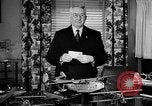
Early 1900s American aviation scenes; American flight pioneers speak about their associations with the Wright Brothers
Aviation pioneer, aircraft designer and builder, Glenn L. Martin, at his desk, stands behind a model of the Martin M-130 Clipper flying boat. He reads a 1910 postcard from the family doctor to his mother, warning that her son (Glenn) will kill himself if he persists in his aviation endeavors. Next, one of Martin's earliest employees and collaborators, Donald Douglas, Sr. is seen with his dog. He says his first memory of things in aviation, was seeing the first Wright airplane demonstrated for the Signal Corps in 1908, at Fort Myer. Period film shows the Wright Flyer airplane with twin rear propellers turning. Next view shows Orville Wright along with military officers and officials, standing near the launching tower (from which a propelling weight would drop). Orville Wright is seen climbing aboard the airplane, after the first flight demonstration, as Lieutenant Lahm joins him to be the first military officer to ever fly in an airplane. Next, the weight is seen falling from the launching tower, propelling the airplane along a single track to take off. It is seen flying above spectators at the Fort Myer drill field. View of a U.S. Army balloon in flight overhead. Scene shifts to pioneer Army balloonist, Roy Knabenshue, who was hired by the Wright Company in 1910. He holds a photograph of a balloon, and identifies Walter Brookins, in the photograph. (Brookins was taught to fly by the Wright brothers and became the first instructor for their Exhibition Team.) Knabenshue extols the skills of Brookins as a Wright Company pilot, along with Arch Hoxsey and Ralph Johnson. While Khabenshue is speaking, views of a Wright Flyer in the air at Fort Myer are seen.
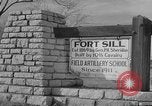
U.S. Army officers receive training at Ft. Sill, Oklahoma; Ft. Scott, Kansas; and Ft. Bliss, and White Sands, New Mexico
Officers training at artillery school in the United States. View of the Fort Sill Field artillery school, Oklahoma. Officers look through binoculars during their gunnery training class. They learn service and firing techniques on field. They learn techniques of rocket bombardment. They learn to fly aircraft and phenomenon of meteorology. They release weather balloons. At Fort Scott, Kansas, officers load coastal guns and are trained about destroying sea borne assets. At Fort Bliss, Texas, officers learn antiaircraft techniques. Long range rocket is launched at the White Sands Proving Grounds.
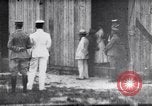
U.S. Army personnel move the Wright airplane to the launching site for an official exhibition of its flight in Virginia, U.S.
Official trial of the Wright airplane at Fort Myer in Virginia, United States demonstrating compliance with specifications in the presence of the Aeronautical Board, U.S. Signal Corps. The storage building for Wright airplane at Fort Myer. U.S. President William Taft looks through doors which are surrounded by U.S. Naval and Army officers and civilians. President Taft in the crowd. Army personnel removing the doors from the building. Men remove the airplane from the hangar. They move the airplane across to the launching site near the headquarters building at Fort Myer.