


 Francais
 Deutsch
 Italiano
Refine Your Search
Fort-monroe stock footage and images
- Showing 529 to 534 of 771 results more
more Hide
Hide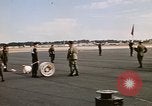
Families greet United States Army Special Forces soldiers as they return at Pope Air Force Base in North Carolina.
United States Army Special Forces return to Fort Bragg, North Carolina. United States Army soldiers and a band lined up as they hold American flags at Pope Air Force Base. Families wait for the return of United States Army Special Forces. A sign reads ' United States Air Force Pope Air Force Base'. A United States C-123 aircraft taxis after landing. Soldiers of the special forces get off the aircraft as they return after an attempted rescue of American prisoners of war from a camp near Hanoi, North Vietnam. The family members greet the soldiers. Photographers take pictures. An officer of the special forces speaks into a microphone. (Vietnam War period).
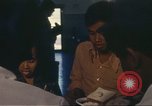
Vietnamese refugees having their food at a camp during Operation New Life in Pennsylvania, United States.
Receiving camp for Vietnamese refugees set up during Operation New Life, Operation New Arrival in the United States. Vietnamese refugees having just arrived at Fort Indiantown Gap, Pennsylvania. Men and women serving food to the Vietnamese refugees. The refugees seated at a table, having their food. Children eating food.
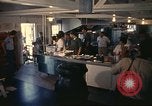
Vietnamese refugees boarding buses after processing and lunch during Operation New Life in Pennsylvania
Activities of newly arrived Vietnamese refugees during Operation New Life / New Arrival in the United States. Vietnamese refugees at Fort Indiantown Gap Pennsylvania, having arrived for initial processing. Men and women serving food to the refugees. The refugees walking towards their buses after having lunch. The refugees board the buses holding their personal gear.
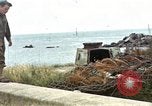
U.S. troops and war correspondents at destroyed German fortifications near U.S. Naval observation post in World War II
Allied troops on the French coast shortly after the Allied Invasion of Europe in World War 2. Abandoned fortifications built by slave labor. A soldier looks at metal fences. Officers and soldiers walk through the fort. German weaponry destroyed by retreating German forces. A soldier walks on rubble in Granville. Observation post of the U.S. Navy. A lighthouse that separates Normandy from Brittany. A U.S. soldier on the lighthouse looks out to the sea.
U.S. Signal Corps officers and soldiers use mine detectors, modern radars, and meteorological equipment during World War II.
The role and contribution of the U.S. Army Signal Corps in combat and war. U.S. shuttle ships loaded with signal communication supplies for U.S. and Allied troops in the European Theater make their way in the Atlantic ocean. The Squier Laboratory at Camp Alfred Vail in Fort Monmouth, New Jersey. A technician works on signal communication equipment in the laboratory. U.S. soldiers use mine detectors in the European Theater during World War II. The mine detectors detect metallic, non-metallic mines, wooden box mines, and mines in glass containers. Artillery soldiers bury large microphones into the ground in advance zones. The microphones relay back information on enemy artillery. Soldiers receive the information on radio sets. U.S. aircraft on a training flight simulating real combat situation: The aircraft lost in heavy rain and rough weather, looking for the location of Boston. The pilot switches on a modern advanced radar. The radar waves pierce thick clouds, are reflected by Earth's surface and display an image on the scope. The image shows the clear location of Boston harbor directly under the aircraft. U.S. bombers attack over the Channel coast on D-Day (6 June, 1944). U.S. soldiers employ meteorological equipment for long range weather forecast in the European Theater during World War II. Soldiers release a hydrogen balloon into the sky. Another soldier uses an apparatus to take readings of atmospheric conditions behind enemy lines. An aircraft drops an automatic weather station called SCM-18-TI by parachute into enemy territory. The timed mechanism sends out weather data in codes. The interior of the automatic weather station lying open in a field.
Germany under Paul Von Hindenburg during World War I and Adolf Hitler during World War II.
'Sieg im Westen' (Victory in the West) depicts Germany in World War I, and the first phase of German assault on France and the Low Countries during World War II. German troops swear loyalty to Nazi German Fuhrer Adolf Hitler. Panoramic views of the German countryside. Mountains, farmers harvesting crops, German cities, a cathedral, steel mills and coal mines. German troops reviewed at a colonial post. German troops advance during World War I. German President Paul Von Hindenburg and Generalquartiermeister (Quartermaster general) Erich Ludendorff. Animated maps depict powers allied with and arrayed against Germany in WW I, the extent of German advances, and the effect of the Versailles Treaty on Germany's borders. Forts are demolished, cannon and hangars destroyed, ships scuttled, and planes junked. German communists arouse crowds. Communist literature, montage demonstrates hyperinflation during the Weimar Republic. Inflated price posted on food. German Fuhrer Adolf Hitler reviews storm troops. Paul Von Hindenburg reviews German troops. German troops train with wooden tanks. French Prime Minister Andre Leon Blum and other officers review a military parade at Champ-Elysees in Paris. Troops march before the Arc de Triomphe. Paul Von Hindenburg appoints Adolf Hitler Reich chancellor. Hitler spades some earth, men build factories, war material production begins during rearmament of Germany, and concrete is laid for an autobahn (freeway).