


 Francais
 Deutsch
 Italiano
Refine Your Search
Italy airfields stock footage and images
- Showing 1981 to 1986 of 3777 results more
more Hide
Hide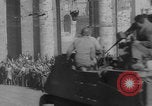
Italians greet Allied forces after liberation of Rome (WW2)
Allied forces enter Rome after liberation from Nazi Germany during World War II. Roman men and women welcome United States soldiers on moving tanks. Allied soldiers enter Rome through the Porta Maggiore, also known as the Porta Prenestina (Piazza di Porta Maggiore, 00182 Roma RM, Italy). Aerial view of United States tank and soldiers entering Rome. Italian men and women cheer and welcome Allied soldiers outside the Colosseum (Piazza del Colosseo, 1, 00184 Roma RM, Italy). Soldiers marching on the Via di S. Giovanni in Laterano towards the Colosseum. A regiment of the British Army plays bagpipes outside the Altar of the Fatherland (Altare della Patria), also known as the Victor Emmanuel II National Monument (Piazza Venezia, 00186 Roma RM, Italy), near the Capitoline Hill. Adoring Italian women reach out to soldiers on a jeep. Crowds gathered to watch Allied military vehicles drive on Via dei Fori Imperiali towards Piazza Venezia. Italians watch the entrance of Allied trucks into the Saint Peter’s Square (Piazza San Pietro, 00120 Città del Vaticano, Vatican City) of the Vatican City.
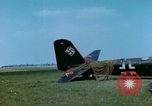
Wrecked German Luftwaffe airplanes in a field.
A burned out German Ju-188 followed by several other destroyed aircraft, as filmed by American forces at the airfield, near the end of World War 2. Rear view of a Bf 110G-4/R3 and a side view of another Bf 110G with a damaged front half. Last aircraft is a He-111 bomber with a broken tail. Frankfurt-Rhein Main airfield.
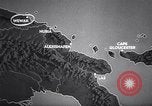
USAAF B-24 Liberator bombers drop 1000 lb demolition bombs over Nubia in World War II.
1943: An animated map depicts the strategic Japanese air and shipping base at Nubia in Papua New Guinea, during World War Two. 25 August 1943, Nubia: USAAF 5th Air Force B-24 Liberator bombers drop 1000 lb demolition bombs, from 16,000 feet, over Nubia. They target bivouac and supply areas. That afternoon, U.S. B-25s, flying low to the ground, make strafing attacks against the Japanese airfield at Nubia. United States soldiers unload jeeps, bulldozers, scrapers and other construction equipment in an abandoned Japanese airfield at Nadzab. U.S. 5th AAF constructing their air base. USAAF C-47s bring Australian infantrymen to the new base.
U.S. Air Force film about the Military Airlift Command (MAC)
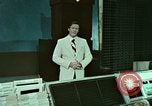
Opening scene shows a C-130 aircraft on final approach, and about to land on an airfield, at dusk. Next, a MAC Lockheed C-141 Starlifter aircraft is seen flying over a body of water. Its tail number is 63-8075. (Nicknamed "Petunia Pig," it was flown in accelerated operations beginning in 1964, and eventually logging about 15 hours a day in regular service, to provide the Air Force advance information about the operational capabilities of this type aircraft.) The next airplane shown is a MAC Lockheed C-5 Galaxy, about to land. Its unique 28-wheel landing gear is clearly visible as it approaches and touches down. Scene shifts to the MAC Command and Control Center, at Scott Air Force Base, Illinois, where Air Force controllers are monitoring MAC worldwide operations. The wall in the background is covered by a map of the world showing numerous MAC air routes. A civilian narrator speaks about the Military Airlift Command. Camera pans over the Command Center wall map, showing North and South America and associated MAC routes and then across the Atlantic to Europe and Africa. Bucolic scenes of farmland and fields in the vicinity of Scott Air Force Base, Illinois. Next, three large jet transport aircraft are seen on an airfield ramp. Suddenly, one explodes and is destroyed in fire and smoke. Rescuers carry and injured person on a stretcher. Another scene shows a bus and cars consumed in flames.
Tanks and troops transported by the Military Aircraft Command during Army Reforger 76 exercise in Europe.
A civilian narrator is speaking from the Military Airlift Command (MAC) Headquarters Command Post, at Scott Air Force Base,Illinois. He mentions MAC missions supplying war materiel to Israel, in 1973, and the famous Berlin Airlift of 1948. Scene shifts to troops in military exercises, riding across fields in U.S. M113 armored personnel carriers (APCs) and walking with their weapons and gear. An M60 Patton tank moves along a muddy road, past the camera. Troops of the U.S. Army 101st Airborne division stand in formation on a ramp next to a MAC C-141 transport aircraft. They are about to be airlifted to Europe, to participate in War games, in Germany. Some of their armor and trucks seen offloading at a destination airfield. Major John Gray, Jr. of the 1st Brigade, 101st Airborne Division is interviewed, standing in front of a C-141 aircraft from the MAC 62d Airlift Wing, stationed at Joint Base Lewis-McChord, Washington. UH-1 (Huey) helicopters deploying infantry in a field and moving away as the troops advance during an exercise. M113 APCs moving past the camera. MAC C-141s landing in Germany as they airlift the U.S. troops who participate in these exercises.Several C-141s taxiing on the airfield. A MAC C-5 Galaxy aircraft with its nose hatch open and armored vehicles that it carried, parked in front of it. Closeup of turret on an M60 medium main battle tank. View of the tank being loaded into a C-5 and view inside the aircraft as the tank is maneuvered in its cargo hold.
U.S. Air Force Military Airlift Operations in 1968 during the Vietnam War, and during 1976 border tensions in Korea
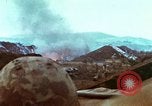
View from a U.S. Marine bunker as enemy shell explodes nearby, during the siege of Khe Sanh in 1968 during the Vietnam War. The United States Marines in the Battle of Khe Sanh firing mortars and a 105mm howitzer from their bunker. Enemy shells exploding on the tarmac, where American Air Force C-130 aircraft are parked. Marines rushing wounded comrades on stretchers, to C-130s for evacuation. Scene shifts to U.S. Marine Corps Lieutenant Colonel James P. Sheehan, standing at Camp Pendleton, California. (He was a company commander in the siege at Khe Sanh.) As he describes the C-130 aircraft support operations, a contingent of marines marches past, behind him. Scene shifts to a civilian narrator standing in the Military Airlift Command (MAC) Headquarters Command Center at Scott Air Force Base, Illinois. Among other things, he describes MAC support to the Tactical Air Command in Korea. Camera focuses on MAC air routes in the vicinity of the Philippines, Japan, and Korea. Next, is seen view of airfield at Mountain Home Air Force Base, Idaho, briefly at sunset, and then at night, as pilots of the 366th Tactical Fighter Wing and their F-111 aircraft prepare to depart for Korea, in response to border tensions, in August, 1976, after North Korean forces killed two American officers ("Korean Axe Murder Incident" and resulting "Operation Paul Bunyan"). Ground crewman directs a taxiing F-111 using lighted wands. The F-111s takes off. One of them is seen landing after the 7 thousand mile flight to Korea, as Major Paul Malandrino,Jr. (unseen) of the 366th Wing, speaks about MAC's airlift support. A C-141 MAC aircraft is seen landing. View of a C-141 with tail doors open and its cargo of military equipment on the ramp behind it. Glimpse of a marine with rifle and earphones, guarding equipment on the airfield ramp. Closeups of F-111 aircraft taking off.
CRITICALPAST.COM: About Us | Contact Us | FAQs - How to Order | License Agreement | My Account | My Lightboxes | Shopping Cart | Advanced Search | Featured Collections | Website Terms & Conditions | Privacy Policy ©2026 CriticalPast LLC.
License Agreement |
Terms & Conditions |
Privacy Policy
©2026 CriticalPast LLC.