


 Francais
 Deutsch
 Italiano
Refine Your Search
Italy airfields stock footage and images
- Showing 2539 to 2544 of 3777 results more
more Hide
Hide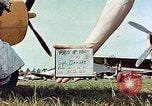
Entire complement of U.S. 362nd Fighter Group walk past parked P-47 airplanes at Illesheim Air Base, Germany
Immediately after the end of World War II in Europe, all personnel. of the U.S. Army Air Forces 562nd Fighter Group, walk past the camera between two parked P-47 aircraft, on Illesheim Airfield, Germany.
General Twining congratulates Pilots of U.S. Air Force who shot Japanese planes, in Guadalcanal Solomon Islands during WWII.
General Twining arrives to congratulate fighter Pilots of the U.S. Air Force, in Guadalcanal in Solomon Islands, during World War II. General Nathan Twining steps out of his jeep and walks towards a group of Air Force Pilots. He congratulates Captain John Mitchell and then speaks to Pilots of the 339th Fighter Squadron. General Twining and other Pilots stand in front of a P-38 fighter airplane and talk. Pilots who shot three Zero Fighters and three bombers of the Imperial Japanese Navy Air Service (IJNAS) over Ki hill Airfield near Munda Point. The three Pilots, Captain Thomas Lamphier, Jr.,, Lieutenant Busby Frank Holmes and Lieutenant Alex E Barber pose for a photograph. (These three would later participate in U.S. Operation Vengeance, on April 16, 1943, in which they engage a group of Japanese aircraft, including one carrying Admiral Isoroku Yamamoto, the architect of the Pearl Harbor attack. He would perish when they down the Mitsubishi G4M bomber carrying him.) Pilots leaving in a jeep. A Pilot stands on the wing of P-38 fighter, besides its canopy.
A runway strip under construction by Seabees at Banika Island during War II.
A runway strip under construction by Seabees,during World War II, at Banika Island (part of the Russell Islands, in the Solomon Islands). Aerial view of the runway strip under construction on the site of a coconut plantation. (This is the South Strip. Another airfield was also built across the bay, on the north side of the island.)
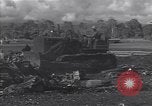
Earthmover cleans way for strip at Henderson Field of U.S. Air Force at Guadalcanal in Solomon Islands, during World War II.
U.S. Air Force runway strips and air fields at islands of Guadalcanal in Solomon Islands, during World War II. A new runway strip at Henderson airfield being constructed for U.S. Air Force fighter aircrafts nearby the sea shore of the island. An operator operates an earthmover and cleans the area for landing strip. U.S. airmen near earthmover watch the process.
Wrecked airplanes and P-38 operations on Henderson Field, Guadalcanal, during World War II
U.S. military personnel working at end of Henderson airfield on Guadalcanal during World War 2. One pushes a wheelbarrow. Camera pans across and along runway to P-38 aircraft parked haphazardly in grass. It continues to pan, showing lots of damaged aircraft and parts, including several P-40s. Mechanics work on one of the P-40s. A fuel truck passes. Tents are seen behind the piles of parts and aircraft. Numerous auxiliary fuel tanks are piled up in one area. Broken aircraft parts are seen in a ditch off the side of the runway. Trees and foliage are in the background with tents pitched amongst them. As the camera continues to pan farther down the runway, it reveals more orderly campsites, with tents and laundry drying. Mechanics work on the engine of a P-38 parked on a sandy ramp. Palm trees and water seen in background. More P-38s are parked in good order. Scene shifts to a P-38 taking off. It is followed by a second, and then a third, all taking off in quick succession.
B-29 , tail number 42-224802 on Guam, Mariana Islands during World War II.
Camera pans across North airfield on Guam, Mariana Islands, in World War 2. Next a large group of Airmen are seen standing around a shiny B-29 bomber parked on the ramp. It has "K333" stenciled on left side of its forward fuselage. Its tail number is 42-224802. (This B-29 is named "Purple Shaft," but that is not stenciled on its left side.) The airmen walk around and examine it. Next, The aircraft commander, Lieutenant Warren Richard Aylsworth is seen speaking with a Captain, as they stand next to the plane. Others join in the conversation. (Note: The plane is scheduled to fly to Tinian this night, the 20th, but will land at Saipan, instead, because runway lights were not yet operational on Tinian. The "Purple Shaft" will be the first B-29 to arrive at Tinian, the following day, December 21, 1944.)
CRITICALPAST.COM: About Us | Contact Us | FAQs - How to Order | License Agreement | My Account | My Lightboxes | Shopping Cart | Advanced Search | Featured Collections | Website Terms & Conditions | Privacy Policy ©2026 CriticalPast LLC.
License Agreement |
Terms & Conditions |
Privacy Policy
©2026 CriticalPast LLC.