


 Francais
 Deutsch
 Italiano
Refine Your Search
Japanese-martial-arts stock footage and images
- Showing 763 to 768 of 4336 results more
more Hide
Hide
Japanese airplanes attack and bombard Pearl Harbor during World War II. Views from ground in immediate aftermath of attack.
Japanese air attack on Pearl Harbor, Hawaii, United States during World War II. Japanese officials seated at a desk discuss amongst themselves. Narrator indicates they plot an attack on Pearl Harbor. Japanese airplanes warming up on Japanese aircraft carrier ship in preparation for the attack. Japanese aircraft flying overhead to attack Pearl Harbor. Street scenes in Honolulu during the attack on Pearl Harbor. Nurses, workers, and civilians running to assist wounded, and smoke from attack visible in distance. A two-man submarine on a beach, that narrator says was used in the attack on Pearl Harbor. Stern of the 2-man mini or midget Japanese submarine. Japanese pilot dead in water and Japanese airplane hoisted out of water in Pearl Harbor after the attack.
U.S. Navy task forces combat Japanese fleet in battle of Coral Sea and Battle of Midway in World War II
Animated map shows Japanese massing for attacks against Australia, Midway Island, and the Aleutians in World War 2. U.S. naval forces prepare for the battles of Coral Sea and Midway. U.S. warships seen underway in the Pacific Ocean. Crewmen on the aircraft carrier, USS Yorktown (CV-5) push a Douglas SBD Dauntless aircraft with folded wings. Senior officer on the carrier looking through binoculars. Ship's flight operations personnel are alerted by bugle over intercom to report to their stations. flight deck operational crews assemble on deck. Aviators assemble in ready rooms. They are told a Japanese carrier has been sighted and they are to attack its aircraft. Ready rooms are notified of enemy contact at 125 miles. The pilots scramble up stairs to the flight deck and their airplanes. They climb into cockpits Douglas SBD Dauntless planes, start engines, taxi, and take off one at a time. They form up in flights of 3 aircraft each and fly overhead. View of the Island on the Yorktown, as they wait for aircraft to return. Antiaircraft gunners wait in readiness for possible Japanese attack. A formation of Japanese Aichi D3A (Val) aircraft is sighted. They dive at the Yorktown, as her gunners fire away at them. Black flak clouds fill the sky. An explosion as a bomb strikes the Yorktown. She lists and burns and is wracked by another explosion. An SBD dauntless rocks loose near the end of flight deck. USS Yorktown along with other ships in the task force battling Japanese aircraft. A Japanese torpedo plane is downed on the surface of the sea. Flames and smoke at forward port area of Yorktown's flight deck. Gunners hit wings of attacking airplane. Firefighters on Yorktown set up hoses on her deck. More U.S. aircraft airborne to attack Japanese force only 15 miles away. U.S. dive bomber dropping a bomb. An SBD dauntless lands on a carrier deck. Navy aviators pose on deck. Closeup of a Dauntless landing. "Scorecard" compares U.S. and Japanese losses in the two engagements.
Operations of Japanese soldiers and officials during the invasion of the Philippines.
The invasion of the Philippines Islands by Japanese occupying troops during World War II. Map shows Manila and surrounding area in Central Luzon. Truckloads of Japanese troops passing on a street. They pass the ruins of San Fernando, Pampanga. Belltower of Metropolitan Cathedral of San Fernando (Metropolitan Cathedral of San Fernando, Consunji street corner General Hizon street, San Fernando City, Pampanga). A horse-cart Kalesa on the street. A woman gets off from the Kalesa. A sign in a Japanese market reads: 'Army wants to buy pigs, fish, vegetables and chickens. For sale rice, sugar, salt, soap, cigarettes. Transactions with Japanese money'. Filipino women buy and sell vegetables and fruits at the Japanese market. View of bananas and corn for sale in the market. Japanese soldiers distribute English language newspaper 'The Tribune'. A Filipino woman reads the newspaper. Filipino workmen construct a building for the Japanese Army. Japanese Army General Masaharu Homma appears with staff. General Homma poses with other officials in front of Lazatin House (523 Consunji St, San Fernando, 2000 Consunji St, San Fernando, 2000 Pampanga).
Japanese air operations from Clark Field, after its capture by forces of Japan in World War II
Aerial view from Japanese aircraft of smoke rising from bombs dropped on Philippines, after its occupation by Japanese forces in World War 2. Several Japanese Aichi D3A (Type 99 Navy dive bombers, later called "Val") filmed from Japanese-occupied Clark Field, as they fly overhead in formation. Two of them pitch up and execute a loop, together, as Japanese military personnel on the ground watch them. Momentary view of pilot in cockpit of airplane. Those on the ground cheer and applaud the maneuver. A wrecked U.S. Army B-17 bomber is seen with all four engines removed. Camera shows cockpit interior and "Model B-17D, Air Corps, Serial No. A.C.40-3069" stenciled on the fuselage. (It is believed parts from this aircraft were used by the Japanese to repair B-17 40-3095, which was later flown to Japan as a war prize.) View of a destroyed American B-10 bomber. Interior of wrecked hangar in which Japanese maintenance is being performed on a Mitsubishi Ki.30 and a Mitsubishi Ki-21 twin engine bomber ("Type 97 Heavy Bomber" later called "Sally.") Japanese mechanics work on a bomber outdoors on the ramp. Ground crew meet a Mitsubishi Ki.30 "Ann" single-engine attack plane as it taxis in after landing. They load bombs on it. Momentary glimpse of mechanic climbing into a "Sally bomber." "Sally" bombers lined up on the tarmac.
Japanese prisoners at a prison camp after being captured by American forces in the Pacific Theater during World War II.
The Japanese being taken as prisoners in the Pacific Theater during World War II. Allied soldiers cross a water channel and advance in Luzon, Philippines. Soldiers fire and advance. Explosions occur on the island. The soldiers fire rifles and guns. A soldier loads shells into a mortar and fires. A Japanese urges the natives over a loudspeaker to surrender. American soldiers aboard a ship as they look through binoculars to spot any Japanese soldier. Japanese soldiers swim towards the ship and come aboard as they surrender. Another local speaks into a loudspeaker as he urges the Japanese to surrender. A Japanese soldier waves a leaflet and surrenders to U.S. soldiers. A wounded Japanese soldier after surrendering to U.S. troops. Japanese prisoners at a prison camp. Prisoners eat and are lined up on the camp grounds.
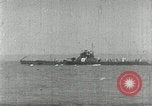
Japanese sailors and officers undergo a training on a submarine underway in the Pacific Ocean during World War II.
A training of Japanese submarine sailors in the Pacific Ocean during World War II. A Japanese submarine underway at sea. Crewmen on the deck smoke cigarettes. A naval gun aboard the submarine. A man waves signal flags. A Japanese battleship underway as the sailors aboard the submarine wave their hats. Japanese sailors and officers on the bridge of the submarine. A sign in Japanese. Japanese sailors go through a hatch on the deck of the submarine. The gun in the foreground. The conning tower of the submarine. A Japanese officer looks through binoculars. Japanese Naval officers on the bridge. A man with a large pair of field glasses. Crewmen in the engine room work on the controls