


 Francais
 Deutsch
 Italiano
Refine Your Search
Japanese-martial-arts stock footage and images
- Showing 1213 to 1218 of 4336 results more
more Hide
Hide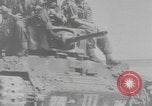
U.S. soldiers searching for Japanese prisoners and firing at their positions along a shore in the Solomon Islands.
United States troops in the Solomon Islands during World War II. Tactical maneuver of bypassing some Japanese held islands and advancing to more strategic positions is explained. U.S. soldiers aboard a tank advancing along a shore. Some of the soldiers walking along the shore. They fire at Japanese positions. Holding rifles they search for Japanese prisoners. Buildings on a field. The soldiers standing in front of the buildings. Dead bodies of Japanese soldiers lying on the field.

U.S. 4th Marines and 7th Infantry Division land on the Marshall Islands and Japanese ships are strafed in the Pacific Ocean.
A film titled: 'Attack on the Marshalls' depicts landing of U.S. troops on the Marshall Islands during World War II. A Japanese flag flying atop a flag pole. Animated map shows areas occupied by the Japanese. U.S. troops invade the areas. Marshall Islands, New Guinea and other places on the map. The 4th Marines and the 7th Infantry Division land on the Marshall Islands. U.S. airplanes taking off from an air base. They fly in formation overhead. A Japanese ship convoy underway in the Pacific Ocean. They are strafed from the air. Smoke arises as the ships explode. Aerial view of the Pacific Ocean. U.S. airplanes aboard an aircraft carrier underway. Japanese airplanes being shot down by United States aircraft and crashing into water, as seen in wing camera or gun camera footage .
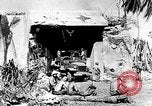
U.S. Marines load Japanese ammunition on a truck near a magazine on Kwajalein Atoll in the Marshall Islands.
A military training film details operations of U.S. forces on Kwajalein Atoll in the Marshall Islands during World War II. American Marines at the island. They stand nearby and inside a Japanese ordnance and ammunition magazine. They empty the ordnance storage area which was loaded with Japanese bombs. Ammunition is loaded onto a truck. Several Japanese have taken shelter in the basement of the magazine. Some of the Japanese in the magazine commit suicide. The remaining are taken prisoners. Debris in the area.
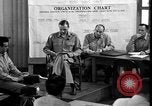
Major Tisdell talks about American surrender to the Japanese in 1942 during trial of General Hommal in Manila, Phillipines.
U.S. Army Major Achille C. Tisdell testifies before a military tribunal in Manila, Philippines during the trial of Japanese Army General Masaharu Homma for World War II crimes. Major Tisdell, aide-de-camp to Commanding General of the American forces in Luzon Major General Edward King, says that Colonel William and Major Marshall went in a jeep to contact the Japanese forces. They met the forces at a bridge. Japanese infantry elements led them to head quarters. Tisdell says that a Japanese Major General kept Colonel Williams as a hostage allowing Major Marshal to return to the American headquarters. After his return on April 9, 1942 General Edward King assembled some officers.
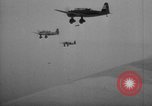
Japanese bombing of Rangoon, Burmese citizens evacuate from bombing during WW2
Three Imperial Japanese Army light bombers (likely Mitsubishi Ki-51 Sonia Type 99 Assault Planes) drop bombs over Rangoon (present-day Yangon, Myanmar) during World War 2. Explosion from dropped bombs. Burmese child runs away. A child rides on the back of his mother running away from bombing. Japanese bombers drop more bombs over buildings in Rangoon, destroying them. Buildings on fire due to Japanese bombings. Huge fire in roof of building. Burmese refugees sit on roof of moving train cars as railroad train moves down track. Farmland on fire. Rangoon’s destroyed buildings after Japanese bombings. Buddhist statues surrounded by debris.
The Philippines under Japanese occupation, liberation by allied forces, Philippine Independence ceremony.
The Philippines under Japanese occupation, liberation, and subsequent granting of independence by the United States in World War 2. Bodies of Filipino and United States soldiers killed during the Japanese invasion of the Philippines. Captured American, Filipino, and Australian soldiers raise their hands after the Fall of Corregidor. United States General Jonathan M. Wainwright negotiating the surrender of The Phillipines with Japanese General Masaharu Homma in 1942. Brigadier General Lewis C. Beebe and Major Thomas Dooley are seen to Wainwright's left. An American warship firing during the United States Pacific campaign to defeat Japanese occupying forces in the Pacific. United States soldiers get off an amphibious landing craft during the U.S. retaking of the Philippines. United States General Douglas MacArthur arrival in Leyte Gulf with a retinue consisting of Philippine President-in-exile Sergio Osmeña, Lieutenant General Richard Sutherland, Philippine Brigadier General Carlos P. Romulo, Major General Courtney Whitney, Philippine Sergeant Francisco Salveron and CBS Radio correspondent William J. Dunn in Palo, Leyte, the Philippines- a fulfillment of his promise to return to the Philippines. General Douglas MacArthur speaking at the Independence Day ceremony in Manila on July 4, 1946. “America never wavered in that purpose. America today redeems that pledge.” Says General MacArthur. United States Senator Millard Tydings, the co-sponsor of the Tydings–McDuffie Act (a law that provides independence to the Philippines after a 10-year transition as a Commonwealth) attends the ceremony. Paul V. McNutt, the United States High Commissioner of the Philippine Commonwealth (later the first United States Ambassador to the Philippines), reads the United States President Harry Truman's official proclamation of Philippine Independence. Filipino elites and United States dignitaries watch the ceremony in the Independence Grandstand (a temporary structure built in front of the Rizal Monument). Manuel Roxas being sworn in as the first President of the Philippines after gaining independence from the United States. The Philippine national anthem, Lupang Hinirang, plays in the background. High Commissioner McNutt lowers the United States flag from the flagpole as President Manuel Roxas raises the flag of the new Republic of the Philippines. A celebratory parade following the Independence ceremony takes place, which includes floats from various provinces in the country. A float with signs reading: "Let's Produce and Rebuild,". "Mountain Province" float with women wearing formal Filipino Baro’t Saya gowns. "The City of Manila" float with soldiers. "The University of the Philippines" (UP) float featuring two women dressed as allegorical figures and sign saying, “The University of the Philippines At the Service of the State”. "The Division of City Schools" float features two Filipinos in traditional attire in front of a Statue of Liberty model. A float, likely belonging to the National Library of the Philippines, with children and a huge book model. The Chamber of Commerce Philippines float contains a machine gear model and small models of an aircraft and a ship. American soldiers marching, carrying the United States flag. A military marching band play. Filipino soldiers marching with the Philippine flag. Military aircraft in flight above the Independence Grandstand in Manila.