


 Francais
 Deutsch
 Italiano
Refine Your Search
Japanese-martial-arts stock footage and images
- Showing 1333 to 1338 of 4337 results more
more Hide
HideColor Sound
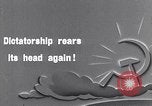
Russian troops march in Red Square as Joseph Stalin waves. Women provide much labor in Russian economy
Russian soldiers march. Joseph Stalin waves. A huge crowd gathered during the march. Palatial buildings in rear. A person views a piece of art and decorated cross and vessels displayed in Russian Orthodox Church. A woman holds a child in a public nursery, where other children are in cribs. Women working in various factories and performing heavy labor at construction sites. Women cleaning streets.
Rocket motor designs by International scientists and inventors, reflecting early work by German rocket researchers
Designs by various international scientists and inventors who have contributed to solving the problems of rocket motor development, based on the German preparatory work. Their combustion chamber designs owe much to the German pioneers in the field. Shown are design sketches by Russian scientist, Konstantin Tsiolkovsky (Ziolkowsky) in 1914; French inventor Henri Melot, in 1920; German Friedrich Zander, in 1931; Bull, 1932; The American Rocket Society, with several designs from 1932; and The Cleveland Rocket Society. Views of rocket combustion research activity by Ernst Loebell of the Cleveland Rocket Society in 1933. He is seen outdoors in the snow with his apparatus. View of Loebell's test firing stand, and a picture of an actual test firing, outdoors. Ernst Loebell with model and rocket motor from his spaceship projects of 1934 and at the International Exposition dedicated to Art and Technology in Modern Life held in Paris, 1937. Cutaway views of the spaceship. The rocket motor wrapped in cooling coils. Rocket motor design by John Shesta of the American Rocket Society, from 1934. Design by Rene Armengaud of France, in 1934 and Deich in 1935.
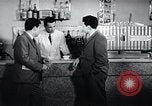
U.S. Information Agency informs people abroad about American life and culture through radio, libraries, concerts, and exhibits
Worlwide activities of the U.S. Information Agency. Four men in a bar in Italy. Narrator refers to European apprehension right after the war about America and the atom. The Italian men are polled and now understand about peaceful uses of atomic energy. Maps showing 200 U.S. Information Agency posts in 80 countries. An "Amerika Haus"in a major German city. Germans enter and peruse books and newspapers. An "Amerika Hause" book mobile (autobucherei) drives into a German village. Local people enter and browse the bookshelves. A boy selects a book entitled "Christoph Kolumbus" (Christopher Columbus). A german policeman perusing a book. A man walking out with several books. A discussion group, under auspices of USIA, gathered around a table. A concert with orchestra and chorus (Conductor appears to be Wilhelm Furtwängler, of the Berlin Philharmonic, who died in 1954, so this is likely a shot from 1953-1954 range). A sign on building in Berlin reads: "RIAS" (Radio in American Sector). A German speaking radio announcer in RIAS broadcasting. People visiting the "Family of Man" exhibit which originated in the Museum of Modern Art in New York City and shown in 37 countries abroad, under USIA sponsorship.
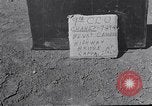
USAAF 321st bomb group B-25s attack bridge near Capua, Italy., during World War II
B-25 of the U.S. Army Air Forces 321st Bombardment Group parked at Grottaglie Airfield in Italy, during World War 2. It displays nose art showing two cartoon characters and lettering reading: "Sylvester the Snarp." Two characters are shown. The smallest shoulders a bomb. Missions flown by the plane are recorded with bombs painted on its fuselage. Momentary glimpse of another B-25 parked in the distance. Scene shifts to aerial view of bends in the Volturno River near Capua, Italy. At lower right of image, smoke can be seen rising from explosions as bombs strike a bridge over the river and nearby roadways. View from overflying aircraft is obscured momentarily by cloud cover. Then network of roads is clearly seen. Scene shifts to B-25 bombers flying in formation.
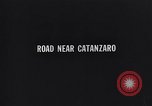
Bombing over road near Catanzaro, Italy.
U.S. Army Air Force 340th bomb group bombs over road near Catanzaro, Italy. Close-up aerial view of American B-24 Liberator bomber aircraft with nose art name "Rum Dum". Bomber group hits bombs over target area. Aerial view of bomb explosions over road near Catanzaro. Smoke rises over target (World War II period).
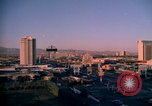
Wide, elevated view of casinos and hotels in Las Vegas.
View from high building in the early morning, and then again at evening, of attractions in Las Vegas: Views of Dunes, Holiday Casino, Flamingo, Aladdin (theater for performing arts, with Bing Crosby featured), MGM Grand Hotel, Tropicana (Folies Bergere 76), Paradise Hotel and Casino. Neon signs of various hotels and casinos in the mid 1970s.
CRITICALPAST.COM: About Us | Contact Us | FAQs - How to Order | License Agreement | My Account | My Lightboxes | Shopping Cart | Advanced Search | Featured Collections | Website Terms & Conditions | Privacy Policy ©2026 CriticalPast LLC.
License Agreement |
Terms & Conditions |
Privacy Policy
©2026 CriticalPast LLC.