


 Francais
 Deutsch
 Italiano
Refine Your Search
Japanese-martial-arts stock footage and images
- Showing 1339 to 1344 of 4337 results more
more Hide
Hide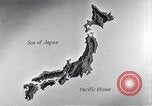
Modern buildings and streets in Tokyo, Japan.
Animated physical map of Japan showing major cities of the country. Streetcar moving in front of the Asahi Shimbun building in Tokyo, Japan. Art deco buildings in Tokyo. St. Luke's International University (10-1 Akashicho, Chuo City, Tokyo 104-0044, Japan) in Chuo, Tokyo. People shopping at a department store in Ginza district. People stand outside a kabuki theater. Pedestrians and neon lights at Ginza. A train leaves a subway. View of a subway tunnel. A policeman directing traffic. Pedestrians crowd a street. Women wearing kimono cross a bridge and walk towards a lake with Torii gate.
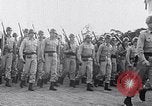
United Nations Security Council meeting to protect South Korea and preparation by US Marines and Army for Korean War.
United Nations meets to organize military action for protection of South Korea from Communist North Korea. United States troops in Tokyo, Japan prepare to advance to Korea. U.S. Army forces are seen passing in review before General MacArthur and General Omar Bradley in Tokyo, Japan. Back in the United States, a B-29 bomber, "moth balled" by being entirely encased in "cocoon" plastic since after World War 2, is rolled onto an airfield. Air force personnel remove the heavy plastic from the body and tires of the B-29, revealing its World War 2 nose art name "Lucky 13" (which had been among B-29 aircraft of the 25th Air Service Group in World War II). Navy Vought F4U Corsair aircraft with folding wings are unloaded from giant containers in aircraft hangars. A group of the F4U aircraft lined up at an airfield. Military equipment being loaded onto waiting ships, and carried by soldiers at a warehouse area. Units of the 1st U.S. Marines answer the call, are seen piloting amphibious vehicles in the ocean and onto the dock landing ship USS Gunston Hall (LSD-5) . Canadian sailors are seen boarding ships and Candian Navy destroyers leave British Columbia for Korea. Women and children wave form dock. Destroyers underway in sea. White, African American, and Hispanic young men in the United States are seen standing in lines at a United States Army enlistment office, answering the call to serve as new recruits in the Army. A group of new recruits raise their right hands and take an oath of service. U.S. President Harry S Truman speaks to a meeting of the Reserve Officers Association meeting, indicating that the only reason for this action is to hopefully arrive at the peace in the world that was hoped for when the United Nations was created. He leaves and shakes hands with officers. At Security Council meeting of the United Nations in Lake Success, New York, the President of Council, Arne Sunde, of Norway, invites Korean Ambassador to join table. Ambassador Chang comes and sits. The United Kingdom representative presents resolution which the body votes on (United Nations Security Council Resolution 84). It is passed by 7 to 0 in favor. The U.S. is asked to designate a military commander for the United Nations forces. The Korean ambassador, Chang Myon, expresses gratitude to the UN Security Council.
U.S. Army helicopters in flight and aerial view of 9th Infantry Division base camp in Vietnam.
U.S. Army 9th Infantry Division in Vietnam. Aerial view of water filled rice paddies. Formation of helicopters in flight. Pilots in helicopter. Aerial view of base camp. Buildings and sheds at the base. Trucks parked. Nose art on helicopter reads "162nd Assault Helicopter Company, Vultures."
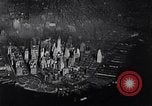
Transcontinental Air Transport (TAT) providing combined rail and air service taking passengers across the U.S.A. from coast-to-coast
Operations of the Transcontinental Air Transport (TAT) Company. Aerial view of New York City's Manhattan Island, below. Camera focuses on Pennsylvania Station (Penn Station) seen from above, and then at street level. Travelers purchasing tickets for combined transcontinental rail and air travel at a window in the station. Families seeing travelers off at one of the railroad gates. Temporary sign at gate reads "The Airway Limited, second section." View of passengers on rear car of train as it pulls out. The car displays Pennsylvania Railroad logo sign reading "The Airway Limited, Pennsylvania Railroad." Views of Pennsylvania RR passenger train and closeup of locomotive wheels in motion. Animated relief map shows train proceeding from New York, past Columbus, Ohio, to Port Columbus station in Ohio. Transcontinental Air Transport, Inc. billboard sign at the station shows picture of passengers connecting between a train and an airplane. Billboard reads: "Port Columbus, Eastern Transfer Point, Air-rail Service, Coast-to-Coast." Passengers leaving the train and entering the station waiting rooms. Their baggage being weighed (Narrator says 30 pounds is the allowance.) View from terminal roof, of a Ford 5-AT-B, trimotor passenger airplane ready to accept passengers for the next phase of their travel. A logo on fuselage has "TAT" with small ribbon through it reading, "Transcontinental Air Transport." View of passengers seated inside the aircraft. The plane taxis and takes off from the Port Columbus airport. Ground is snow-covered, but the runway is plowed. Closeup aerial view of the airplane flying over the city of Columbus, Ohio. Distant view of it flying close to the LeVeque Tower skyscraper (a 47-story Art Deco-style building at 50 West Broad Street). Aerial view of the airplane passing the train, continuing westward, from Port Columbus. Views inside passenger cabin of the plane. Animated map show plane heading to Indianapolis. Officer hands out TAT illustrated map and points out features to passengers. Closeup of map. Aerial view of the airplane on final approach to land at Indianapolis airport. Clerk at airport typing arrival message on teletype, and company executives reading it at their headquarters. Animated map show plane moving to St. Louis, Missouri. View from air of Missouri and Mississippi rivers. Passengers in cabin. aerial view of the plane on final approach, over snow, to St. Louis. The aircraft taxiing on ramp and parking at terminal building, where passengers enter, under cover of awning-covered walk. Closeup of the aircraft engines. Inserted view of TAT engine overhaul facility, with Charles Lindbergh, the airline's technical adviser, and TAT officials inspecting the operation.
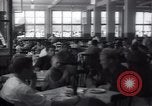
Workers at a community facility in Russia.
Russian workers eating at a community facility in Russia. Outside can be seen a playground, with tennis court. Several people play tennis at the community facility and some gather in a classroom to look at an art exhibit. Local slum housing and shacks in Soviet Union are shown.
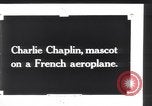
Cartoon of Charlie Chaplin as "The Little Tramp" is painted on nose of a French Farman bomber in World War I
Opening scene shows nose gunner compartment of a parked Fremch Farman biplane bomber as viewed upward from the ground below. It is embellished with a painting of Charlie Chaplain as the iconic "Little tramp." Above, the nose art, a French gunner displays the maneuverability of his machine gun mounted in the open nose position of the aircraft.