


 Francais
 Deutsch
 Italiano
Refine Your Search
Japanese-martial-arts stock footage and images
- Showing 1573 to 1578 of 4328 results more
more Hide
Hide
Japanese civilians visit Shinto shrine and perform rituals in Japan.
Shintoism as a religion practiced in Japan. A Shinto priest reads from a paper. A torii found in a Shinto shrine garden. View of the “floating” torii gate of the Itsukushima Shrine (1-1 Miyajimacho, Hatsukaichi, Hiroshima 739-0588, Japan) in Hiroshima Prefecture, Japan. A Japanese man stands under the “floating” torii gate. Two Shinto priests walking. Stone stairs leading to a Shinto shrine. A man bows at a small shrine. Façade of a Shinto shrine (likely the Kitano Tenmangū Shrine in Kyoto, Japan). Crowds of worshippers visit a Shinto shrine. The Imperial Chrysanthemum Seal (kikumon) is displayed on the side of a Shinto gate. Priests perform purification rituals. Japanese woman performs rituals. Priest gives blessing to people.
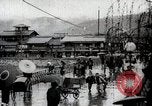
Japanese on a bridge, in the rain, near town in Japan.
Scenes from Japan during the 19th century. Japanese pedestrians walking, in a light rain, on a town bridge in Japan. Pedestrians in kimonos hold wagasa umbrellas. Rickshaws cross the bridge. Japanese women play shamisen, and two girls use a hand fan and an uchiwa fan.
Tactics of the 3rd Fleet and 7th Fleet in the naval battles and Japanese planes attack over U.S. carriers in Philippine sea.
Naval battle of Philippines between the United States and Japanese Imperial Navy. Animated diagrams show tactics of the 3rd Fleet and 7th Fleet in the naval battles on the Philippine (October 23-24, 29). Southern American unit destroys the battleships. Explains maneuvers employed in the Surigao and San Bernardino Straits. Shows Japanese planes attacking ships and being drowned. The carrier Princeton is damaged and sunk. Large smoke rises from carrier Princeton. American carriers are damaged. Several U.S. planes make crash landings on a carrier. United States Navy ace Commander Captain David S. Mc Campbell lands. He exits the cockpit and is greeted. (World War II period).
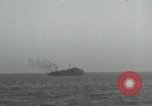
Japanese plane bombs USS Ommaney Bay and activities aboard USS Mississippi in Philippines.
Japanese plane bomb USS Ommaney Bay (CVE). Japanese plane crashes in water close aboard. General Kruger uses binoculars on bridge of USS Mississippi. Smoke rises from warships. Ships at sea. (World War II period).
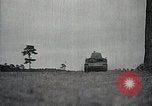
Japanese Army conducts realistic war game with live-fire exercises involving infantry, armor, artillery and aircraft.
Film opens showing a Japanese Type 89 Yi-Go tank heading straight toward the camera. Next, mounted artillerymen ride up a hill with team of horses pulling caissons. More are seen passing trees, pulling caissons and Type 91, 105mm light field howitzers. They raise a lot of dust and they race across a barren stretch of land. Elsewhere, Several soldiers are seen with large canvases laid out on the ground. Small rolled up tents appear to be lined up on one canvas. Meanwhile, the artillerymen are starting to set up positions at various spots along the crest of a hill. Closeup of one of their horses. Next, batteries of anti-aircraft guns are seen pointing skyward, each surrounded by a team of about 10 soldiers, are seen firing. Kawasaki biwing aircraft fly overhead in formation, and the anti-aircraft guns are lowered as they pass. The guns are elevated again and resume firing. Scene shifts to the field artillery, where crews are manning the 105mm howitzers and firing them. Closeup of one of the gun crews in action. Shells are seen bursting on a sandy area near a shoreline in the distance. Some field artillery under camouflage nets. An army telegrapher sends messages with his key. Several soldiers at a field communications center also send messages. Two high wing monoplanes fly overhead. Closeup from behind Japanese artillery crew firing their field piece. More views of shells striking in distance. The guns under camouflage nets are seen firing. A huge explosion nearby throws large amounts of earth into the air. Views of the antiaircraft guns and crews dissolves into views of shells exploding. Two soldiers crawl along the ground, dragging a long pole with them. Soldiers jump up and abandon their position just before a big explosion occurs there. In final scene, several soldiers are running and shouting.
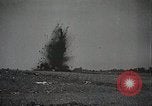
Japanese army conducts military exercises that involve inflatable rafts and pontoon bridges
Japanese Army conducts military exercise. Artillery shells explode in the distance. Some raise white smoke, while others create craters and throw large amounts of earth into the air. Japanese soldiers run carrying rolled up canvases. From them they remove and inflate rubber rafts that they carry up over a hill and down to a shoreline. They jump into the rafts and paddle furiously toward an opposite shore. The national red ball flag (sun-mark flag) is displayed on one raft. Closeup of occupants in one raft. Machine gun fire is heard in the background. The rafts reach the opposite shore where the troops jump out and charge up a hill in smoke. View from camera located at defensive obstacle as the troops arrive there. They place sections of pontoon bridges over the obstacles and cross over them. Then they carry bridge sections down a steep embankment to another shoreline where they place them end-to-end in the water to form a serpentine floating bridge. Soldiers on each section maneuver them with long poles into position spanning the water to the next shore. Next, armed troops are seen running across the new pontoon bridge. Two of them carry a version of a Hotchkiss machine gun (licensed by Japan as their Type 3 Heavy Machine Gun). One of the last few soldiers crossing the bridge, carries the sun-mark flag.
CRITICALPAST.COM: About Us | Contact Us | FAQs - How to Order | License Agreement | My Account | My Lightboxes | Shopping Cart | Advanced Search | Featured Collections | Website Terms & Conditions | Privacy Policy ©2026 CriticalPast LLC.
License Agreement |
Terms & Conditions |
Privacy Policy
©2026 CriticalPast LLC.