


 Francais
 Deutsch
 Italiano
Refine Your Search
Japanese-martial-arts stock footage and images
- Showing 1579 to 1584 of 4328 results more
more Hide
Hide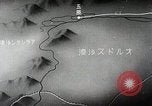
Japanese Expedition in China continues to Ningxia Hui by truck. Views of life and culture in China.
Animated maps show route taken by a Japanese expedition in China. The expedition looks at map to locate their next destination. The team passes through the Ningxia Hui desert. Luggage on truck. Safari proceeds to Yellow River. Expedition unloads the truck, stuck in mud at bank of river. Truck passes away. View of mountains and entrance. Men with mules. Life and cultures of China: Views of different buildings and life of Chinese people. People with carts and camels. Traffic policeman at crossroad and signals. Landmarks and monuments in China. Ancient pagoda tower structure and the Haibao Pagoda Temple in Yinchuan, Ningxia, China. The Chengtian Temple Pagoda in Yinchuan. Sleeping statue of Buddha. The Japanese expedition team speaks with Chinese locals in Yinchuan. View of a Buddhist ceremony. Troops ride horses.
Japanese army invading Manchuria
Japanese troops, with vehicles, horses, and supplies,moving into Manchuria. A gun crew manually pushes a field artillery piece up a steep slope in the rugged snowy landscape. Troops ride in a truck on a snow-covered street into a town. Camera shot from snow-covered street of an army truck coming head-on, and right over the camera. Army trucks following a twisting road downhill between snowy hills. Troops bundled up against the cold in the back of the trucks. A contingent of soldiers spread out and moving across a snowy field. Blowing snow and a soldier's smashed helmet on the ground. Japanese grave markers in a snowy cemetery.
Japanese air evacuation and treatment of wounded during their Manchurian campaign
Japanese care for wounded soldiers during their invasion of Manchuria . A Fokker Super Universal aircraft lands in a valley. Japanese soldiers carry wounded to the airplane. One is carried on the back of a soldier. Others are on stretchers. Inserted shot of a Kawasaki KDA-2 (Type 88 reconnaissance bomber) with engine running. More wounded being placed aboard a Fokker Super Universal. The monoplane taking off. Another KDA-2 biplane flying overhead. Wounded being placed aboard ambulances and view of several driving slowly down dirt embankment. A wounded soldier being carried on a litter into a field hospital tent. View of medical staff treating the wounded. Soldiers carrying a comrade with a bandaged leg, into a tent.
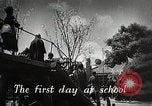
Infusing Nationalistic feelings in Japanese students.
Japanese children pray and bow their heads to the national flag.The totalitarian government infuses state shintoism in young children and it often blends religion with nationalism.This is done in order to destroy free thought and individuality among young Japanese.Minimum of six years of schooling is compulsory in Japan and all schools are under municipal control.Children draw and paint a picture of a bird and are taught to admire a cherry blossom tree.Fifth grade students read from their text books in a reading period.These government approved textbooks are poor in quality.
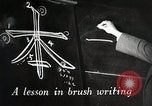
Students learn Japanese characters in school
Teacher draws Japanese characters on the blackboard in a class and Students learn to paint these characters with a black ink and a paint brush.In the first six years of school education, in Japan, mastering Japanese word characters is elementary requirement.Learning these characters is a difficult task therefore teacher instructs and helps the students as they paint the characters.
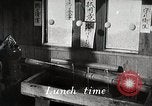
Japanese children wash hands, eat food and taught to learn physical exercise in Japan.
Japanese films show school activities to explain the school system and deficiencies are noted by narrator. The films emphasize the school's role to develop nationalism in Japan. Lunch time: Children wash their hands and come out from the building to take lunch. Children served vegetables and fish in food. Emphasis on physical culture by calisthenics and gymnastics: Children run for exercise. Children do physical exercise. Children learn the correct methods of formal exercise. Children are taught to exercise for strong and good health, which is necessary for soldier. Children do calisthenics under trained teacher. Children do gymnastic to build body and make formation. Boys doing calisthenics. (World War II period; anti-Japanese propaganda).
CRITICALPAST.COM: About Us | Contact Us | FAQs - How to Order | License Agreement | My Account | My Lightboxes | Shopping Cart | Advanced Search | Featured Collections | Website Terms & Conditions | Privacy Policy ©2026 CriticalPast LLC.
License Agreement |
Terms & Conditions |
Privacy Policy
©2026 CriticalPast LLC.