


 Francais
 Deutsch
 Italiano
Refine Your Search
Japanese-martial-arts stock footage and images
- Showing 2911 to 2916 of 4328 results more
more Hide
Hide
Chindits with a pack train enter a Burma village and load and fire mortars during World War II.
The Chindits or the Indian 3rd Infantry Division of the British Indian Army in Burma in World War 2. The troops with a pack train consisting of mules enter into a Burma village. They load and fire mortars and machine guns. A Chindit looks through a pair of binoculars. Firing in the village toward Japanese held Mogaung. Chinese troops move to join the Chindits. The soldiers and the pack train move forward. The Chinese troops in a reunion with the Chindits exchange hats and greet. A plane strafes Japanese positions. Smoke due to explosions. Machine guns are fired. Japanese forces abandon Mogaung and Chindit and Chinese soldiers move in to the destroyed area. Dead enemy Japanese soldiers amid the ruins. Three Chindits posing near a Burmese Pagoda, honoring the mythical creatures that are their namesake guarding a Pagoda.
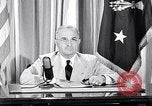
President Harry Truman of the United States speaks about dropping atom bomb on Hiroshima, hours before attack on Nagasaki.
President Harry S. Truman of United States addresses the United States following his return from the Potsdam Conference in Germany, during World War II. President sitting at a desk at the White House explains the choice of Hiroshima as a target for the atomic bomb due to its focus as an industrial rather than a residential center. (This speech is made on the same day as the dropping of the atomic bomb on Nagasaki, but either before the Nagasaki bombing occurred, or before it was confirmed and announced publicly). President Truman warns of additional atomic bomb attacks on more industries in Japan and says the Japanese can foresee what will happen in a future atomic bomb attack, based on what happened at Hiroshima. Truman reminds about the number of warnings issued to the Japanese by the US, Chinese and British governments and how the Japanese rejected them. In a foreshadowing of the attack on Nagasaki, Truman says "I urge Japanese civilians to leave industrial cities immediately, and save themselves from destruction."
Reconstruction of Japan and introduction of democracy in Japan after the end of World War 2
A film titled 'Road to democracy' shows Japanese soldiers marching and attacking Pearl Harbor. Reconstruction being carried amidst ruins in Hiroshima. General MacArthur comes out from a building and salutes as Japanese look on. Japanese war crime trials being conducted. Japanese war equipment being scrapped and melted in furnaces. Emperor Hirohito visits patients and children. People campaign for elections using banners. Women vote for the first time in the elections.
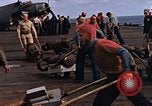
Operations aboard Escort Carrier USS Steamer Bay (CVE-87) during assault on Iwo Jima in World War II.
Aviation ordnance men wheel bombs across flight deck on Escort Carrier USS Steamer Bay (CVE-87) of Task Group 52.2, during operations against Japanese-held Iwo Jima, during World War 2. Views of flight deck operations as they launch several Grumman TBF torpedo bomber aircraft. View of the bridge, with victory record of 21 small Japanese flags, one Japanese destroyer, and two other Japanese flags, painted below it. Two officers talking on the bridge.
Social and economic distinctions in Japan
Japanese civilians seen working. Japanese Army and Navy stand first in social rankings, followed by Aristocratic families and political leaders whereas last in social rankings, are the civilians. Animated pictures seen. Japanese police taking civilians to prisons. Fanatic organization's leader seen. Newspaper headlines showing murder of Premier by the fanatic organization. Japanese children in classrooms. A motto reads 'Hakko Ichin'. (World War II period).

Western fashions designed in Japan displayed by models in New York
Japanese-designed Western fashion displayed by models in New York City. A model wears a silk blouse with kimono-inspired sleeves. Another model shows off a hat patterned after a rice bowl and a modern one-piece dress. Models wear Japanese-designed dresses inspired by different facets of Japanese culture such as theater and nature. A woman wears a dress inspired by Japanese theater. A woman wears a kimono-inspired Western dress.
CRITICALPAST.COM: About Us | Contact Us | FAQs - How to Order | License Agreement | My Account | My Lightboxes | Shopping Cart | Advanced Search | Featured Collections | Website Terms & Conditions | Privacy Policy ©2026 CriticalPast LLC.
License Agreement |
Terms & Conditions |
Privacy Policy
©2026 CriticalPast LLC.