


 Francais
 Deutsch
 Italiano

Refine Your Search
Japanese-martial-arts stock footage and images
- Showing 2923 to 2928 of 4337 results more
 Hide

United States Army Major General Shepherd in Tsing Tao, China
Japanese forces surrender at Tsing Tao, China after World War II. Major General Shepherd of 6th Division of U.S. Marine Corps seated at table. A Japanese general wearing a sword standing. The Japanese general stands as General Shepherd accepts Japanese surrender. Admirals sitting in background. A flagpole behind table. Houses in far background.
FBI agent William Sebold (posing as Harry Sawyer), and successful filming of members of Duquesne spy ring in the United States.
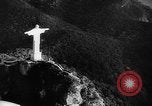
Aerial view of Christ Redeemer Statue on Mount Corcovado, Brazil. The director of the Federal Bureau of Investigation (FBI), John Edgar Hoover, narrates this 1944 clip and talks about enemy agents in the United States during World War II, before America's entrance into the war. German and Japanese suspects seen in South America. A German fleet carries German agents aboard merchant and cargo ships. German agents in formation on deck of ship, shown debarking the ship after receiving instructions. Japanese and Nazi German colonies being established in South America in large cities and in remote areas of Patagonia. Automobile industries, hotels, shops, and other industries established by Nazi German agents. German signs and Nazi Swastikas and Nazi flags shown on some buildings in South American countries including Brazil. A Nazi flag. A view of German factories in South America. Photographs of Adolf Hitler in a school building where young boys and girls are being instructed by their teacher. German pilot shown operating a passenger airliner; aerial view of from aircraft of Rio de Janeiro Brazil, including port and city areas. A dramatization depicts well planned accidents in the factories and sabotage attempts to slow production of goods bound for the United States. The Federal Bureau of Investigation (FBI) receives reports about planning of German attack on the Panama Canal. A woman watching a teletype machine as a report arrives. A man in a radio room of the Federal Bureau of Investigation receives information and turns to type out a report on his typewriter. Men and women convicted as spies are seen together in a room with U.S. federal agents. The spies are taken in a police van. Man serving as projectionist seen running a film projector. A film of Fritz Duquesne case in the FBI office shows FBI Agents' successful secret filming of members of the Duquesne spy ring. The film is shown being loaded onto a projector and then played. FBI agent William Sebold (posing as spy Harry Sawyer) is seen with Fritz Duquesne and other spy ring members: Pedestrians and vehicular traffic on a New York street corner as Sawyer and Duquesne prepare to meet. German spies sit together in a hotel room in New York City, recorded by hidden camera. Heinrich Clausing, a spy ring member and former cook on the cruise ship SS Argentine is seen. Also seen is Hartwig Richard Kleiss putting on his hat and smoking a cigar. He's shown giving money to Sawyer for purchase of a spy camera, according to narration. J Edgar Hoover notes that German agents communicated through a Long Island radio station that was secretly controlled by the FBI. Hartwig Kleiss is seen showing the blueprint plans of the steamship SS America, including plans for its secret gun emplacements. Fritz Duquesne is shown in the film, removing diagrams of various American arms that he had concealed in his sock Japanese agent Takeo Ezima, of the Imperial Japanese Navy, is also seen meeting in the hotel with Harry Sawyer.
United States aircraft strafe aircraft, shore installations and gun emplacements in Okinawa, Japan during World War II.
Strafing attack on Japanese aircraft, shore installations and gun emplacements by U.S. aircraft during World War II. A Japanese float plane shot at and catches fire during night. Japanese Betty and bomber aircraft and a Sampan ship under attack. Strafing shore installations and gun emplacements in Okinawa. A Japanese single engine fighter plane turning over on its back. A strafing attack on houses and a bridge over a small stream.
USS Lexington (CV-16) is attacked in Manila, Philippines; Pilots inspected aboard USS Ticonderoga.
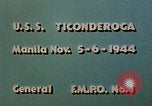
A strafing attack on U.S. Navy ship USS Lexington (CV-16) by Japanese planes off the coast of Manila, Philippines during World War II. A Japanese plane in flight and flak in the sky. Plane moves towards water in a dive and hits the water with a large explosion. U.S. Navy aircraft carrier Lexington (CV-16) under Japanese air attack. A Japanese kamikaze aircraft dives and hits the aircraft carrier. Next scene shows U.S. Navy ship Captain Dixie Kiefer and Admiral A. W. Radford walk down the flight deck of USS Ticonderoga (CV-14 )and inspect pilots. Aircraft in background on the deck. Captain Kiefer and Admiral Radford on the bridge.
Explosions occur and wounded Marines are treated in Iwo Jima during World War II.
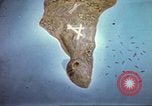
A film about Allied invasion of Iwo Jima, Japan (Operation Detachment) during World War II. Clip opens with view of simple model of the island. This is followed by battle scenes on Iwo Jima. Explosions occur and smoke rises. Intense battle scenes during Battle of Iwo Jima. A walking wounded Marine with his arm over another Marine is assisted to safety during fire fight. Wounded Japanese prisoner is carried to safety. Scenes of rocket launchers firing rockets at Japanese enemy positions. View behind a Marine as he fires a machine gun. A Marine fires a rifle at a Japanese soldier lying in a ditch. Fire and smoke rises as explosions occur. Another wounded marine in great pain is carried by two fellow Marines for medical care by Corpsman. Blood plasma being administered to a wounded Marine. Flame throwers direct fire on Japanese positions. Artillery fired at Mount Suribachi. United States Marines soldiers through cratered landscape.
U.S. Marines land and advance near Mount Suribachi amidst enemy fire during the Battle of Iwo Jima in World War II.
'Action on Iwo Jima' depicts the Battle of Iwo Jima or Operation Detachment during World War II. United States Marines Divisions eliminate positions on Mount Suribachi. Mount Siribachi on the island coast. Additional waves of Marines arrive at the island. 3rd Marine Division arrives to enforce the 4th and 5th Divisions. Landing crafts and ships approach the shore amidst enemy fire and explosions. Crouched Marines in a Landing Craft Vehicle Personnel (LCVP). Marines advance inland amidst mortar fire and machine gun fire by the Japanese. They advance across mine fields on the beach. Soldiers unload supplies from landing crafts and ships. They pull a tank across the beach. A view of the battle from inside a tank. Marines battle around Mount Suribachi. Advanced units scale cliffs and take cover against grenades and demolition charges from the Japanese in caves and pill boxes. The Marines use flames to flush Japanese soldiers out of dug in positions. A Japanese soldier takes cover from machine gun fire. Guns fired and explosions on the island.