


 Francais
 Deutsch
 Italiano
Refine Your Search
Japanese-martial-arts stock footage and images
- Showing 2953 to 2958 of 4327 results more
more Hide
Hide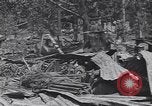
U.S. Army troops occupying Makin Island during World War II
A column of U.S. Army troops from elements of the 27th Infantry Division, make their way through destroyed Japanese structures on Makin Island, during World War 2. They patrol through jungles and engage in fire fights with Japanese defenders. One U.S. Army soldier carries a wounded soldier on his back. U.S. troops occupy an area of thatched roof huts. U.S. Army M3 Lee medium tanks moving across the sand. A wrecked Japanese ship in the surf. More views of U.S. M3 Lee tanks firing at the wrecked ship. U.S. aircraft bombing Japanese ships near the shore.
African American soldiers engaged on all fronts in World War 2
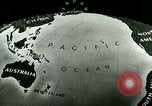
Film opens with map of the world showing the various theaters of operation in World War II. Narrator refers to Allies liberating town after town, as they advance. View of American troops being welcomed in a European town during an advance (probably Italy in 1944). Next, African American troops are seen boarding troop transport ships. A huge convoy of ships is seen from the air. Huge piles of war materiel on a dock. Ammunition being delivered by landing craft from the transport ship USS Hunter Liggett (APA-14) to American troops at a beachhead in the Pacific. An African American sailors directs the lowering of a piece of artillery from a ship into a landing craft. Construction equipment being used to clear the way for a new landing field. Docks, roads, and bridges being built as the Allies advance. American troops in the swamps of the South Pacific. American Army engineers clearing trees to build the Alaska Highway (ALCAN Highway) in 1942. Corps of Engineers building the Ledo Road (from India to China) during the war. African American soldiers building a bridge across a river in Europe. A U.S. Army truck under fire, driving along a dirt road in Europe as shells burst all around it. U.S. troops firing various kinds of field artillery and tank guns. U.S. infantryman using a flame thrower. Closeup of African American soldier using a bayonet and others firing small arms. A tank being blown up by artillery fire. A Japanese Mitsubishi A6M3 Zero aircraft maneuvers overhead in the Pacific theater. An African American soldier runs to man his Browning .50-caliber, water-cooled antiaircraft machine gun, and begins firing as the Zero fighter plane strafes his position. Closeup of Japanese pilot in his cockpit and his machine guns firing from leading edges of his plane. His rounds strike all around the U.S. gunner, who turns and follows him with more fire. His tracers show behind the plane. Closeup of the African American gunner as he continues firing. View of the Japanese airplane rolling over and diving. Next the Japanese plane, aflame, crashes on a tropical island and explodes. (Note: It is apparent that some of these combat scenes have been made up of clips from other sources, edited into this film.) (World War II; WW II; World War 2; World War Two)
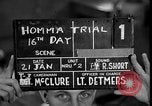
Major Tisdell recalls events of April 8, 1942 in Bataan, Philippines during the Homma trial in Manila, Philippines.
U.S. Army Major Achille C. Tisdell testifies before a military tribunal in Manila, Philippines during the trail of Japanese Army General Masaharu Homma for World War II crimes. Major Tisdell takes an oath on the 16th day of the Homma trial. He says that he was aide-de-camp to Major General E.P. King, Commanding General of the American forces in Luzon in April, 1942. Major Tisdell recalls that Japanese forces had pushed back the American forces in Bataan to a point that it was difficult for the Americans to reorganize. He also talks about the lack of ration for the American forces. Major Tisdell says that U.S. reserves were released for the forces. He says that on 9th April, 1942 General King was unable to make contact with Japanese commander and Colonel Edward C. Williams volunteered to make contact with the Japanese.
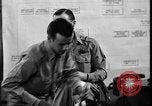
Major Tisdell says that U.S. officers were disarmed after American surrender in 1942 in Manila, Phillipines.
U.S. Army Major Achille C. Tisdell testifies before a military tribunal in Manila, Phillipines during the trial of Japanese Army General Masaharu Homma for World War II crimes. Major Tisdell, aide-de-camp to Commanding General of the American forces in Luzon Major General Edward King, speaks about the American unconditional surrender in Bataan before the Japanese forces. He recalls that an Japanese officer asked General King how many guns and tanks they had. The Japanese asked General King whether they would surrender and the General nodded his head. After this all American officers were disarmed.

General MacArthur speaks on Philippine Independence Day
Filipinos attend the proclamation of Philippine independence ceremony in Manila as the United States grants independence after World War 2. Smiling crowds of Filipinos in attendance. A Filipino boy watches the ceremony while holding a hotdog on a stick, a common snack brought under American influence in the Philippines. View of the Independence Grandstand (a temporary structure built in front of the Rizal Monument) in Manila with American flag and Philippine flags on tall flag poles. United States General of the Army Douglas MacArthur gives a speech during the Philippine Independence ceremony. “with this ceremony, a new nation is born. A nation conceived in the centuries-old struggles of people to attain the political liberty to embark upon its own national destiny.” Says General Douglas MacArthur. Filipino women with umbrellas watching MacArthur’s speech. Map of the Philippines. Filipinos smiling. View of Jones Bridge, on the riverbanks of the Pasig River, connecting to the Binondo Chinatown district in Manila. The Philippine National Bank (PNB) in Escolta Street, the historic financial district of Manila. Heacock’s Department Store, selling American appliances such as Remington, with various Manila billboards such as “ASIA LIFE”, “Elizade & Co Inc. Tanduay Distillery” and “Goodrich”. The old Legislative Building (now the National Museum of the Philippines). View of the Port of Manila. Men offloading crates of sugar and hemp to be exported to markets abroad, particularly in the United States. A ship sailing away from the Port of Manila. Factory smokestacks emitting smoke. Filipinos in steel and petroleum plants. Filipinos building a vehicle on an assembly plant. People at the Philippine Legislative Building entrance. Filipinos in panic, running for shelter, after air raid siren sounds. Evacuating people board a crowded bus. Japanese bombing of Manila. Japanese tanks with soldiers enter into Manila, prominently flying the Japanese flag. Japanese soldiers wade through water on a coast, climb a steep hill. Smoke in battlefield.
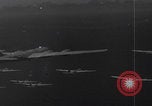
Crewmen inside Boeing B-29 bomber heading to Japan (WW2)
A group of United States Army Air Force Boeing B-29 Superfortress bomber planes in flight over the Pacific Ocean during World War II. A pilot holding the yoke inside the bomber cockpit. Another crewman sits in the cockpit. The view inside the cockpit of a B-29 Superfortress during a flight. B-29 Superfortress bombers flying over the Pacific Ocean as seen from an aircraft above. Crewmen relaxing in flight. A crewman smoking a cigarette looking out through window of the bomber airplane. Navigator taking down notes. Crewmen at work. They check their equipment during the flight. Crewmen such as the bombardier, pilot, co-pilot, and flight engineer assuming their positions. Right gunner touches some switches or buttons on the switchboard before turning to man the gun. B-29 upper gunner sits in raised position known as the “Barber chair” and viewing dome. Bomber formation head toward Japan. Gunner aims at Japanese fighters. Japanese fighters attacking formation of B-29 bombers. B-29 bomber machine gun turns and fires at Japanese fighter planes. A Japanese plane catches fire from machine gun strafing. A crewman uses binoculars in cockpit.