


 Francais
 Deutsch
 Italiano

Refine Your Search
Japanese-martial-arts stock footage and images
- Showing 3115 to 3120 of 4337 results more
 Hide
Color Sound
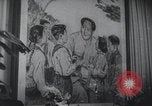
Implementation of the Mao Zedong led economic and social plan titled the 'Great Leap Forward' in Red China.
Postwar living conditions in the People’s Republic of China under the Communist regime of Mao Zedong (Mao Tse-Tung) photographed by Indians visiting the country. The film highlights China's problems of industry, agriculture, and excess population. Advertisements and posters for the Mao Zedong led economic and social plan titled the 'Great Leap Forward' in 1958. Objectives of the plan. Agriculture, industry, and education in China, including brief shot of men, women, and children in classroom, possibly for re-education. Men and women work in factories and plants. A Russian sign reads 'Made in the Soviet Union'. Workers inside a huge automatic automotive plant set up and supplies by the Soviet Union (SU). A steel and iron company rebuilt and enlarged with the aid of Soviet Union. A seamless steel tube mill supplied and erected by the SU. A plant designed, equipped, and built by SU technicians. A bridge over a river. Women work in a high voltage testing laboratory equipped by the East German government. A fully automatic petroleum refinery built by the Japanese. A heavy gilding machine plant started by the Japanese in 1937. Various factories, plants, and industries in China. Rural farmland and irrigation. People work in backyard furnaces, factories, presses, rolling mills and automotive factories. Deserted city streets with few cars. Workers inside an automotive plant. Communist Party of China Chairman Mao Zedong signs a pact with the Premier of the Soviet Union Nikita Khrushchev. Newspaper headlines regarding the disagreements leading to rifts in the China-Soviet relations in 1960. The Soviet Union withdraws technicians and support from China resulting in closure of industries. Statistics highlight China's dropping industrial production in steel, coal, electricity, and petroleum compared to that of USA, Soviet Union, and United Kingdom.
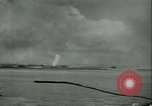
Mission of Joint Assault Signal Companies during amphibious assaults in World War II
Montage of military footage assembled to describe Joint Assault Signal Companies, in World War 2. Some inserts are inconsistent and anachronistic. Scenes of U.S. amphibious assault on a Japanese-held island in the Pacific theater. Camera focuses on small fast-moving assault boat carrying Army and Navy personnel of a Joint Assault Signal Company. A Japanese Aichi B7A Ryusei "Grace" aircraft flying low over the water in background. U.S. troops leaving an LST (Landing Ship Tank) and wading ashore. Some pushing a jeep through the surf. Members of a Joint Assault Signal Company running ashore with a spool of communications cable. Others carrying small arms climb out of an assault boat. Signal company soldiers laying communications cable as they move through jungle. Sailor aboard a U.S. warship ostensibly communicating with the signal company via light blinker. Naval gunfire bombarding enemy positions. Narrator's mention of air support is followed by anachronistic insert of U.S. Army B-10 bombers in formation flight; of bombardier in nose; and views of bombs falling. Next, a formation of B-25 Mitchell bombers is seen in flight and bombs falling. Back in the jungle, signal company men string wire on palm tree. Field artillery firing. Soldiers hunkered down in a shell hole. Signal company soldier using SCR-300-A Radio set.
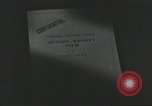
Battle off Empress Augusta Bay, during World War 2.
Night engagement off Empress Augusta Bay, during World War 2. Documents describing U.S. forces engaged in the battle. View of the Augusta Bay at dawn. Animation on screen shows the Guadalcanal naval battles and the attacks on Solomon Islands and Bougainville Island. A diagram depicts the movement of U.S. Navy Task Force 39 from Empress Augusta Bay to Shortland Island and diverting towards Treasury Island. Fleet of ships en route. United States B-24 Bomber in flight. Diagram shows the route of Japanese Forces and the United States Task Force 39. Fleet of Japanese ships on the way.
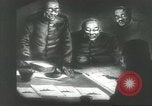
The Destroyer positions and torpedo attack at the Empress Augusta Bay.
Painting depicts Japanese planning an attack. Map shows the Empress Augusta Bay. The range of torpedo action distance between the Japanese cruisers and the United States Task Force 39 cruisers. Diagram depicts the position of destroyers and the torpedo attack. (World War II period).
Rear Admiral A S Merrill states his observations on the Commander Task Force 39 at battle of Empress Augusta Bay
Rear Admiral A S Merrill states his observations on the Commander Task Force 39 during the Battle of Empress Augusta Bay. United States B-24 Bomber in flight. The Task Force should develop a tactical doctrine to attack the Japanese enemy. Radar shows the Northern Southern and center Japanese enemy groups in range. Division 45 pass an enemy target thinking it to be friendly. Cartoon animation of a sailor with NBC emblem on sleeve. (World War II period).
U.S. Marines of 7th Regiment, 1st Marine Division, advance towards radio tower at Peleliu Island, Palau.
View of Japanese airplane motor at Peleliu Island, Palau. Dead Japanese soldiers on ground. Three Marines of 1st Marine Division walk down road with walkie-talkie. Soldier stands next to tank, speaks over phone. Troops advance towards dense jungle area. Tank advances towards radio tower away from the jungle. (World War II period).
CRITICALPAST.COM: About Us | Contact Us | FAQs - How to Order | License Agreement | My Account | My Lightboxes | Shopping Cart | Advanced Search | Featured Collections | Website Terms & Conditions | Privacy Policy ©2026 CriticalPast LLC.
License Agreement |
Terms & Conditions |
Privacy Policy
©2026 CriticalPast LLC.