


 Francais
 Deutsch
 Italiano
Refine Your Search
Japanese-martial-arts stock footage and images
- Showing 3211 to 3216 of 4328 results more
more Hide
Hide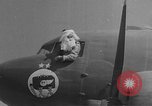
An American soldier dressed as Santa Claus distributes gifts to American airmen in China.
Allied preparations to attack Japanese positions in China. A man dressed as Santa Claus in the cockpit of an aircraft. He distributes gifts to American airmen. A United States Army Air Forces plane flies low over an area and drops bombs over a Japanese airfield. Bombs impact and explosion occurs. (World War II period).
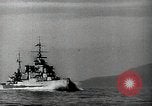
Events in career of Chester Nimitz. The battle for Okinawa.
The U.S. assault on Okinawa during World War II. U.S. battleships bombard Okinawa. U.S. amphibious assault forces in landing craft and fighting their way on shore under heavy fire from Japanese defenders. U.S troops employ tanks, flame throwers, machine guns, recoilless weapons, and small arms. Funeral services aboard a U.S. naval ship for fallen American servicemen. U.S. naval ships defending against Japanese Kamikaze attacks. Admiral Nimitz visiting troops on Okinawa, following the battle.
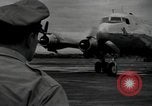
Events in career of Chester W Nimitz. The end of World War II and postwar years.
Fleet Admiral Chester W. Nimitz is met by General of the Army, Douglas MacArthur, as he arrives by airplane in Manila, Philippines. Japanese diplomats and military officers board the U.S. Battleship, Missouri, to sign surrender documents. Admiral Nimitz is one of the signatories. Nimitz is given a hero's welcome, in Washington, DC, replete with a military parade. He addresses a joint session of the U.S. Congress. Admiral Richard Byrd briefs Admiral Nimitz (now Chief of Naval Operations) about the 1947 expedition to Antarctica. Admiral Nimitz receiving an honorary degree from Columbia University, in New York. (Others present during this event include General Dwight Eisenhower and General George Marshall.) Nimitz, appointed as UN Plebiscite Administrator for Kashmir. He is visited by members of the Japanese Diet and signs autographs for them. Nimitz standing with President Truman, who appoints him to a special commission on internal security. Retired Admiral Nimitz at home in his garden at Berkeley Hills, California. Weather vane at his house contains 5 stars and replica of a submarine.
Philippines President Jose Laurel and members of his cabinet celebrates 1st Anniversary of Philippines Republic.
From a Japanese propaganda newsreel, in English, released during World War 2: Philippines President Jose Laurel and members of his cabinet kneel at prayer in a church, to celebrate 1st Anniversary of the Second Philippine Republic (while the Philippines was under Japanese occupation during World War 2). Philippine soldiers march on street. President Laurel gives a brief speech. Officials and civilians listen to his speech. People on street with banner reading 'Independence Anniversary'. Leaflets given to civilians by Filipino stage and movie stars. Performers read poetry and sing, including Norma Blancaflor (birth name Lydia Jurado Velasco) and Corazon Noble (Ms. Patrocinio Abad). The Philippines flag. (World War II period).
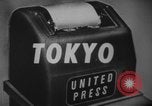
Turmoil on May 1, 1952, in Tokyo, Japan created by factions objecting to the April 28, 1952 Treaty of San Francisco
Film starts showing United Press wire service receiver with report in it. "Tokyo" is superimposed on the image. A huge gathering of Japanese people is seen, most holding umbrellas on a rainy day. Camera view from behind some of the crowd, with the National Diet (Legislative) building in the background. Groups of men rush through the crowd creating disturbance. They protest the Treaty of San Francisco on April 28, 1952, which ended U.S. occupation, but levied heavy penalties on Japan including confiscation of all assets owned by the Japanese government, firms, organization and private citizens, in all colonized or occupied countries. Closeups of some surrounding a uniformed policemen and roughing him up. Views inside the House of representatives chamber, where members are in a state of turmoil. Member are dragging one legislator. Closeup of him sitting on the floor and of another legislator waving a fan to cool off. A cadre of uniformed officers enters the assembly room and forcibly removes several struggling legislators. Following that, a group of legislators forces another to the Chairman's position in the chamber. (Note: Political conflicts, between supporters of politician Hatoyama Ichiro and those of Prime Minister Shigeru Yoshida resulted in the Prime Minister declaring an “Out of the blue” dissolution of the House of Representatives in August, 1952.)
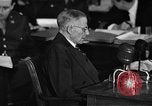
U.S. Army Major General Short defends himself in testimony about the Pearl Harbor attack,before a Joint Congressional Committee
Retired United States Army Major General Walter Campbell Short testifies before a Joint Congressional Committee investigating facts leading up to the Japanese attack on Pearl Harbor,December 7, 1941, and defends himself. Among the matters he mentions are the closely guarded secrets surrounding U.S. intelligence information concerning Japanese military and diplomatic communications (so-called "Magic"). At the end of his remarks, he gives thanks to the Committee for bringing out facts. Other officials seated around him listen to him. Some of those present applaud General Short, at the conclusion of his testimony. The officials stand after his testimony. (World War II period).
CRITICALPAST.COM: About Us | Contact Us | FAQs - How to Order | License Agreement | My Account | My Lightboxes | Shopping Cart | Advanced Search | Featured Collections | Website Terms & Conditions | Privacy Policy ©2026 CriticalPast LLC.
License Agreement |
Terms & Conditions |
Privacy Policy
©2026 CriticalPast LLC.