


 Francais
 Deutsch
 Italiano
Refine Your Search
Japanese-martial-arts stock footage and images
- Showing 3205 to 3210 of 4328 results more
more Hide
Hide
A film titled 'The Warning' showing scenes of London as citizens prepare for air raids (WW2)
A film titled 'The Warning' from World War II. Narration in Japanese. Street scenes in London. Factory whistle blows announcing end of work day. People walking on the streets. Houses and city streets in view. Double decker buses and cars seen. Children playing beside a river (presumably the Thames). Boats and swan seen in the river. Newspaper headlines seen, including "War chiefs discuss mobilisation"; "Stocks Slump"; "All Navy Reserve Called Up" and "The Crisis: Latest" seen on The Evening Standard. People playing tennis, cricket and golf. Buildings seen. People sitting in a pub (bar). Antenna of transmitter on radio station. An air raid information message being transmitted from the British government on radio stations during the time of the German Blitz. British people at home and work seated and listening to their radios as the broadcast message is read. British military forces on shore of the English Channel readying anti-aircraft batteries. Japanese narration overlays clip.
Confederate Air Force of World War 2 aircraft at Airsho '76 in Harlingen Texas, including Pearl Harbor reenactment scenes
Confederate Air Force showing historical aircraft at air show in Harlingen Texas. Reenactments of Pearl Harbor attack during World War 2. Japanese planes (torpedo bomber) Kate's replica and (fighter plane) Zero's replica remade from U.S. aircraft are used in the show. Zero and Kate Japanese planes in flight. Explosions seen. Smoke rises in the sky.

International doll show for the benefit of Italian Red Cross in Italy
International doll show for the benefit of Italian Red Cross in Italy. Dolls of 36 nations put on display. People gather to watch the exhibition. A man and a woman viewing Japanese dolls. Dolls such as Ballerina dolls, bisque Japanese dolls and baby dolls are seen. Mrs. Therese Dupuis, the wife of the Canadian Ambassador helped in organizing the show. Mrs. Dupuis turns a baby doll’s head to change its facial expression. A pair of Canadian dolls depicting a Canadian Mountie and a Indigenous Canadian girl. A doll with a dresser. Children watch the dolls in the show. A group of Dutch girl dolls. A pair of Dutch dolls and a miniature windmill.
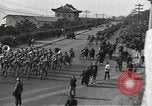
U.S. 6th Marine Division marching into Tsingtao, China, after Japan's surrender ending World War II
Following the Japanese surrender, ending World War 2, on September 2, 1945, U.S. Marines were sent into China to help the Nationalist Chinese Government with the surrender of Japanese forces occupying parts of China. This film shows Marines of the 6th Marine Division marching into Tsingtao (aka Qingdao) China on that mission. Headed by a brass band, they march along an avenue in the city. A number of Chinese civilians walk alongside them. A man riding an empty rickshaw, is seen on the sidewalk. A U.S. military policemen stands guard along the line of march. Some Chinese enter the roadway to follow the band, walking, riding bicycles, and several on a horse-drawn wagon. They have to move aside to avoid interfering with the first contingent of marching Marines following the band. Next a squad of Marines is seen marching onto a dirt field. Many Marines are assembled in another field across the road in the background, where a U.S. M4 Sherman tank and other armor are also seen. The squad is followed by a larger group of Marines. Shift in scene shows Marines marching past a building displaying the Nationalist Chinese (Republic of China) flag.
Operation of United States Coast Guard in Okinawa and Iwo Jima, Pacific Theater during World War II
Overseas activities of United States Coast Guard in World War 2. February 19, 1945, U.S. Marines invade Iwo Jima in Pacific Theater. Naval guns and aircraft bombard Iwo Jima. Mountain in the background. Aircraft in flight. Marines and Coast Guardsmen aboard landing craft. Marines landing on Iwo Jima under heavy Japanese fire. Destroyed landing ships litter water's edge. Marines hunkered down and treating wounded, under fire. LSTs and other ships at established beachhead. Vehicles drive onto beach. April 1, 1945, Marines attack Okinawa. Navy warships bombard Okinawa with heavy guns and continuous rocket fire. Beachhead is established against light resistance. Japanese kamikaze aircraft attack American invasion ships. Several ships are hit and sunk. Surviving sailors are helped aboard rescue boats. Antiaircraft fire from American ships fills sky with smoke and flak. A kamikaze aircraft crashes in the sea. Sky filled with American bombers. Aerial view of Atomic bomb explosion over Nagasaki Japan on August 9, 1945. Raising American Flag on Japan homeland.
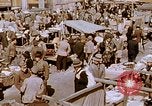
People gathered at an open air markets they purchase fish and other food items in Hiroshima, Japan.
Way of life in Hiroshima, Japan after the explosion of Atomic bomb during World War II. A large number of people gathered at an open air market in Hiroshima. People gathered around stalls selling shoes, knick knacks and Kimonos. A Japanese woman cooks fish. A man sells Kimono. He wears a Kimono to amuse people. Woman weighs and sells fish. A Japanese woman makes a purchase. A woman sells meat and she cuts meat into small pieces.
CRITICALPAST.COM: About Us | Contact Us | FAQs - How to Order | License Agreement | My Account | My Lightboxes | Shopping Cart | Advanced Search | Featured Collections | Website Terms & Conditions | Privacy Policy ©2026 CriticalPast LLC.
License Agreement |
Terms & Conditions |
Privacy Policy
©2026 CriticalPast LLC.