


 Francais
 Deutsch
 Italiano

Refine Your Search
Japanese-martial-arts stock footage and images
- Showing 3391 to 3396 of 4337 results more
 Hide
Color Sound

The Marine Corps capture an airstrip and inspect dummy tanks and planes in Okinawa, Japan.
The operations of the U.S. Marine Corps in Okinawa during World War II. Marines advance along the way. They fire guns. Smoke arises due to firing. Corpses being inspected. A wounded Japanese soldier crawls from his nest. Marines and Japanese troops skirmish in a wooded area. An airstrip is captured and graded. Dummy tanks and planes and a "Baka" suicide plane being inspected (A Yokosuka MXY-7 Ohka). Soldiers stand near an aircraft. Planes take off from the runway.
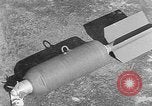
Optimum mix of fragmentation and incendiary bombs is determined during tests at Eglin Field, Florida, during World War II
Conclusions of tests conducted by U.S. Army Air Forces, at Eglin Field, Florida, seeking best way to attack Japanese homeland during World War 2. Actor Lee J. Cobb, portraying an Air Force Captain, smoking a pipe in his "office." Views of M-41 fragmentation bomb and a bundle of M-69 incendiary bombs. The Captain holds a model of a B-17 bomber and uses it to discuss bombing techniques. B-17 in flight. Views of effects of fragmentation bomb, showing numerous small holes produced by it. Aerial view of the test area houses. Mixture of M-69 incendiary bombs and M-41 frag bombs being dropped by the plane on the test area. Various views of resulting damage and effects. Test report is shown, concluding that demolition bombs are not effective against congested wooden structures; that M-41 frag bombs deter early firefighting efforts; and that a mix of 80 percent M-69 incendiaries and 20 percent M-41 frag bombs is optimum. Views of Japanese cities burning, from such bombing, during the war.
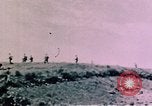
U.S. Marines fire cane fields using flame thrower tanks and grenades during the Battle of Okinawa, Japan.
Activities of the U.S. 1st and the 6th Marine Divisions on the island of Okinawa, Japan during World War II. United States Marines advance on the battlefield. Tank flame throwers and prosperous grenades being used to fire cane fields driving Japanese from cover. Japanese prisoners of war stripped to their loincloths, being marched to the stockade. United States flag flies from a pole after capturing the island of Okinawa.

Units of task force including DD (destroyers), BB (battleships) and CL (light cruisers) fire antiaircraft guns.
Japanese air attack on task force ships underway in Pacific Ocean. Units of task force including destroyer, battleship and light cruiser fire antiaircraft guns. Japanese plane dives and passes midst heavy flak fire. (World War II period).

Destroyer and battleship fire antiaircraft guns underway at sea, Pacific Ocean.
Destroyer and battleship fire antiaircraft guns underway at sea. Japanese plane explodes and tailspins into water midst tracers. Man floats through air in parachute and lands in water. Antiaircraft guns fire. Japanese plane crashes in water. (World War II period).
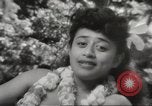
Everyday life and diversity of Polynesian people in Hawaii before the attack on Pearl Harbor during World War II.
Various Polynesian people and everyday life in Hawaiian Islands before American involvement in World War 2 and the attack on Pearl Harbor. Women from dominant ethnic backgrounds in Hawaii introduce themselves, including women from Korea, Portugal / Portuguese, China, Phillipines / Filipino, Native Hawaiian, Caucasian / Anglo, Japanese. Narrator describes it as a melting pot. Polynesian children on a long staircase in a village. Group of Hawaiian school children walking to school with some girls wearing Japanese style clog sandals. Diverse crowd of citizens walking on sidewalks of a downtown area of Honolulu near stores and shops. Hawaiian police officer directs traffic. 1930's cars seen on streets. Children in scout uniforms including Girl Scout and Boy Scouts salute. Groups of Hawaiian children playing and relaxing, and seen at desks in school classroom. Graduation ceremony at a high school in Hawaii as graduate young men and women walk by on a stage. Colorful traditions and customs of various cultures in Hawaii are shown. People wearing leis. Women doing various dances including hula and other dancing styles. The Aloha Tower in Honolulu Harbor and scenes of various women from different backgrounds each saying Aloha.
CRITICALPAST.COM: About Us | Contact Us | FAQs - How to Order | License Agreement | My Account | My Lightboxes | Shopping Cart | Advanced Search | Featured Collections | Website Terms & Conditions | Privacy Policy ©2026 CriticalPast LLC.
License Agreement |
Terms & Conditions |
Privacy Policy
©2026 CriticalPast LLC.