


 Francais
 Deutsch
 Italiano
Refine Your Search
Japanese-martial-arts stock footage and images
- Showing 3463 to 3468 of 4328 results more
more Hide
Hide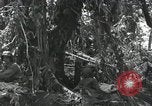
Wounded soldiers at Bougainville carried on litters to C-47 aircraft via an ambulance during WWII.
U.S. soldiers crawling through underbrush during Bougainville campaign in World War 2 against the Japanese. American soldiers carry injured soldiers. Wounded US soldier or Marine lying on litter, using helmet for pillow. Soldiers squatting in forest. Loading wounded on litters into ambulance backed up to a plane. Soldier walks towards jeep with "Operations Officer - Acorn l3". Ambulance on field. Ambulance backed up to open door of C-47 loading wounded on plane. Two soldiers rest in the shade of a C-47 wing. Wounded soldiers lie inside medical evacuation aircraft.
USIA film describing the ways it conducts its world-wide operations
Segment of U.S. Information Agency film describing its world-wide operations. Map shows 217 overseas posts in 17 countries, of the USIA (also known abroad, as the U.S. Information Service). Animated map zooms in on one post, in Rio de Janeiro, Brazil. Aerial view of Sugar Loaf Mountain overlooking the harbor and city. Street scene in Rio. USIA Public Affairs Officer, William A. Wieland, is seen walking along a sidewalk in the city. Next he is seen in the office of Ambassador James S. Kemper, briefing him about USIA activities. View of the Brazilian Foreign Office building. Mr. Wieland meets with the Chief of the Cultural Division there. Book stacks in the USIA Thomas Jefferson Library in Rio de Janeiro. Mr. Wieland conferring with a librarian. He is also seen at the USIA broadcast facility in the U.S. Embassy. Film shifts to street scene in Cebu, the Philippines. A building displaying American and Philippine flags, is labeled: " United States Information Service." Inside, and American and a Filipino worker give bundles of literature to local workers for distribution. One, a bus driver, carries his bundle onto his open-sided bus, displaying the name, "Cebu, Autobus." He waves as he drives away. The USIA Public Affairs Officer is seen visiting the Mayor of Cebu City, Vincente S. del Rosario; giving a news release to the editor of a newspaper; broadcasting on local radio;and socializing with local editors. USIA drive a mobile movie van into a remote village where many children are playing. They set up a screen and projector. Almost everyone in town attends the showing. Scene shifts to USIA headquarters building at 1778 Pennsylvanis Avenue,in Washington, DC. Director Theodore Streibert holds a staff meeting. View of President Eisenhower addressing U.S. public media leaders about confronting the Soviet Union with truthful information about the U.S. and the West, on April 16, 1953,in Washington, DC. A USIA technician transmitting text of the speech to its public affairs officers around the world. Views of newspapers carrying the story in Paraquay, Ireland,Algeria, and Burma. The President's speech was printed in a pamphlet entitled "The Peace We Seek," ahd sent abroad where it was translated into Arabic,Japanese, Persian, and 20 other languages. Four million copies were distributed. Posters about the speech were also distributed.
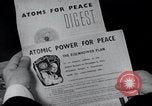
Voice of America broadcasts President's speech and USIS "Atoms for Peace" exhibits are presented worldwide
President Eisenhower of the United States addresses United Nations on December 8, 1953 about atomic bomb and atomic weapon dilemma in the nuclear age (part of Atoms for Peace initiative). Operators in radio transmission control rooms note down readings. View of time clocks of various places in the world including Honolulu, New York, London, Moscow, Calcutta, Bangkok and Tokyo displayed. The Voice of America broadcasts program in different languages by announcers. Scene of a family sitting in a living room as they listen to the president's speech on a console radio. People work at typing, printing, and translating the speech. USIA motion pictures service prepare newsreel of president's speech. A man views air mail of USIA films. Exterior views of several different United States embassy buildings worldwide. A guard standing outside the building. A Public Affairs Officer at the U.S. embassy in Japan, in Tokyo, meets with U.S. Ambassador to Japan Robert Murphy. USIA members seated around table for meeting, and, in Washington DC, creating publications about the Atoms for Peace program. People seated in a USIA library in Brazil read books and various USIA materials. Architects design 30 foot high Atoms for Peace exhibits. An exhibit being setup in a foreign country (possibly in North Africa). Exterior and interior views of the West Berlin, Germany Atoms for Peace exhibit. Prime Minister Jawahar Lal Nehru in India is seen arriving in a jeep to view the Atoms for Peace exhibit in India. Prime Minister Nehru inside the exhibit hall watching a presentation. In Japan, a woman operates remote-controlled robotic hands to hold radioactive materials, at a demonstration for Japanese citizens. In a city in Italy, a view of a mobile van unit carrying an Atoms for Peace exhibit. Scenes from a film "A is for Atom" that was translated into 30 languages and shown all over the world. Wide view of the Kremlin in Moscow, Russia, Soviet Union. A Russian radio commentator speaking at a microphone. Propaganda dramatization showing the Russian announcer attacking American plans for Atoms for Peace.

Broadcasting the news about launch of Friendship 7 in cape Canaveral, Florida.
Launch of Friendship 7 piloted by astronaut John Glenn in Cape Canaveral, Florida. Emblem of NASA. Message in light circling the Times Building in Manhattan, New York City, at night, reads: 'Glenn ready for orbital flight.' A title slate reads: 'Friendship 7'. View of Times Square New York City, at night. Views from various parts of the world, with voices in background, broadcasting about the event in their respective local languages. Parliament buildings in London. Wide view of the Eiffel Tower in Paris at dusk or dawn. A woman in a vegetable market. People buying and selling goods in an Arab market including some men wearing Keffiyeh. A neighborhood in China. A Japanese city at night with neon signs. A Mexican man carrying a guitar. View of various images broadcast on television (the images show the television screens) from American cities, including titles "Man into space -- Los Angeles;" "Sioux City --Mercury shoot;" "New Orleans-- standing by orbital flight." and "Please stand by man in orbit --Boston."
Allies demand the unconditional surrender of Japan in World War II. Entry of Soviets and use of atomic bomb ends the war.
Representatives of three nations, seated around table at Potsdam Conference held at Cecilienhof in Potsdam, Germany. British prime minister, Clement Attlee; President of United States, Harry Truman; and representative of Soviet Union, Joseph Stalin at the Potsdam Conference, July 1945. They deliver an ultimatum of unconditional surrender to Japan. Swarms of B-29 bombers and Aircraft Carrier Task Forces destroy Japanese homeland. Planes on carrier decks.Navy Grumman carrier-based TBF aircraft dropping bombs.. Destruction of ships at sea. Mushroom cloud due to atomic bombing. Chart depicts the power of one atomic bomb. Britain's 'grand slam' bomb, most destructive conventional bomb ever produced. Doctor Ernest Orlando Lawrence, inventor of the cyclotron (atom smashing machine). A man works at the Cyclotron at the University of California, Berkeley. General Leslie Groves, head of the project speaks. He is seated with Dr Vannevar Bush, government director of science and research, and Dr Richard Tolman, technical expert. Quantities of uranium shipped from Alberta, Canada are used in bombs. The atomic bomb process (Manhattan Project) is developed in widely separated areas; scenes from Hanford Project plant in Richmond, Washington. Project personnel exit cars and enter into the search area before starting their work day. Lieutenant colonel Franklin T Matthias with the army corps of engineers, appointed to the Hanford Project. Sign of 'Oak Ridge' in Tennessee. Largest of the three atomic bomb plants located near the Tennessee Valley Authority (TVA) dam. Employed personnel in atomic bomb plants are seen going to work. Man and woman employees at the plan read and smile at a Knoxville Journal newspaper in August 1945 with news headline "Power of Oak Ridge Atomic Bomb hits Japs" after the atomic bomb was dropped in Hiroshima. View of dense prefabricated home communities to house large number of Oak Ridge plant workers. View of families setting up their houses in trailer towns after the prefabricated homes were full. People come out from the Henebry's Jewelers and supermarket, among stores setup to meet the needs of the quickly built city. Scenes changes to show view of Soviet leader Joseph Stalin at conference. Russian artillery and troops in a parade at Red Square in Moscow, Russia (these parade scenes are from the May 1, 1945 May Day parade, just days before Germany's surrender). President Harry Truman reports on the latest developments regarding the war with Japan. He states that the United States is prepared to destroy every productive enterprise in Japan and the U.S. shall completely destroy its power to make war. He warns of an attack by the U.S. due to the rejection of the July 26th ultimatum at Potsdam. He warns that Japan "should expect a rain of ruin from the air; the like of which has never been seen on this earth." Truman notes that it will be followed by an unprecedented sea and land invasion of Japan.
Crab canning, crab cargo shipping and inspection of crab in Japan.
Lacquering and packing: Japanese workers work at machines for lacquering and packing of tins in a factory. Shipping is neither safe and nor easy in rough sea. Cargo boats in operation to bring back the canned goods. Cargo steamer underway at sea. Technical experts and exporters meet to study their business to ensure for growth and prestige of trade abroad. Technical experts inspect the crab for export.