


 Francais
 Deutsch
 Italiano
Refine Your Search
Japanese-martial-arts stock footage and images
- Showing 3667 to 3672 of 4328 results more
more Hide
Hide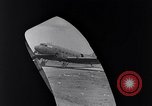
Paratroopers of the U.S. Army 11th Airborne Division make a combat drop on the Tagaytay Ridge, Luzon, Philippines, in World War II
U.S. paratroopers of the 511th Parachute Infantry Regiment (511th PIR), 11th Airborne Division, conduct a combat parachute drop to reinforce American troops engaging Japanese forces at Tagayatay Ridge, on Luzon, the Philippines, in World War 2. View from inside a C-47 transport aircraft, looking through its open rear door, at another C-47 taxiing on an airfield ramp. It displays "X44" stenciled below its cockpit. Brief aerial view of the airfield from an airplane overhead. Several C-47s seen flying in formation. Closeups of some C-47s. Next, paratroopers of the U.S. 11th Airborne Division are seen jumping from C-47s. Their chutes open rapidly after leaving the aircraft. Some of the chutes of troopers, jumping from aircraft forward of the camera plane, pass very near as they descend. Aerial view looking upward at parachutes descending with clouds behind them. Glimpse from cockpit of camera plane shows numerous parachutes deployed from C-47s some distance ahead. Closer view from below and left of three C-47s shows paratroopers exiting open aircraft doors. More parachutes seen from above, as they descend. View from C-47 cockpit of five others in formation, at the same altitude,ahead. Below them, dozens of parachutes are seen descending toward the ground. Inside a C-47, several troopers stand at the open rear door and one helps another jump from the plane. Several paratroopers passing the right wing of the camera plane as they descend.
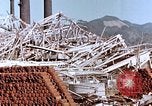
Collapsed steel frame building from atomic blast in Nagasaki, Japan, following World War 2
After effects of atomic bombing in Nagasaki, Japan during World War II. A wrecked steel frame structure and torpedo compression chambers are seen. The interior of the building shows floor covered with debris,broken corrugated asbestos roofing,pieces of chairs,blueprints and an upturned drafting table. A Japanese farmer carries 'Honey Buckets' and tightens the caps to prevent leakage. A metal steel room is seen. Floor covered with debris.
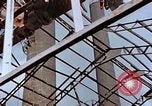
Damage is shown from the atomic bomb at Nagasaki, Japan during World War 2
After effects of atomic bombing in Nagasaki, Japan during World War II. Wooden truss structure that served as a fire station for the building. Japanese men and women at the wrecked building site.
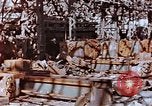
After effects of atomic bombing in Nagasaki, Japan during World War 2
After effects of atomic bombing in Nagasaki, Japan during World War II. Steel beam bent to its maximum extent and completely destroyed. Debris is seen in the foreground. A bent steel column as a result of the blast. Demolished concrete columns are seen. Japanese clear the debris.
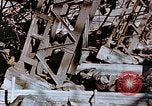
Building destroyed by atomic bombing in Nagasaki, Japan during World War 2
After effects of atomic bombings in Nagasaki, Japan during World War II. Concrete base of a column and point at which failure occurred. Destroyed roof above a bank of metal lathes. Japanese move the wheel of a machine. Native carpenters work on pieces of wood.
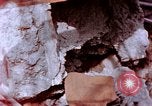
Site of destroyed building in Nagasaki, Japan, caused by atomic bomb during World War 2
After effects of atomic bombing in Nagasaki, Japan during World War II. Base of a displaced concrete column. A steel column uprooted from its concrete base. An electric pole with a number of broken wires attached to it. Japanese workers remove debris from the area.
CRITICALPAST.COM: About Us | Contact Us | FAQs - How to Order | License Agreement | My Account | My Lightboxes | Shopping Cart | Advanced Search | Featured Collections | Website Terms & Conditions | Privacy Policy ©2026 CriticalPast LLC.
License Agreement |
Terms & Conditions |
Privacy Policy
©2026 CriticalPast LLC.