


 Francais
 Deutsch
 Italiano
Refine Your Search
Japanese-martial-arts stock footage and images
- Showing 3919 to 3924 of 4336 results more
more Hide
Hide
Scenes of U.S. Army Air forces operations on Adak Island during the Aleutian Islands Campaign of World War II
As film begins, organ music is heard. Camera pans across tops of tents showing sky above. Scene shifts to a Chaplain conducting Sunday services in the open. A soldier plays a field organ as soldiers and airmen participate in the service. Closeup of the Chaplain kneeling before a makeshift altar where objects are placed to facilitate communion in a mass or service. Complete change of scene shows airmen arranging bombs for loading aboard an open truck that then backs up to an airplane, into which they are loaded. Narrator notes that these are all purpose bombs weighing 250, 500, and 1000 lbs, respectively. Closeup of a 1000 lb bomb in foreground marked "GP 1000 lb AN-M44." Airmen arnorers install fins and fuses before loading the bombs aboard the aircraft. An airman loads belts of machine gun ammunition at a gun turret of the airplane. others load guns elsewhere on the aircraft. Closeup of pilots being given final briefing about the mission, before departure. Narrator notes that the mission will involve two flights of B-24s and one of B-17s. Planned altitudes and routes of the bombers are drawn on a map in colors. They are to attack a Japanese installation on Kiska Island. Fighter support is described. A Flight crew assembles near their B-24 Liberator bomber. Closeups of individual crew members waiting on the airfield ramp. Scene shifts to fighter pilots who will be accompanying the bombers. They converse in front of a row of fighter aircraft. They are wearing flotation gear over their flight suits. The area is paved with Marsden matting (pierced steel planking). Closeups of men in the group, including: Lieutenant George I. Rudell, Lieutenant Holy P. Mail, Lieutenant Lial A. Bean, Major Willson Aston, Lieutenant Henry J. Strencops and Colonel Jackson.
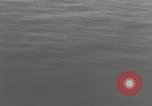
A formation of Martin PBM Mariner aircraft drops depth bombs during an aerial patrol in the Pacific Theater.
Aerial anti-submarine patrolling in the Pacific Theater during World War II. A fleet of United States Navy Martin PBM Mariner aircraft seen flying over water. Aerial views as seen from the PBM Mariner. The aircraft drop depth bombs into the sea to combat Japanese submarines. A convoy of ships underway at sea.
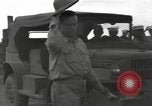
Bob Hope and his USO Troupe visit a U.S. Navy base on Mios Woendi island, Schouten Islands, Papua New Guinea, during World War II.
Bob Hope and members of his USO troupe ride on a PT boat during visit to entertain U.S. Navy personnel during World War 2. In opening scene, Bob Hope doffs his pith helmet as he strolls past the camera to climb aboard a PT boat (PT-331) of U.S. Navy Motor Torpedo Boat Squadron 21, where several naval officers greet him. Members of Hope's USO troupe, Patty Thomas, and Francis Langford, step from jeeps to board the PT boat. Next, the two are seen in the cockpit of the boat next to its captain, Lieutenant Kermit W. Montz, USNR, as the boat speeds along in the water. Among sailors occasionally glimpsed behind them is Radioman 1st Class bill Thielen. In change of scene, Bob Hope climbs out a hatch, holding onto his pith helmet to keep it from blowing off. The boat's number, 331 is clearly displayed on superstructure behind him. Various Navy sailors on deck. (Note: Squadron 21 received a Presidential Unit Citation for outstanding performance during the Huon Peninsula Campaign against Japanese forces from October 1943 to March 1944.)
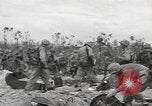
U.S. Marines rest on a beach in Palau during World War II.
Allied invasion of Palau Islands during World War II. Marines on a beach. A Marine strings a wire in the foreground at the beach. The Marines march towards the front. They rest on a beach. A 40 mm anti aircraft gun placed behind a sandbag mound. A Landing Vehicle Tracked in shallow waters after being knocked out in Japanese firing.
Role of Air Transport Command and increase in naval power of the U.S. during World War II.
Animation depicts the role of Air Transport Command during World War II. A man brushes his teeth. A globe depicts Air Transport Command aircraft flying around the world. Animation depicts Chinese war effort against the Japanese and the amount earned by a Chinese soldier. U.S. Naval Fleet at the beginning of the war. U.S. Naval Fleet after a 14 fold increase in number of ships during the war.
U.S. Marines raise American flag on top of Mount Suribachi in Iwo Jima, Japan during World War II.
Allied invasion of Iwo Jima, Japan during World War II. A Japanese howitzer canon fires at a beach resulting in explosions. Landing Ship Tanks at the beach. U.S. Marines raise American flag on Mount Suribachi. (This is the event on which the Marine Corps Memorial, or Iwo Jima Memorial sculpture is based). A group of combat Marines pose and cheer after the flag raising.
CRITICALPAST.COM: About Us | Contact Us | FAQs - How to Order | License Agreement | My Account | My Lightboxes | Shopping Cart | Advanced Search | Featured Collections | Website Terms & Conditions | Privacy Policy ©2026 CriticalPast LLC.
License Agreement |
Terms & Conditions |
Privacy Policy
©2026 CriticalPast LLC.