


 Francais
 Deutsch
 Italiano
Refine Your Search
Japanese-martial-arts stock footage and images
- Showing 3925 to 3930 of 4336 results more
more Hide
Hide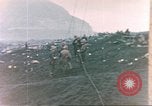
Signal Corps men string communication lines in Iwo Jima, Japan during World War II.
Allied invasion of Iwo Jima, Japan during World War II. Signal Corps men string communication lines on the island. United States Marine infantry men with carbines and a dog as they walk across a beach. Entrance to mountainous caves dug by the Japanese. The Marines on a hill.
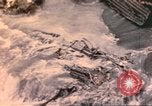
Dead Marines on a field in Iwo Jima, Japan during World War II.
Allied invasion of Iwo Jima, Japan during World War II. U.S. aircraft on a field. An aircraft in flight. It emits smoke from tail section. A sign reads 'Wash mess gear here'. A United States Marine with chemical sprayer on his back. He sprays bodies of dead Japanese soldiers.
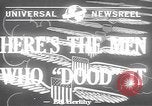
General Arnold decorates 25 fliers at Bolling Field in Washington DC, during World War Il
U.S. Army Air Force fliers being decorated at Bolling Field in Washington DC, United States. Commanding General of the U.S. Army Air Forces, Lieutenant General Henry H (Hap) Arnold, decorates aircrew members who took part in the Doolittle Raid against the Japanese in World War 2. Lt. Gen. Arnold pins the Distinguished Flying Crosses on the airmen. A flier with his wife after receiving the medal.
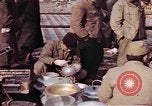
A customer looks over some aluminum kettles and pedestrians alongside a road in Tokyo, Japan.
A market place in Tokyo, Japan. A peddler sells his wares on a sidewalk along Jinga Way in Tokyo. A prospective customer looks over some aluminum kettles. People walk on the sidewalk. Assorted type of Japanese, male, female as well as children, pedestrians. In Shinjuku area, Beppu : small shops and pedestrians alongside a street. A small store sells wicker baskets.
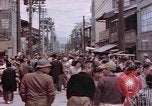
People shop in a narrow street and walk along a street in the outskirts of Kyoto, Japan.
Japanese people on a street in Kyoto, Japan. A narrow street. People shop near buildings. People walk along a street in the outskirts of Kyoto near a river. People ride on bicycles. A car driven on a road.
U.S. Army Training film emphasizing Army Air Forces safety rules of the air for pilots training in PT-17 "Kaydet" aircraft.
Opening scene shows a fuel gauge reading half empty in a U.S. Army Air Forces Stearman Boeing PT-17 “Kaydet” bi-plane trainer aircraft. Closeup of pilot with helmet and goggles in open cockpit of the airplane. Narrator says rules require pilot to return to base immediately. View of the aircraft descending toward the field. Animated diagram showing proper entry into left traffic for the active runway. View of PT-17 on final approach to the runway. Closeup of pilot in the cockpit. He makes a three-point landing on the first third of the runway and rolls without braking. Next, assisted by a wing walker, the pilot taxis to an open slot on a line of aircraft and stops on a parking line. The pilot steps from the cockpit, wearing a seat pack parachute, and begins walking to the field office, when he stops to converse with the narrator. He complains, somewhat about the restrictive rules for pilots in training and expresses desire to fight the Germans and Japanese in World War 2. Narrator defends the rules of safety, first, saying "You can't fight until you can fly." Scene shifts to four pilot trainees who "washed out" of the program for various infractions of the trainin safety rules. They are carrying their belongings in duffle bags and wait at a bus stop for transportation away from the base. Camera focuses on each of the men in turn, as narrator describes their failures to follow rules. Scene shifts to the airdrome where successful student pilots are seen walking toward the camera. Series of scenes showing student pilots performing various preparatory actions before flying their planes. One standing on a wing, checks the "Form One" that contains aircraft maintenance record. Another sitting in his cockpit notes that his gas, oil,cockpit switches, and flight controls all check OK. Another pilot is fastening leg straps of his seat pack parachute and comments about need to keep checking when taxiing down the line for takeoff. Closeups of pilots addressing the camera with admonitions about rules to follow. View of massed parked PT-17 training planes. Views of current war planes in flight, including Bell P-39 Aircobra, Lockheed P-38 Lightning, Republic P-47 Thunderbolt, and Martin B-26 Marauder bombers. Many good views of such airplanes in takeoffs, formations and aerobatic maneuvers. (World War II; WW II; World War 2; World War Two)
CRITICALPAST.COM: About Us | Contact Us | FAQs - How to Order | License Agreement | My Account | My Lightboxes | Shopping Cart | Advanced Search | Featured Collections | Website Terms & Conditions | Privacy Policy ©2026 CriticalPast LLC.
License Agreement |
Terms & Conditions |
Privacy Policy
©2026 CriticalPast LLC.