


 Francais
 Deutsch
 Italiano
Refine Your Search
Japanese-martial-arts stock footage and images
- Showing 4279 to 4284 of 4336 results more
more Hide
Hide
U.S. Army soldiers operating M4 Sherman tanks; tank guns being fired from U.S. tanks in World War 2.
Training film 'Combat firing by the individual tank' depicts operations and uses of tanks during World War II. Tanks being parked on a field. A U.S. Army tank commander aboard a tank. Guns being fired from the tank. Wrecked Nazi German armored vehicles on a battlefield. A wrecked Japanese machine gun nest in the Pacific theater. Wrecked Axis equipment and vehicles following an Allied attack. A U.S. Army M4 Sherman tank commander inside a tank watches through binoculars. Interior tank views of soldiers operating M4 Sherman tank controls and firing tank guns. Close-up views of tank guns including machine gun firing. Soldier loading HE projectile into 75mm gun and firing it. He then loads a 75mm armor piercing APC projectile and fires it. Lastly, he loads a smoke projectile shell and fires it. M3 Stuart light tank shown in the field, and close up of a canister used on its 37mm gun. The 37mm gun is fired.
Animation depicts the growth of Chinese economy after World War II.
Chinese economy during World War II. Animation depicts the growth of economy. A soldier standing with a rifle. The Chinese fought against the Japanese for six and a half years. Chinese soldiers earned a lot of currency after the period.
In the United States, U.S. Army General George Catlett Marshall speaks about the contribution of the WAAC in World War II.
A film titled: 'We're in the army now' on the Women Army Auxiliary Corps (WAAC) in the United States. U.S. soldiers fighting the Japanese in the Pacific. Smoke from bombardment and firing. The soldiers advancing on a battlefield. U.S. Army General George Catlett Marshall seated at a desk in his office. He speaks about the contribution of the WAAC in World War II. A woman of the WAAC standing nearby.

The recruitment of women as Marines in the United States, during World War II.
A film titled: 'Lady Marines' on the recruitment of women in the United States Marine Corps, during World War 2. Views of Marines engaged in combat. U.S. Naval guns firing. A Marine dive bomber in action. Splashes in water from explosions. Marines in an amphibious assault on the beach. Paramarines making a jump. Tanks moving on the field. U.S. Marines firing machine guns. Paramarines boarding an airplane. Views of U.S. Marines in non-combat assignments in Washington, DC. Exterior of the U.S. Capitol building. Trucks being refueled. Marine mechanics maintaining vehicles. Marines engaged in administrative and logistical wartime support activities. A Marine typing a document on a typewriter. Comments about the need to free trained Marines for combat. A scene of Japanese soldiers celebrating a victory. A poster with the photograph of a woman reads: 'Be a Marine'. On February 13, 1943 the Marine Corps Womens Reserve is formed. Women are recruited to relieve Marines for combat. Women Marines salute.
U.S. soldiers unloading equipment from a landing craft and working on a field in the Solomon Islands.
United States troops in the Solomon Islands during World War II. Tactical maneuver of bypassing some Japanese held islands and advancing to more strategic positions is explained. Trucks and jeeps parked on an island. Soldiers aboard vehicles board a landing craft. An officer instructing a group of soldiers. The soldiers aboard the landing craft underway at sea. A barrage balloon in flight overhead. The soldiers look for enemy airplanes. The landing craft underway at sea. The soldiers unloading equipment from the landing craft at an island. Soldiers working with picks and shovels on a field.
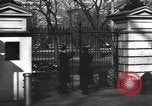
White House entrance during World War 2 and President Roosevelt addresses U.S. Army guards of Washington DC
US Army guard standing at the entrance of the White House building. They open a gate as a car arrives. (Narrator indicates it is an army pilot arriving in the car to receive a medal from the President after he hit a Japanese battleship during World War II.) The US Army guards for the Military District of Washington march in formation on the grounds of the White House. President Roosevelt addresses them. He speaks about their duties and service, and acknowledges that they, and he, might rather be closer to the front, but that their job protecting Washington is important. The guards marching after the address.
CRITICALPAST.COM: About Us | Contact Us | FAQs - How to Order | License Agreement | My Account | My Lightboxes | Shopping Cart | Advanced Search | Featured Collections | Website Terms & Conditions | Privacy Policy ©2026 CriticalPast LLC.
License Agreement |
Terms & Conditions |
Privacy Policy
©2026 CriticalPast LLC.