


 Francais
 Deutsch
 Italiano
Refine Your Search
Richmond-viginia stock footage and images
- Showing 73 to 78 of 101 results more
more Hide
Hide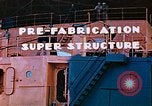
Prefabrication of Liberty ship superstructure at shipyards in California during World War II
View of steel plates laid out on concrete at shipyard in California during World War 2. The plates are stacked in labeled areas. A crane lifts a plate and is guided by worker. Steel plates and related parts stacked and being picked up by a Hyster Straddle Carrier and transported to the superstructure assembly area. (Note: May include scenes from Kaiser Shipyard in Richmond, California as well as Hunters Point Naval Shipyard in San Francisco.)
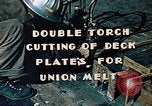
Deck Plates being trimmed with double acetylene torches during construction of Liberty ship in World War II
Workers at shipyard in California, during World War 2, use a set of double acetylene torches to trim steel deck plates for a Liberty ship. The device maintains parallel cuts in adjoining deck plates, preparing for union melt. (Note: May include scenes from Kaiser Shipyard in Richmond, California as well as Hunters Point Naval Shipyard in San Francisco.)
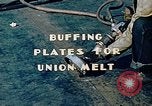
Preparing Liberty ship deck plates for union melt at shipyards in California during World War II
Preparing to join Liberty Ship deck plates by union melt at shipyard in California during World War II. Worker uses mechanical buffer to prepare edges of two plates prior to joining by union melt. Welder makes several tack welds. Another worker buffs the tacked spots. (Note: May include scenes from Kaiser Shipyard in Richmond, California as well as Hunters Point Naval Shipyard in San Francisco.)
Construction yard and launch of Victory ship and recruitment of young men to United States Maritime service training station.
Construction yard for a United States "Victory Ship" during World War 2. View of hammer head cranes. Workers in the ship yard. Workers weld parts of victory ship. Cranes and machines. Cranes pull up a Part of ship. Different parts of the ship like giant fan of ship, nuts and bolts, copper wires, chains, ventilators, winches, large and small valves, ten ton anchor. A worker of ship talks about different ship parts built in different parts of the country and mining of minerals used to build a ship, in progress in various parts of the country. He tells about parts of the ship like engine and boiler brought to the shipyard. Launch of the ship SS Fred Morris from the shipyard. It slides down the ways into into the water. Recruitment of James Hacket of Colorado and other boys to States Maritime office of Commander Richmond, the superintendent. Emblem of United States Maritime. James Hacket goes to a queue outside medical examination room, talks to new recruits standing there and joins the queue. United States Maritime Service training station of the U.S. Coast Guard, where merchant marine seamen are trained, in Port Hueneme, California. United State Maritime training Station Band. Sailors march and officers salute to the flag at the training station.
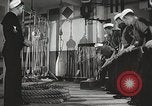
Training of young men at United States Maritime service school and at the American Sailor training ship.
Training of young men at United States Maritime service school to become Merchant Marines, during World War 2. Young men in the training school learn to handle anchor. Some boys learn to bake and cook food as a part of training. Young men get training to use various types of guns. Boys get evening out to meet their family members or any other way they want to spend their evening. Boys sing the song 'Blow the men down'. A trainee named James Hagget shares his dreams about being at sea. They board the "American Sailor" training ship. Sailors pull up the anchor. Ship underway to sea. Commander A C Richmond, captain of American Sailor and Superintendent of Maritime.
Construction of Liberty Ships vital to War Effort in World War 2
World War II Liberty Ships that carry war materiel like guns,tanks and planes, in the Marine Shipyard in Sausalito, California, across bay from Richmond California shipyards. View of Vice Admiral Emory Scott Land (retired), speaking about the need for ships, and more ships, for the war effort. Among Liberty ships shown are Billy Mitchell, George Chamberlain, Waslater, Cermak and Charles Summer. Ships with bow numbers 434, 432, and others lined up under construction. View of Senate bill 3500, Merchant Marine Act of 1936 authorizing merchant ship building to support commerce and National Defense. Marine architects and engineers work with blueprints and models to optimize design for fleet of merchantmen that would eventually be called "Liberty Ships." National Posters seen. One shows burly shipyard worker with sledge hammer and reads: "Swing it Brother." Another shows convoy of ships at sea and reads: "You Build ''em. We'll sail 'em." Construction begins. Timbers, plates, anchors , engines, steel blades, and other of the hundred thousand items needed build a ship. Crowds of Shipyard workers leaving after a work shift. A sign on building reads,'It can and will be done', and another, under which workers walk advertises war bonds . Shaping metal with gas torches. Fabricating ribs of steel. Spray painting. A woman welder named Mary Smith, welding with torch. Cutting steel using patterns and torches. Fabricating bulkheads. Riveting. Derricks lift heavy assemblies.