


 Francais
 Deutsch
 Italiano

Refine Your Search
Saint-raphael stock footage and images
- Showing 535 to 540 of 704 results more
 Hide
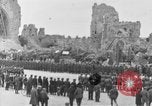
Destroyed St. Martins cathedral in Belgium and views from a moving car of the Schwebebahn suspended railway in Germany
Allied military and some civilians gather for a ceremony at the ruins of Saint Martin's Cathedral, in Ypres Belgium, destroyed by Germany in World War 1. Scots Guards in kilts are seen among the assembled military. A ladder is seen and something is being raised by a hoist in the background,as preliminary cleanup is being undertaken. Scene shifts to point of view footage from a moving rail car on the Suspension Railway (Schwebebahn) in Barmen-Elberfeld Germany. At first it travels above a street in the city. Then it is seen moving over the Wupper River, in the Elberfeld region, as another suspension rail train approaches from the opposite direction. It continues traveling along (above) the waterway. (Note: Barmen-Elberfeld was re-named Wuppertal in 1930. The Schwebebahn is still in operation today, and is the oldest operating transportation monorail in the world. It is now called the Wuppertal Suspension Railway. Its original full name is: "Electric Elevated Railway (Suspension Railway) Installation, Eugen Langen System" (Anlage einer elektrischen Hochbahn (Schwebebahn), System Eugen Langen)).

American, French and Russian delegations at an Allied Control Council meeting in Berlin, Germany, a year after World War 2
Allied delegates at a meeting in Berlin, Germany. Allied Control Council building in Berlin, Germany. Meeting of the Allied control Council. Russian delegation. Chairman of the meeting General Joseph T. McNarney. Marshal Georgy Zhukov. American and Russian delegates. French delegation with its head General Pierre Koenig. Koenig with his political advisor Jacques Tarbe de Saint Hardoin.

Henry C White, French Premier Georges Clemenceau and Marshal Ferdinand Foch in Paris, France for the Paris Peace Conference.
Officials arrive for the Paris Peace Conference in Paris, France. Officers in uniforms pose for a photograph. United States Navy Admiral Benson and United State Ambassador to France Henry C. White leave the Hotel Crillon building (10 Pl. de la Concorde, 75008 Paris, France). They read the document in hand. Henry C. White speaks with the officials. French Premier Georges Clemenceau and Marshal Ferdinand Foch get inside a car. View of the Élysée Palace (55 Rue du Faubourg Saint-Honoré, 75008 Paris, France) with flags in the foreground. People walking in the street.

People gathered at Westminster Abbey to pray for peace in London, England.
People gathered at the Collegiate Church of Saint Peter at Westminster, Westminster Abbey (Dean's Yard, London SW1P 3PA, United Kingdom) in London, England. People read a poster on the wall. A busy street with people walking and vehicles on the road in front of Westminster Abbey. Men and women enter the gate. View of the church building. People pray for peace inside the church.
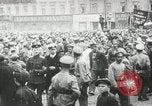
Post-World War 1 events in Russia
Crowd milling about in Kronstadt, West of Saint Petersburg,Russia, as group of Russian sailors, soldiers and civilians, marches in their midst carrying a Sign reading "Peace, Freedom, and Bread." On March 7, 1921, The Bolshevik government sends 60,000 troops under command of Mikhail Tukhachevsky to quell the disturbance. They are seen marching in the streets. Next scene shows women looking amongst the fallen for their relatives. View of Leon Trotsky (Commander of the Red Army) walking with some of his staff. View of human remains. Brief view of Lenin. Trotsky writing at his desk. Narrator mentions the State Security Agency called "Cheka," being replaced by the Joint State Political Directorate (AKA OGPU). Narrator calls it the Political Police. Vyacheslav Mikhailovich Molotov is seen walking with a group of Soviet workers and politicians ostensibly charged with overseeing the OGPU. Another scene shows Molotov conversing with Joseph Stalin (Iosif Vissarionovich Stalin). Mikhail Ivanovich Kalinin stands to Stalin's left. views of Stalin. Lev Kamenev, a leader in Moscow City politics. Russian families on a train platform preparing to travel in box cars (to Siberia?). farmers harvesting grain in Russia. A woman shopkeeper cuts a loaf of bread in pieces and weighs them on a scale for sale to a customer. American foodstuffs provided as aid to Russia. Some of the American food being unloaded at a pier. American Relief Administration Chief, Herbert Hoover, standing at a port. Food being distributed to Russian citizens, and to children. Newspaper of March 14, 1923, announces the Lenin suffers a stroke. In January, 1924, a newspaper headline announces that "Lenin is dead." Lenin seen in coffin. Funeral cortege, including principal Soviet leaders, carries the coffin outdoors in falling snow. Spectators watch and others follow in the solemn funeral march. Narrator states that "Stalin,Zinoviev, and Kamenev force Trotsky into exile." Soviet citizens are seen at hard labor under new "Five year plans."
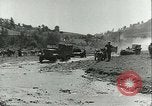
German forces invade through rural areas of Poland and enter Warsaw (WW2)
Invading German advancing into rural Polish regions in 1939. Trucks, motorcycles and infantry follow along the path of a shallow riverbed and ford it over rocks near the remains of a wooden bridge. German troops riding in an Sd.Kfz. 11 special motorized vehicle (Sonderkraftfahrzeug) towing an artillery piece, make their way through shallow water. Another military vehicle moves across remains of a destroyed steel bridge in the background. Closeup of smiling German soldier and his comrades, all shouldering M42 machine guns, as they enter the city of Warsaw on October 1, 1939. German infantry march into the city through smoke and debris to parade for Adolf Hitler on October 5, 1939 (not seen). In the background the twin towers of All Saints Church (plac Grzybowski 3/5, 00-115 Warszawa, Poland) dominate Grzybowski Square. Mounted officers lead marching infantry along a street in Warsaw. Views of German soldiers receiving newspapers as they proceed deeper into Poland. They read them as they march informally. Closeups of German infantry making their way in the company of horse-drawn wagons carrying troops, supplies, and towing artillery pieces. Staff cars, trucks, and motorcycles move over dirt roads near piles of debris.