


 Francais
 Deutsch
 Italiano
Refine Your Search
Vietnam-security-police stock footage and images
- Showing 835 to 840 of 6186 results more
more Hide
Hide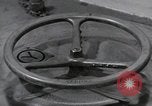
Compartmentation of a navy ship to protect it from damage in the United States.
A training film depicts compartmentation of a ship's hull to protect from damage in the United States. A hatch of a ship. Animation depicts a ship and a hole below the water line. A navy ship which is divided into several water tight compartments. Small compartments on the deck. Water tight compartments created on the deck. Different openings in a compartment for safety. Water enters the compartment. Water tight doors in each compartment. Additional doors and hatches in the compartment. All water tight doors are secured. A water tight door with material condition of readiness XRAY. An XRAY label on the door. An authorized personnel opens the door. A personnel closes a door. A door with material condition of readiness YOKE. Another personnel works on a hatch. A personnel operates all controls for water tightening security.
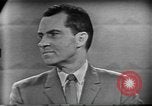
Richard Nixon talks about his executive experience and leadership during a presidential election debate in Chicago, Illinois.
The first Kennedy-Nixon Presidential Debate in Chicago, Illinois. Sander Vanocur from NBC News asks Republican candidate Vice President Richard M. Nixon about executive leadership and his governmental executive decision-making experience. Nixon answers and states that the President of the United States does not disclose instances where official family members have made recommendations. He states that he has given advice to the President whenever he has asked. He has been a part of the National Security Council, the cabinet and has met legislative leaders. He compares his experience in the executive branch with that of Kennedy's in the legislative branch. Democratic candidate Senator John F. Kennedy presents his views and states that there is no certain road to the presidency. He tells that he have met decisions on matters which affect not only the domestic security of the United States, but as a member of the Senate Foreign Relations Committee.
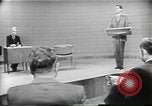
During a presidential election debate in Chicago, Illinois Nixon states that he hopes to control the House and get a majority.
The first Kennedy-Nixon Presidential Debate in Chicago, Illinois. Bob Fleming from ABC News asks Republican candidate U.S. Vice President Richard M. Nixon whether he could work better with Democratic majorities in the House and Senate than Senator Kennedy. Nixon answers and says that he hopes to control the House and to get a majority in the House in the elections. He states that the President cannot control the Senate and the President needs the support of the country and people to get his programs accomplished. He says that whenever a majority of the people are in favor of a program, the House and the Senate respond to it and it does not matter if the House and the Senate in the next session is Democratic or Republican. He disagrees with the reason of a presidential veto by Kennedy. Democratic candidate Senator John F Kennedy presents his views. Kennedy talks about the bill for minimum hourly wage system against which the Republicans voted. He then talks about the federal aid to education bill which failed because the Republicans did not vote for it. He talks about the third bill of medical care for the aged which is tied to Social Security, which is financed out of Social Security funds and it does not put a deficit on the Treasury. Kennedy concludes that these are three programs which are quite moderate and not extreme.
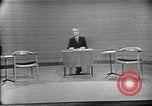
Richard M. Nixon and John F Kennedy give their summation speeches during a presidential election debate in Chicago, Illinois.
The First Kennedy-Nixon Presidential Debate in Chicago, Illinois. Moderator Howard K Smith asks the candidates to give their summation speeches. Republican candidate U.S. Vice President Richard M. Nixon starts his summation speech and compares the progress of the Soviet Union with that of the United States. And he states that in terms of the Gross National Product (GNP), the U.S. is far ahead of the Soviet Union. He compares his proposals with that of Kennedy and states that his own proposals would result in greater growth. He compares his health program which provides a choice of having either government insurance or private insurance with that of Kennedy's health program with compulsory government health insurance under Social Security. He talks about the spendings and inflation during Truman Administration. He concludes his speech and states that U.S. President's should work for every program that would mean growth. Democratic candidate Senator John F Kennedy comments on the statement given by Nixon regarding comparison of the Soviet Union and American economy. He speaks in favor of his proposed health program for aged which was an amendment to the Kerr bill and which provides assistance to all those who were not on Social Security. He thus contrasts Nixon's point on health program for the aged. He concludes his speech and speaks about the goals and responsibilities of the Americans. Moderator Smith thanks the candidates.
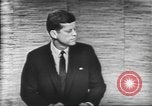
During a presidential election debate in Washington DC, Kennedy comments that its proper to express regrets to nations.
The second Kennedy-Nixon Presidential Debate in Washington DC, United States . Edward P. Morgan of ABC News asks Democratic candidate Senator John F Kennedy about sending apologies or regrets to General Secretary of the Communist Party of the Soviet Union Nikita S Khrushchev over the U-2 reconnaissance aircraft incident. Kennedy answers that if it could save the summit conference it would have been proper to express regrets. He speaks that the U-2 flights were proper from the point of view of protecting their security. But they were not in accordance with the international law. He speaks about the regrets expressed to Castro, to Southern Russia and to Eastern Germany under the Eisenhower Administration during the past years. He mentions the regrets expressed by the Soviet Union and the Chinese Communists to the U.S. over incidents. He states about they should have a stronger military force and should increase their strength all over the world. Republican candidate U.S. Vice President Richard M. Nixon presents his views and states that Senator Kennedy is wrong in thinking that Khrushchev might have continued with the summit conference if the U.S. had expressed regrets. He disagrees with Kennedy's analogies that the U.S. is a strong country and can express regrets for any wrong doings. He also disagrees in expressing regrets to anybody for doing things which has the support of the Congress and which is right from point of view to protect the security of the U.S. (This 4 part debate is sometimes called the Great Debate)
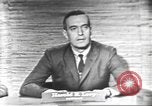
Kennedy and Nixon present their views about tax increments during a presidential election debate in Washington DC.
The second Kennedy-Nixon Presidential Debate in Washington DC, United States. Harold R. Levy of Newsday asks Democratic candidate Senator John F Kennedy about his recommendations to increase tax. Kennedy answers and states that in the present scenario tax increase is not desirable. He says that if it would be essential to U.S. security he would suggest a tax increase. He talks about his programs for economic growth, care for the aged, development of natural resources which would build the strength of the United States. He states that Americans can mobilize their economy and resources. Republican candidate U.S. Vice President Richard M Nixon comments on the increasing expenditures for defense, mutual security, economic and technical assistance. He says that he thinks it may be necessary to increase taxes to maintain a sound economy. He concludes and states that no president can add billions of dollars to his nations expenditures and not pay for it, after all the payment is made by peoples money.
CRITICALPAST.COM: About Us | Contact Us | FAQs - How to Order | License Agreement | My Account | My Lightboxes | Shopping Cart | Advanced Search | Featured Collections | Website Terms & Conditions | Privacy Policy ©2026 CriticalPast LLC.
License Agreement |
Terms & Conditions |
Privacy Policy
©2026 CriticalPast LLC.