


 Francais
 Deutsch
 Italiano
Refine Your Search
Vietnam-security-police stock footage and images
- Showing 841 to 846 of 6186 results more
more Hide
Hide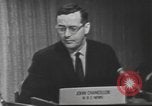
Vice President Nixon and Senator Kennedy debate in the United States over nuclear tests resumed by the Soviet Union.
The fourth presidential election debate held between Democratic nominee Senator John F. Kennedy and Republican nominee U.S. Vice President Richard Nixon in in New York, United States on 21st October 1960. NBC News correspondent John Chancellor asks a question to Senator Kennedy in relation with U.S. relations with the Soviet Union. Correspondent Chancellor asks if Russians have resumed testing of nuclear devices as per news from Atomic Energy Commission of Washington and if the U.S. would resume its own nuclear weapon testing in 1961. Senator Kennedy replies to the question and says that the next President of the United States should make one last effort to secure an agreement on the cessation of nuclear bomb tests. He mentions the Conference for the Reduction and Limitation of Armaments from 1932-1934 held in Geneva, Switzerland. Kennedy says that he believes the effort should be made once more by who so ever is elected the President of the United States. Senator Kennedy says that if they fail in making the effort, the responsibility will be clearly on the Russians and then they'll have to meet their responsibilities for the security of the United States, and they may have to test underground. He says that there may be testing in outer space. Senator Kennedy says that he is most concerned about the whole problem of the spread of atomic weapons. ABC News correspondent Quincy Howe asks the Vice President to comment. Vice President Nixon says that the Soviet Union is filibustering. He says further that the elected president should immediately make a time table to break Soviet filibustering.
Marshal Josip Broz Tito at his mountain headquarters near Drvar, Bosnia.Yugoslavia. Tito's troops training in Italy during World War II
Note: This film was shown during World War 2 and edited for security reasons. Accordingly, some narrated statements are incorrect or misleading, and should be disregarded. Film opens showing a sentry posted at Yugoslav Partisan Leader Marshal Josip Broz Tito's mountain headquarters in Drvar, Western Bosnia, Yugoslavia. Marshal Tito steps from his headquarters to a lower porch where he stands with American OSS Officer, American Army Major Linn M. Farish, American Liaison to the Partisans, and British Brigadier General Fitzroy Maclean, Winston Churchill's special envoy to the Yugoslav leader. (For security reasons, they are identified as war correspondents.) Scene shifts to the town of Drvar that has experienced several periods of German occupation. Local people go about their daily activities and some pose for the camera. Women are seen salvaging silk from Allied parachutes, that they have spread out on the ground. It will be used as bandages for their Partisan army. View from above of a number of Partisan fighters gathering before the camera. One, a woman with dark hair wearing a black coat, is identified by the narrator, as a 21-year old Montenegrin who left school to join the Partisans. Closeup of that woman conversing with uniformed women soldiers. Next, a loose column of Partisan fighters is seen marching slowly through the town of Drvar. Scene shifts to a large formation of marching Yugoslav Partisan soldiers, who are training in Italy. They are seen standing if formation in a field, under Marshal Tito's command. He orders their officers forward and exchanges salutes with them. Marshal Tito then inspects the ranks. Women soldiers are seen conversing with Tito. He converses with his Chief of Staff, General Koča Popović. Closeup of a smiling woman Partisan fighter. Closeup of a soldier with a notable white moustache. Closeup of two uniformed women with Red Cross armbands. The Partisan soldiers marching across the field with shouldered arms. Film closes with closeup of Marshal Tito in front of his headquarters.
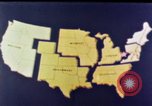
The process of tax return processing with aid of early computers at Internal Revenue Service Centers in the United States.
A film discussing automatic data processing in tax administration at U.S. Internal Revenue Service National Computer Center. Workers process the income tax returns and make use of ADP (Automatic Data Processing) machines or computers at computer service centers in the United States. The workers sort tax return papers, open packets and empty mail bags filled with tax return documents. A chart depicts the whole process of income tax return processing. Computer data tapes are stored at service centers. Examiners check essential preliminaries on tax return form like signatures, dates, address, and social security number. Information is then sent to punch cards. Female workers at equipment. It is explained how error is checked and Good Tape, Error Tape, and Error Register machines are shown. An error register equipment gives details of problems causes during the tax processing which is handled by Error Resolution Branch. Letters listing the problems encountered in processing tax information are sent to tax payer if necessary from service division. Return file is maintained. Functions of the service station involves sending of notices sent to tax papers which includes notice for due balance and notice of error. A settlement register is examined by trained personnel. Workers at various equipment in service station. It is further explained how a tax payer can avoid errors by shows the essential entries on W-2 form. Various entries including social security number are highlighted.
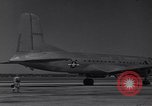
Cargo being loaded by winch in side door and jeep being loaded by elevator in a C-74 aircraft at Wright Field, Dayton, Ohio
U.S. Air Force C-74 Globemaster cargo aircraft at Wright Field in Dayton, Ohio. A C-74 Globemaster parked at Wright Field. Several ground crew stand in wheel well under No.3 engine of the aircraft. A ground crewman works on the tail of the C-74 aircraft, which displays the identification number: 265402 . No. 2 engine and open side door of the aircraft. A loadmaster stands in the open doorway with cable winch control in his hand. Man on ground secures cargo which loadmaster then raises with electrical winch .A jeep being loaded using platform elevator at underside of the C-74 Globemaster. Cargo hold of the aircraft with jeep being lifted up by elevator. Loadmaster secures elevator platform and then closes bottom cargo doors. Jeep is driven several feet forward inside the cargo compartment.
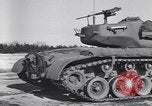
The mechanism the engine of U.S. T26E3 tank being explained in the United States.
A film about the U.S. T26E3 tank. A tank parked on the ground. Man points at the wheel of the tank. The working of the engine as the tank is being explained. The power train is examined. The engine of the tank. The location of the oil coolers and the engine radiators in the engine. The gas tanks, having their own fillers. View of radiator fill, where cap must be securely tighten against the seal. The security measures prevent the engine failure.
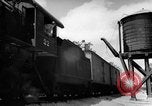
725th Railroad Battalion personnel repair a train after an air attack at Camp Claiborne in Louisiana, United States.
A film about training of 725th Railroad Operating Battalion personnel at Camp Claiborne in Louisiana. A train on the roll. Officers at a desk as they plan for a mock attack on a railroad train to impart practical training to 725th Railroad Operating Battalion personnel. Security guards aboard the train as they fire at attacking airplanes. Air attack causes damage to railroad track. Personnel inspect the damaged track. Caboose being informed about the damage. Security guards move to vantage points to provide a protection cover during repairing work. A signal man goes up a pole to make connection to an open telephone line. He makes a call to a dispatcher and the First Sergeant. The First Sergeant blows a whistle and repair parties load onto trucks. Others load onto railroad motor cars. A sign reads '725th Ry. Opn. Bn.'. The repair parties in trucks arrive at the site of the attack and equipment being unloaded. Broken tyres being removed. Another repair crew arrives. Rails being put in place and angle bar being used to tighten the bolts. A train rolls on the tracks. Guards on duty aboard the train. (World War II period).
CRITICALPAST.COM: About Us | Contact Us | FAQs - How to Order | License Agreement | My Account | My Lightboxes | Shopping Cart | Advanced Search | Featured Collections | Website Terms & Conditions | Privacy Policy ©2026 CriticalPast LLC.
License Agreement |
Terms & Conditions |
Privacy Policy
©2026 CriticalPast LLC.