


 Francais
 Deutsch
 Italiano
Refine Your Search
Vietnam-security-police stock footage and images
- Showing 991 to 996 of 6186 results more
more Hide
Hide
Brokers Cafe and Restaurant with outdoor Curb Market on Broad Street in New York City
The New York Curb Market of Curbstone brokers at work on Broad Street, New York City. A large number of brokers knowns as 'Curb' brokers gather in the street, dealing in unlisted securities. They were also sometimes called the Sidewalk Stock Exchange or Curb Exchange. They communicate with clerks and counterparts leaning out through the open windows of the nearby buildings, shouting and waving hand signals, and recording trades. Crowded street of Curb Brokers in front of Brokers Cafe and Restaurant.
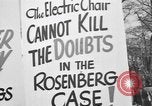
People protest at the White House in Washington, DC, against the judgment made in the Rosenberg spy Case
Large numbers march, at the White House, to protest against the judgment made in the Rosenberg Case. A number carry banners reading "The Afro-American says there are grave doubts in this case." Another banner reads "The electric chair cannot kill the doubts in the Rosenberg Case." Other signs held by marchers ask U.S. President to reconsider the judgment and plead for clemency. An African American clergyman leads some of the marchers. They march in the streets. Some talk to a White House security officer and ask him to accept a letter to the President.
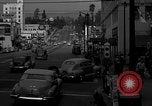
Street scenes near Hollywood Boulevard and Vine Streets in Los Angeles, California circa 1950
Street level view near the southeast corner of Hollywood Boulevard and Vine Street in Los Angeles, California. View facing north on Vine Street. A car towing a three-wheel motorcycle turns east onto Hollywood Blvd. Late 1940s and early 1950s automobiles driving on the street. Camera pans westward and other buildings are seen looking north on Vine, including the El Capitan Theatre at 1735 North Vine Street (now the Avalon Hollywood nightclub), the Ontra Cafeteria at 1719 North Vine Street (now the Redbury Hotel at 1717 North Vine), the Melody Lane cafe at the northwest corner of Hollywood and Vine, and the Harris & Frank store on Hollywood Boulevard. Brief view of a streetcar or trolley going west on Hollywood Boulevard. Street level camera view then shifts to the southeast corner of Ivar Avenue and Hollywood Boulevard, looking west on Hollywood Blvd. Theater marquee of the Admiral Theatre (later the Vine Theatre) is seen across the street at 6321 Hollywood Boulevard. Beyond it, looking west, is the Security Pacific Bank building at 6381 Hollywood Boulevard, and beyond that are the Warners Radio Towers for station KFWB atop the Warner Bros Theatre. Pedestrians walking on sidewalks, and cars and trucks on the street. Scene shifts to various elevated views of Los Angeles with a heavy smog layer settled over the city.
Sir Hubert Wilkins attaches a pipe inside United States submarine Nautilus O-12 (SS-73) in the Arctic region during an expedition.
United States submarine Nautilus during an expedition in the Arctic region. Engine room of Nautilus. A man in the engine room releases lever to operate the shaft. Two rubber air hoses hang from the bulkhead. A technician secures Nansen bottle to a rack on the wall in submarine. He checks the bottle and takes down notes. Sir Hubert Wilkins and a man work on a pipe in the submarine as a line is attached to the pipe.
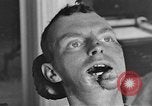
Allied soldiers with mutilated faces in France during World War I.
Allied soldiers in France during World War I. Allied soldiers with mutilated faces due to injuries secured during the war. The soldiers smoke cigarettes. A man with a metal piece attached to his mouth..
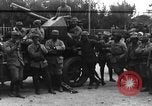
Scenes of Berlin Germany during the Kapp Putsch of 1920
The Kapp Putsch in Berlin during the Weimar Republic period. In opening scene about 20 Freikorps soldiers in uniform, are seen gathered around a motor vehicle on which an anti aircraft gun is mounted. One wears a fez. One soldier cranks a handle to raise the elevation of the gun to a high angle. Civilian spectators watch the demonstration. A warship can be seen in water behind the soldiers. Masts of docked sailing vessels are seen close behind them. Freikorps soldiers walk about. A military band plays as some of the soldiers stop and listen to them and pedestrians and motorists pass by. Flag of Prussia flies over top of a building. Helmeted German soldiers with rifles, stand about, casually, at the gates of a building. Soldiers, loaded onto a Benz truck, pass out newspaper flyers to passersby. People milling about in the street. Freikorps soldiers lined up as an officer inspects their rifles. Their insignia is visible on their left coat sleeves. Crowd of spectators stand behind barbed wire barrier surrounding a cleared square in the city secured by Army soldiers in steel helmets. One of them has Freikorps insignia on his left sleeve. Weimar Republic officials, including Philipp Scheidemann stroll across the square and proceed through the crowd outside the barbed wire barrier. Soldiers examine papers of civilian officials trying to enter the restricted area. One of them is allowed access. Army troops and Freikorps soldiers mingle together as civilians pass by them.
CRITICALPAST.COM: About Us | Contact Us | FAQs - How to Order | License Agreement | My Account | My Lightboxes | Shopping Cart | Advanced Search | Featured Collections | Website Terms & Conditions | Privacy Policy ©2026 CriticalPast LLC.
License Agreement |
Terms & Conditions |
Privacy Policy
©2026 CriticalPast LLC.