


 Francais
 Deutsch
 Italiano
Refine Your Search
Wac stock footage and images
- Showing 97 to 102 of 117 results more
more Hide
Hide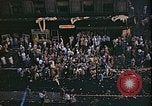
Crowds on F street during V-J Day celebrations in Washington DC, United States.
Victory over Japan Day (V-J Day) celebrations on F Street in Washington DC, United States during World War 2. Aerial view of F Street and the Capitol Theater at 1328 F Street. Confetti and ticker tape raining down from windows above. The confetti being thrown out of government buildings. A soldier attempts to kiss a girl on a street. Sailors grabbing and kissing women against their will in front of the Fannie May candy store on F Street. People hold up newspapers with headlines that read "The war is over. Japs surrender unconditionally." Crowds in the streets. Crowds under the Capitol Theater marquee. Soldiers and sailors in uniform kiss girls walking by. Stacks of newspapers on the sidewalk are distributed. Citizens, soldiers, and WAC women in uniform pickup and read newspapers.
A woman making and eating a sandwich (WW2)
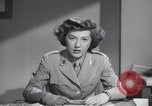
A film titled 'By Request' of the Army-Navy Screen Magazine about the requests of U.S. Army soldiers fighting in World War II. A man places a few papers in place at the 'By Request' office of the Army-Navy Screen Magazine. Door window sign reads “Army-Navy Screen Magazine New York City”. The Women’s Army Corps (WAC) host reads the letter of a person. A woman places tomato slices on a bread and the cabbage leaves. She cuts the sandwich half and serves with a glass of milk. The woman eats the sandwich.
Yugoslav Marshal Josip Broz Tito at his headquarters in Yugoslavia (WW2)
A uniformed member of the U.S. Women's Army Corps (WAC) reads a letter from a soldier named Sergeant Lowry, asking why Army-Navy Screen Magazine doesn't show pictures of Marshal Tito, famous Yugoslav patriot. In response, the next scene shows rugged mountains of Yugoslavia, where Marshal Tito has his headquarters, in World War II. Closeup of Marshal Tito flanked on his left, by British Brigadier General Fitzroy Maclean, Winston Churchill's special envoy to the Yugoslav leader, and on his right, barely seen, U.S. Office of Strategic Services (OSS) Officer, Army Major Linn M. Farish, American Liaison to the Partisans. The three step down to a lower porch at the headquarters building, where Major Farish pumps his arm in the air several times as he speaks to General Maclean. Tito smiles, smokes his pipe, and makes some comment to them. The scene shifts to a British military photographer as he finishes taking a still picture of Tito and his principal staff officers, standing in a group, along with Tito's dog, Tigar.
The U.S. Army Quartermaster Corps with their loads of supplies at times of war overseas (during World War 2).
The United States Army Quartermaster Corps in the United States during World War 2. Supplies for the Quartermaster Corps like boots, dresses, cigarettes and hardware. A tent encampment. A soldier standing in a wooded region. An officer seated at a table in an office. The flag with the Quartermaster Corps insignia flutters from a pole. Point of view shot at nearly eye level with large column of U.S. Army soldiers marching toward camera position, holding rifles as they march in formation. The soldiers eat seated at tables in a dining hall or mess area. The Quartermaster Corps unload boxes of supplies during a war overseas. A number of boxes of supplies on a beach. Several Quartermaster Corps unloading boxes from landing crafts on the beach. View of a pair of boots which is part of the necessary uniform equipment. A large number of cabbages in a heap. Pieces of hardware hung on stands on a wall. The boxes of supplies are stacked in a store before distribution. The corps distributed uniforms. United States Army Soldiers on tanks moving on a path. The soldiers arrive at landing crafts on a beach. Large columns of U.S. Army soldiers march in formation. Women's Army Corps (WAC) and nurses move in formation. Women working in textile webbing factory with large spools of webbing or string during manufacture process. The soldiers march. Ships in a harbor. Supplies at a dock for army and navy requirements.
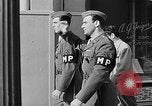
Civilians and soldiers who have committed crime are arrested by the police in the United States.
A training film on functions of military police during a town patrolling in the United States. The MPs walking on a street. They enter a U.S.O. office open to military personnel. Narrator explains that personnel of the Women's Army Corps (WAC) and other women service organizations are subject to same disciplinary control as men. The only exception is that they are not searched by policemen nor are confined to jails or guard houses. They are taken to the nearest women's organization of the armed forces for search and detention. This law is for the WAVES (Women Accepted for Volunteer Emergency Service), women Marines and any other service women. Civilians walking on a street. Parked cars. The MPs talk to a man. If a soldier is hurt or mistreated by a civilian, the MPs can hold the civilian until the police arrives. He can be then arrested by the police. The wounded soldier is treated and is taken to a hospital. The soldier is taken in protective custody. A soldier in a police station. If any soldier attacks a civilian or violates civilian law, he can be arrested by the police. (World War II period).

B-25 bomb at Brest, Canadian troops advance, civilians buy goods and U.S. soldiers secure voting cards in France (WW2)
Normal life of civilians resume after German surrender in some parts of France during World War II. Aerial view of flak in sky. Close-up view of two U.S. Army Air Force B-25 Mitchell bomber aircraft in flight. (Narrator incorrectly states they are British Lancaster bomber aircraft.) View from bomb bay doors of bombs away shot as the B-25 bomber aircraft drop bombs on U-boat pens at Brest. Explosions and smoke rise. The aircraft drop bombs over ground installation over enemy area. Canadian soldier scenes: Troops advance through a burning coastal town in France. Buildings collapsing and gunfire in streets. Smoke rising. Ruins of destroyed French town are seen. Allied Army tanks advance and fire artillery. German prisoners of war from Wehrmacht 7th and 15th armies being marched under watch by Canadian forces. Among the German prisoners is a 13 year old Russian boy who was forced to work by the Nazis. German prisoners in a soup line and seen drinking from mugs. Some appear to be very young boy soldiers. U.S. Army soldiers in Le Mans: American soldiers are welcomed by civilians of France. Happy French civilians waving to U.S. forces including a happy young woman who runs forward and pats a U.S. Army tank with her hand. Men and women collaborationists who assisted the Germans are rounded up by French and marched away. U.S. Army soldiers seated at stools in a French bar drink as the bar maid pours more into their glasses. French civilians line up at shops and groceries to buy food and goods in Le Mans. Pictures of General De Gaulle for sale. American women in U.S. Army uniforms (possibly nurses or Womens Army Corps WAC members) look in shop windows at French fashions. Voting cards: U.S. Army troops read pamphlets that read "requirement of soldiers to vote" and "Soldiers Voting". The U.S. Army GI's receive and mail postcards to their homes requesting absentee voting ballots for the upcoming November 1944 election. The soldiers line up to secure their application cards for absentee ballots.