


 Francais
 Deutsch
 Italiano
Refine Your Search
+"Belgium" +1944 stock footage and images
- Showing 19 to 24 of 132 results more
more Hide
Hide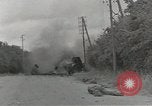
United States 1st Infantry Division soldiers advance into French cities and fight for Aachen during World War II.
The role of United States 1st Infantry Division (Big Red One) in various campaigns in Europe during World War II. United States 1st Infantry Division men fight in France as they advance further inland into the country. Soldiers relax, get a haircut and write a letter back home to their families. On July 25th , 1944 German aircraft launch an air attack. Infantrymen fight in the streets of a city in France. Combat engineers plant land mines. 1st Infantry Division soldiers enter Coutance, Mortain, Etampes, Meaux and Soissons. Soldiers around a monument at the Belgium border. 1st Infantry soldiers advance towards Aachen. Tanks fire as soldiers fight against the Germans in Aachen. Men on a machine gun. On October 25th 1944 Aachen surrenders to the Allies. U.S. Army armored vehicle drives over Nazi flag lying in a street.
Training film for U.S. troops with the Army of occupation in Germany after world War II
Opens with bell tolling Victory against Germany in World War II. Next, a slate reads: "Victory Leads to Peace," and a farmer is seen with cattle pulling a plow. But narrator says "the problem now is future peace," and a map of Germany is shown overlaid with "Your Job in Germany." A cartoon of a soldier is superimposed on the map, along with one of a World War 1 American soldier and a figure of possible future soldier with similar mission. Camera focuses on parts of German aircraft in a jumbled heap. Closeups of weary defeated German soldiers at end ot World War II. Glimpse of Adolf Hitler speaking and haranguing an audience from a podium in an animated and forceful way. Swastika flags displayed from houses in a quaint German town. Joseph Goebbels, Nazi Reich Minister of Propaganda, at a microphone. Glimpse of a German concentration camp. But as they appear, each of the Nazi elements promptly disappears, showing the scenes without such Nazi symbols and persons. Skeleton remains of bombed buildings. Flower displays. Bucolic German rural countryside and quaint old villages in peaceful settings. Camera focuses on a book titled "German History." Chapter I, titled "Blood and Iron," shows Image of Otto von Bismarck. German troops march in a parade. Narrator states that "under Bismarck, the German empire was built." (He formed the German Empire in 1871, unifying Germany with himself as Imperial Chancellor, while retaining control of Prussia at the same time.) The film shows mounted German lancers as it alludes to Bismarck's campaigns against Denmark in 1867; Austria in 1866; and France, in 1870. Germany's leaders celebrating its status, in 1871, as the mightiest power in Europe. Troops marching and girls dancing nearby. Farmers plowing field with a horse and cow. Classic peaceful rural alpine scenes with local people in agricultural pursuits. A group of local German musicians playing folk music as village people dance outdoors. Back to the book, Kaiser Wilhelm II is shown on Chapter 2, entitled: "Deutschland über Alles." Gathering of German soldiers in Pickelhaube (spiked helmets). A German Big Bertha howitzer firing. German troops marching against Serbia; Russia; and France (with view of war damaged French cathedral). German invasion of Belgium in 1940 (with view of clock tower resting in rubble). German troops seen in Italy, walking past battle-damaged buildings. German Zeppelin dropping bombs on British targets and view of bombed out London neighborhood. Next scene shows a capsized ship with survivors running across its hull. Film slate labels the scene as United States, as if it is a U.S. ship attacked by Germany. (Actually, it is the Austro-Hungarian Battleship, SMS Szent Istvan, torpedoed, by Italian torpedo boats, during World War I.) Next, American soldiers in trench are seen going "over the top" and into "no man's land" on the western front of World War 1. Glimpse through a window of Kaiser Wilhelm II, after defeat of Germany, in 1918. View of Germans in a Beer Garden. Picturesque view of German town. A German orchestra performing. American soldiers marching out of Germany, with flags waving. Back to the history book,as chapter III is revealed, entitled "Today Germany, tomorrow, the world," and featuring Adolf Hitler. German troops invading Austria (where a civilian lies dead on the ground). German troops entering Czechoslovakia (where local people in tears render the Nazi salute). They march into Poland (where a girl weeps over someone, not seen, on the ground). They march into France (where a wounded, bandaged child cries in a bed). Next, is a scene from England, where a British child victim of bombing lies dead in the remains of a shelter. German troops invading Norway, Holland, Denmark, Belgium, Luxembourg and Russia (where a woman tries to rouse a dead woman). They invade Yugoslavia (where women sit near coffins of children) and Greece (where a woman rescues a naked child). A U.S. merchant ship explodes after being torpedoed by a German submarine (unseen). Scenes of destruction with people plucking dead victims from rubble of buildings. American troops invading Normandy, France on D-day, June 6, 1944. Several American soldiers fall to German gunfire on the beach. Wounded American soldiers being transported in jeeps on the battlefield and being placed on landing craft for evacuation. Americans walking past huge piles of destroyed aircraft parts. A landing craft filled with wounded American soldiers. American wounded and dead on a battlefield. Sailors abandoning a burning American ship by jumping into the sea. A sailor picked up in a life boat. A wounded American soldier being dragged from the beachhead at Normandy. Various wounds being treated by U.S. Medical Corps personnel. More scenes of American wounded being moved on stretchers. Scene shifts abruptly to German people folk dancing. Film concludes with question marks about the future.

Internees from Brussels at the Buchenwald concentration camp interviewed in Germany.
Internees at a concentration camp in Buchenwald, Germany. Jean Blume, leader of socialist national movement against occupation in Belgium, shares his experiences of the days spent as a prisoner at Breendonk concentration camp in Belgium. He expresses joy at being liberated by American Army from Buchenwald concentration camp. (Note: Jean Blume was a Resistance Leader during the Nazi occupation in World War 2. The Gestapo arrested him on January 19, 1943 and he was imprisoned in Breendonk. In May 1944, he and many others, were sent to Buchenwald. They were released on April 11, 1945.)
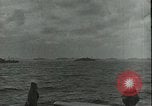
Soldiers of the 1st Infantry Division in England and during the invasion of Normandy and subsequent campaigns toward Germany (WW2)
Soldiers of the 1st Infantry Division training in England under General Clarence R Huebner, in preparation for the D-Day Normandy invasion in World War II. U.S. Navy ships underway at sea. Heavy naval guns bombard the coast of France on D-Day. U.S. Army soldiers seen during assault on Omaha beach with heavy losses on D-Day. U.S. soldiers and tanks encounter heavy German resistance in the "hedge rows." American soldiers digging trenches with shovels and picks and treating wounded comrade. Dead German soldier lying in street as Americans enter the town of Caumont (Caumont l'Eventé). Frenchman civilian pours wine for American soldier after they liberated Caumont l'Eventé from the entrenched German forces. An American helps a French civilian woman to reach a safe place crossing rubble. Damaged French houses along the sides of street. During rest, a soldier gives another a haircut, and another writes a letter. U.S. Air Force B-17s fly overhead and bomb near St. Lo, France on July 25, 1944. Other U.S. Army artillery units, the 4th and 9th Divisions, and General Patton's tanks provided support so the 1st Infantry (First Infantry or Big Red One) could occupy the area. Army combat engineers dig up mines and use construction equipment to clear debris. Wrecked houses and rubble. U.S. soldiers keep advancing through towns and eat and rest as they can. Road sign reads: "Coutances." First Infantry goes through Mortain, Etampes, Meaux, Soissons and across the Belgian border. German prisoners of war walk with their hands raised. German soldier digging out of fox hole. Siegfried Line and dragons teeth. Strong German resistance encountered at Aachen. Tanks fire in the field. House to house fighting in Aachen. Surrender of Aachen. A German flag laying in the street is run over by a U.S. military vehicle. German resistance is heavy during battle scenes in Battle of Hürtgen Forest. German and American artillery are seen in Hurtgen Forest. U.S. wounded treated. The 1st Division is pulled out for rest at the rear, in Belgium.
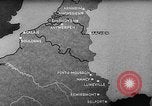
German forces defending against Allied advances toward Germany during WW2.
Map highlighting France, Belgium, and low countries, and German border city of Aachen during World War II. Soldiers riding on German Panther tanks camouflaged with foliage. They pass infantry walking along the side of the road. A Panzer IV with side track protectors. Commander of the German 5th Panzer Army, General Hasso von Manteuffel, conversing with officers of the 116th Panzer Division, September 1944. German tanks and infantry moving across a field. German soldier firing from prone position in a field. Knocked out American M3 halftracks. Captured American jeep and M3 halftrack. A very young German boy soldier escorting two ambulatory wounded American soldier prisoners of war. A small group of American prisoners of war. German field artillery firing and smoke rising from their shells exploding in distance. German troops entering town of Moncel-Les-Luneville, in Northeast France. Fire burning in the town. The Moncel-les-Luneville building after bombing in Luneville, France, at 15 Rue des Tuiliers, 54300 Moncel-lès-Lunéville, France. A Panzer tank enters Luneville. A huge smoke column rising in background.

Red Devil paratroopers of British 1st Airborne Division, drop into Holland to outflank the German Siegfried Line in World War II
At start, the film shows a formation of American C-47 transport aircraft with paratroopers starting to jump from them during World War 2. Viewed moments later from the ground, the sky is filled with trooper' open chutes, descending. An animated map shows Netherlands, Belgium, Luxembourg, and Germany. It shows location of the Allied paratroopers drop in Holland, intended to spearhead a drive around the Main River into Germany. The map then shows German forces encircling the paratroopers and the Second British Army heading North to the rescue. Next, a huge number of American Soldiers are seen assembled out of doors in England. Closeup of General Dwight D. Eisenhower speaking in a microphone to the assembly. Closeups of soldiers including some who are American Army Air Corps pilots, and other aircrew members, mostly Lieutenants. Senior Paratrooper officers stand at attention in front of formation of troopers with American flag beside them.(Narrator says these were the men who made up the "lost division," heroes who fought alone for seven terrible days.) General Eisenhower makes his way between close ranks of the paratroopers. He is followed by Brigadier General and a Colonel. Lieutenant General Lewis H Bereton also makes his way through the ranks. Scene shifts to a base in England where many British Airspeed AS.51 Horsa gliders are seen with paratroopers heading across the airfield to board. American C-47 aircraft are seen in the background. All aircraft are painted with D-Day stripes. Several British and American paratroop officers review a map together. At a tent camp, A military policeman and two U.S. paratroopers checking their weapons and ammunition. Some troopers sharpen their knives. A trooper is issued Dutch and German money. A British and and American trooper in camouflaged helmets, pose before a glider with a huge British roundel on its side. British paratroopers boarding a Horsa glider, named "Gertie." A Horsa glider moving as it is towed by a British Whitley twin-engine bomber. View from side of runway as the bomber takes off with its towed glider behind. (Narrator comments: "Destination, Holland.") Formations of tow planes and gliders in flight. View of pilot in cockpit of a Whitley bomber. Formations of fighter aircraft in flight overhead. View from inside an aircraft as paratroopers exit through a side door. Sky filled with paratroopers in chutes descending. (Note: This Allied thrust into Holland to launch a drive around the German Siegfried Line was known as the Allied joint American-British "Operation Market Garden," which took place 17 to 25 September 1944, the 7 days referred to by the film Narrator. )