


 Francais
 Deutsch
 Italiano

Refine Your Search
+"Belgium" +1944 stock footage and images
- Showing 115 to 120 of 132 results more
 Hide
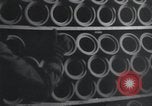
A U.S. soldier examines a crematorium and a gas chamber at Natzweiler- Struthof camp in France during World War II.
Natzweiler-Struthof (or Natwiller-Struthof), a German concentration camp and extermination camp, in France used by the Nazis for political prisoners from Belgium and France during World War II. A U.S. soldier examines urns used for ashes of victims. A crematorium, blood stained coffins and a gas chamber at the camp. An examination or experiment procedure table with indented fluid drains, that drains into a sink below.

An armored convoy of U.S. Army 113th Cavalry Regiment advances towards the Belgian border.
U.S. 113th Cavalry Regiment in Belgium during World War II. An armored convoy including M8 armored cars and M5A1 light tanks advances towards the Belgian border. A sign board on a street reads: 'Rumegies'. A jeep and M8 passes in the foreground.

United States 1st Army engineers construct spans over a river in France, during World War II
A film titled 'Northern France and Belgium' shows United States 1st Army Engineers construct spans over a river in France during World War 2. Soldiers cross over Pontoon and Bailey bridges. Tanks fire fiercely at the enemy targets, causing fire and smoke.

Day and night bombing on German targets by Allied bombers from England during World War II
A line of B-25 Mitchell bombers on an airfield in Britain. They display the British roundel on their fuselages. A line of British de havilland Mosquito bombers on a British airfield. One has its engines running and ground crew are removing ground power unit. A line of Martin B-26 Marauder bombers taxiing on an airfield. Several persons on the ground wave as a pair of B-26s take off in formation. The B-26s display French roundels on their fuselages. View of a B-26 heading toward the camera on takeoff. British Avro Lancaster bombers taxiing out for takeoff. Closeup of one pilot in cockpit of a Lancaster with engines running. The bomber displays numerous mission symbols below the cockpit as well as some nose art. A Lancaster taking off. An animated map showing England, France, Belgium, Holland, and Germany. Enemy gun and rocket sites are depicted as important targets. A formation of B-26 bombers in flight. Closeup of one from above. Formation of Mosquito bombers in flight at low altitude over water.Two British B-25 bombers in close formation above clouds. Next, the animated map shows lines of communication that are important targets. .B-25s seen dropping bombs. Views from aircraft of bombs exploding on the ground. A B-26 bomber surrounded by black Flak clouds. More bombs exploding. More B-25s dropping bombs. Animated map highlights transportation centers such as railroad lines and junctions as the next targets. B-26 bombers dropping bombs in flak clouds and views of exploding bombs below. Finally, the animated map shows enemy war factories throughout Europe that are to be targeted. Huge fires and explosions at night from bombed war factories.
German Oberstleutnant Baron Friedrich August von der Heydte placed in U.S. ambulance after surrendering in World War II
German Paratroop Commander, Oberstleutnant (Lieutenant Colonel) Baron Friedrich August von der Heydte is seen following his surrender to U.S. forces at Monschau, Germany, during World War 2. He has a bandaged right arm, injured when he led a contingent of paratroopers in a nighttime drop during German Operation Stösser. He is being carried on a stretcher and placed aboard a U.S. Army field ambulance. ( Note: Von der Heydte commanded German paratroopers in the ill-fated parachute landings of Operation Stösser, on the Hautes Fagnes, Belgium, during the Ardennes counter-offensive. After attempting, for a couple of days, to return to German lines,through thickly forested area, the exhausted Von der Heydte gave himself up to the Americans at Monschau, Germany.)
Delegates from 51 nations meet for Convention on International Civil Aviation in Chicago.
Scenes from the first International Civil Aviation Conference (ICAO) in the city of Chicago, Illinois. At the invitation of the United States, delegates from 51 nations arrive to begin drafting and concluding the Convention on International Civil Aviation (Chicago Convention), including discussion on freedom of aircraft traffic in the world's aviation routes. Opening scene shows the Stevens Hotel at 720 S. Michigan Avenue, Chicago, United States, with automobile traffic driving past it on the street. Delegates from 51 nations are seen entering the hotel Grand ballroom, being monitored by U.S. Army Military police, as they enter. View from inside the ballroom as delegates enter. Some are seen standing around a globe of the world, discussing the transfer of military air routes back to civilian operations, in the future after the end of World War 2. View from a balcony of the delegates gathered below. Closeups of delegates from: Belgium; a military aviator in uniform, representing Haiti; delegates from Iraq, India, Australia, and Norway. Assistant Secretary of State, Adolf A. Berle Jr., Head of the U.S. delegation, delivers a brief welcoming speech, on behalf of President Roosevelt, from a podium behind which flags of participating nations are displayed. He speaks of the importance of freedom of air space, noting that closed air space can lead to war. He says that the air which God gave to everyone, should not become the means of domination over anyone.