


 Francais
 Deutsch
 Italiano
Refine Your Search
+"Belgium" +1944 stock footage and images
- Showing 25 to 30 of 132 results more
more Hide
Hide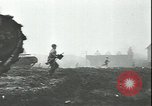
The U.S. Army Signal Corps in War and Peace. Descriptions and demonstrations of VT (proximity-fused) munitions
Opening scene shows troops of the U.S. Army 101st Airborne Division engaged at Bastogne, Belgium, during the Battle of the Bulge, in 1944, during World War II. They advance through fires and set up defenses in buildings, firing rifles from apartment windows. Outside, riflemen fire from behind a concrete barrier. Closeup of one firing his M1 Garand rifle. Glimpses of infantry firing mortars and walls falling to mortar fire. Gun crews firing heavy field artillery pieces, some under camouflage nets and others in the open. Intervening slate reads: "VT." and introduces postwar discussion of Signal Corps-developed proximity fuse, using animated cartoon. Shows how it proximity shells increase their explosive envelope compared to regular time fused munitions. U.S. Army gunner fire a number of proximity shells that burst above ground targets in the distance. A cartoon shows the proximity fused munition being used by a fighter aircraft. A Republic P-47 fighter plane is seen firing VT munitions from guns in its wings. Aerial bombs falling. A line of VT bombs exploding above ground.
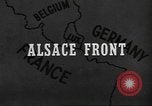
U.S. troops of the 79th Infantry Division engage German forces in the Alsace Front during World War II
Opening shows animated map of Alsace front at junction of Belgium, Germany, and France, in World War 2. Allied forces are schematically shown sweeping toward Wissembourg, Haguenau, and Strasbourg. Next, several U.S. Army M4A3(75) medium tanks are seen driving toward the camera on a rural road, during a pull back by the 7th Army in the first week of January, 1944, from advanced positions at the front. Some are filled with infantry riding atop them. The last of them is seen crossing a bridge 13 miles Northeast of Haguenau. The engineers of the 79th Division place demolition charges to destroy the bridge. Closeup of them placing and then remotely igniting the charge. A huge explosion ensues that completely destroys the bridge. Scene shifts to several U.S. soldiers of an engineer combat battalion preparing 100 pound of TNT in a captured blockhouse at Lauterbach, Alsace. Closeup of engineer carrying the explosives into the blockhouse and preparing the remote detonation device. The engineers string wire in the snow and setup their remote detonation device. One depresses a plunger to ignite the charge and blow up the blockhouse, which explodes in a huge cloud of black smoke. Next, elements of the 79th Infantry Division supported by tanks, are seen moving forward to counter German gains Southeast of Haguenau. (On January 5th the German forces had established a bridgehead across the Rhein (Rhine) river near Gansheim, Germany.) Scene shifts to Drusenheim, Germany where U.S. forces are engaging a Battalion of occupying German forces. Machine gun fire is heard constantly, as American infantry battle the hidden German defenders and tanks drive them from defensive positions near a bridge at the far end of town. Infantry move from behind tanks toward the bridge and are seen crossing it. An M4A3(75) medium tank risks crossing the narrow bridge and is immediately followed by many 79th Infantry troops. The battle continues on the other side of the bridge.
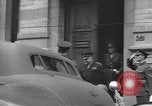
U.S. Army General Dwight D Eisenhower meets the Prime Minister of Belgium and other officials in Brussels, Belgium.
United States Army General Dwight David Eisenhower meets dignitaries in Brussels, Belgium during World War II. He meets Prince Charles, Count of Flanders, Belgian Prime Minister Hubert Pierlot and other officials. The officials standing on the steps of a building. Eisenhower shaking hands with them.
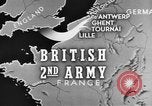
The British 2nd Army rolls through Tournai, fights in Antwerp and Ghent citizens help wipe out final resistance in Belgium.
The British 2nd Army advances on Tournai, Antwerp, and Ghent in Belgium. Animated map shows the advance in Belgium. Sign of France. The British 2nd Army rolls through Tournai, Belgium (September 3): Soldiers advance on Tournai. Army tanks and soldiers move over bridge and fire. Ghent citizens help wipe out final resistance. Large crowd gathers and allied troops on army tanks fire in city. The British 2nd Army fights in Antwerp on 4th September: German equipment burned and soldiers fire. Troops fight in streets. Nazi defenders run near railway tracks. (World War II period).
German prisoner, Otto Richard Struller, is transferred by jeep from Béverce near Malmedy, Belgium during World War II.
A U.S. Military policeman leans against his jeep in front of a small building in Béverce near Malmedy, Belgium during World War 2. Two German prisoners emerge from the building escorted by an armed American soldier. A military photographer passes to the left, in front of them, as two American military policemen escort another German prisoner (Otto Richard Struller) from the building. They each hold one of his arms. The prisoner is bareheaded. They pause and pose for a photographer (unseen). Closeup of the prisoner with MPs at his sides. Camera zooms in on prisoner, Struller. The MPs direct him to a waiting jeep. They all get in and drive away. Closeup of the jeep passing the camera. It drives away along a muddy road, past an overturned vehicle. (Note: The principal prisoner in this film, is Otto Richard Struller, a ballet dancer, who during the war served as a corporal with Panzerbrigade 150 unit Stielau/Stab solar, where he masqueraded as an American soldier behind the lines. He was executed, as a spy, on January 13, 1945 at the Palace of Justice in Huy, Belgium)
Long line of Belgian civilians passes on highway in Manhay, Belgium.
Belgium civilians in Manhay, Belgium. Long line of Belgian civilians on highway. Road sign of 'Erezee' and 'Manhay'. Views of civilians as they pass Belgian guard.