


 Francais
 Deutsch
 Italiano
Refine Your Search
+"China" +1942 stock footage and images
- Showing 19 to 24 of 54 results more
more Hide
Hide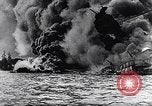
Japanese attack on Pearl Harbor in presaged by a decade of Japanese military aggression in China (WW2)
Opening scene shows the famous image of American battleship USS Arizona as attacked by Japanese forces in Pearl Harbor on December 7, 1941 in World War II. The ship is engulfed in black smoke, and listing. Change of scene to a waterfront in Japan during 1938, where numerous Japanese soldiers board troop ships bound for Manchuria, China. Next, are scenes of Japanese troops marching as they occupy Manchuria. Closeups of some Japanese soldiers. Scene shifts to a train moving on the South Manchurian railway, at a station showing a sign reading,"Chin Hsien." View of steam locomotive pulling a train away from the camera position. (Narrator states that a Japanese train, on the South Manchurian Railway, had been dynamited) This incident triggered a Japanese attack on Mukden, Manchuria. Japanese infantry are seen placing numerous bundles of reeds as a bridge across a wide, shallow, stream and proceeding to cross on their way to invade Mukden. Military supplies are carried on pack animals. In the air, overhead Japanese Mitsubishi G3M Type 96 land-based attack aircraft are seen flying in precision "V" formation. On the ground, Chinese civilians run for cover in the City of Mukden. (The date is September 18, 1931.) Glimpse of Chinese civilians looking at bombing victims on street of Mukden. Brief view of Geneva Switzerland, where League of Nations was housed. A memorial stone monument in that city to Woodrow Wilson, President of the United States and founder of the League of Nations. An entrance to the League of Nations headquarters in the Palais Wilson in Geneva, Switzerland. League delegates in session inside the Palais Wilson. A Japanese Naval Fleet, under command of Admiral Kichisaburō Nomura, is seen steaming toward the Chinese coast and begin a naval bombardment, firing their guns, 15 miles from Shanghai. Japanese Naval biplanes are seen in flight overhead. Japanese troops marching in the streets of Shanghai, as sidewalks of onlookers wave Japanese flags. Next, Japanese troops are seen marching out of Shanghai, at the insistence of the League of Nations. (Narrator states Japan signed a truce with China on May 4th, 1932.) View of Japanese troops entering further, into Mongolia. Japanese soldiers waving flag celebrating formation of the Puppet State of Manchuko in Northeast China and Inner Mongolia, in 1932. Japanese statesmen leaving the League of Nations headquarters, after Japan resigned from the League on February 24, 1933. Japanese infantry moving further into China supported by field artillery fire. Explosions from artillery and damaged buildings, as Japanese troops advance in China. Invaders using tall ladders to scale walls of a damaged fortress in China. Japanese pilots receiving briefing and boarding their Mitsubishi Ki-30 single engine light bomber aircraft at an airfield. View of them taking off and inflight, dropping bombs on Chinese targets. Aerial views of bombs exploding on ground below. Retreating Chinese army marching along the Great Wall of China. Chinese people and military forces moving their military and civilian resources deep into the Chinese interior.
Brigadier General Chennault and Colonel Scott with Flying Tigers and their P-40 aircraft in China
Brigadier General Chennault of 23rd Pursuit Group U.S. Army Air Force, and Colonel Scott standing in front of a map of China. A picture of Chiang Kai Shek. Colonel Scott talking to Flying Tigers personnel and Chinese hosts. P-40 aircraft with shark teeth paintings seen in background. Colonel Scott is welcomed by Captain Wong of China Air force. Pilot R.T. Smith in cockpit of P-40 warplane. The plane has many Japanese kill flags painted on side. P-40s of Flying Tigers lined up. Aerial views of P-40 aircraft in flight. Pilots wearing new flying uniform but with special sign on back 'Free China' written on them. General Chennault inside aircraft as he begins command with his new role under the USAAF leading the China Air Task Force (later the 14th Air Force).
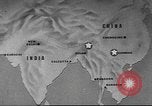
P-40 fighters piloted by Flying Tigers (1st American Volunteer Group) attack Japanese planes in China during World War II.
Flying Tigers (1st American Volunteer Group) operations in China during World War 2. An animation shows location of U.S. 10th and 14th Air Forces in India and China. Japanese troops march. Japanese aircraft taxi and take off. Japanese troops wave as planes take off. Japanese planes in flight. Planes strafe trucks on a highway. U.S. Army pilots assigned to the Flying Tigers (1st American Volunteer Group) beside P-40 Warhawk fighter aircraft. U.S. Army Air Corps Lieutenant General Claire Lee Chennault looks at a map laid on a jeep. Japanese planes in flight over clouds. Flying Tigers come out from behind a tree and run to P-40s. P-40s taxi on an airfield. Formation of P-40s in flight. Interior of a plane shows Japanese gunners cleaning guns while on the mission. Formations of P-40s. Japanese planes being shot down. Japanese planes spin down, hit the ground and explode. A wrecked Japanese plane. U.S. Lieutenant Art T. Smith in the cockpit of a P-40. An animation shows the location of an old Burma road from Rangoon, IndoChina. An American convoy at sea. Cargo is unloaded at a harbor in India and transferred to river barges. Small Chinese barges on the Rour. A small Chinese train loaded with supplies. The cargo being transferred from an American standard gauge train to a small gauge train. Chinese civilians load equipment on trucks.
Destroyed buildings due to Japanese bombardment in China during World War II.
Japanese troops attack Nanking (Nanjing), China during World War II. Japanese troops man aircraft guns. Japanese airplanes come down in flames. A bridge is blown up in China. The roof of a hospital has been bombed. Large letters 'Hospital' on it. Bomb craters all around the hospital. A Chinese woman sits near her dead husband. Children cry. The Premier of the puppet state Reorganized National Government of the Republic of China Wang Jingwei pose with other officials.
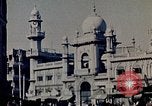
View of a large Indian harbor and members of U.S. Army Air Force in China
A large two storied building with typical Indian architecture with minarets and domes. A bay with small Indian craft, with a single sail and destroyer vessels seen. A large ship on an Indian city harbor. A Street is seen. View of a large Indian temple. A row of four P-66 Vanguards are parked on strip. Pilot is visible in the first plane. Two B-25s are parked in an open field. A P-38 parked in a grass field. Members of American Army Air Force Flying Tigers in China pose for pictures, in group as well as individually in front of a P-40.
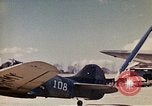
Members of American Army Air Force Flying Tigers in China and Administrative Building in Chapel
Airmen of U.S. Army Air Forces (USAAF) in China pose for photographs.Two officers take turns posing for the camera atop a Flying Tiger P-40. Camera pans across airmen posing in front of the P-40. Colonel Robert L. Scott, Commander, 23rd Fighter Group, is seen carrying a belt of 50 caliber ammunition over his shoulder. He points to Tiger Insignia on the left side of P-40. Scott hands the belt of ammunition to two armament men who load it into compartment in left wing. Change of scene, to view of Administrative Building at Randolph Field in Texas.