


 Francais
 Deutsch
 Italiano
Refine Your Search
+"England United Kingdom" +1944 stock footage and images
- Showing 19 to 24 of 193 results more
more Hide
Hide
The upper deck of a U.S. LST (Landing Ship, Tank) is loaded with army vehicles at Falmouth, England during World War II.
Loading of a U.S. LST (Landing Ship, Tank) at Polgwidden (A.K.A Trebah) beach , Helford River, near Falmouth, Cornwall, England during World War 2. (From the superstructure visible this is probably LST 532, USS Chase County.) A jeep pulls a trailer aboard the LST. Two jeeps on the elevator of the LST as it rises to upper deck. The upper deck of the LST shows a truck backing up on a ramp. (Note:This footage was taken on June 1, 1944, as the troops and equipment embarked for the D-Day invasion of Normandy. They spent the next 5 days very uncomfortably aboard due to stormy weather that delayed the landings until June 6th.)
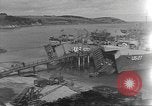
Army vehicles being loaded aboard LSTs (Landing Ship, Tank) near Falmouth, England, during World War II
Loading of U.S. LSTs (Landing Ship, Tank) at Polgwidden (a.k.a. Trebah) Beach, Helford River, near Falmouth, Cornwall, England, on 1st June 1944.in World War 2. U.S. LST 27, operated by the U.S. Coast Guard and U.S. Navy LST 533 are loading vehicles in readiness for the invasion of Normandy. A truck pulls a trailer up the ramp of LST 27. A jeep enters the LST. Some sailors and troops seen on the deck of the LST. A barrage balloon in the sky. U.S.Army vehicles travel through the village of Mawnan Smith on their way to embarkation at Trebah (Polgwidden).
Pilots of the USAAF 334th Fighter Squadron celebrate their victories at Debden Airfield in England, during World War II
Three pilots, Major Gerald Montgomery, Major Howard D. (Deacon) Hively, and Captain Shelton W. "Shell" Monroe, of the U.S. Army Air Forces 334th Fighter Squadron, 4th Fighter Group, discuss a map during World War 2.. Logos of the Eagle Sqadron and the 334th Fighter Squadron displayed above a wall containing small painted German crosses representing enemy aircraft destroyed, probably destroyed, and damaged. Airman stencils two more under the destroyed column. Major Howard D.Hively of Athens, OH.,with another Major looking at record of aerial victories on the wall. Hively holds a sign reading "300 destroyed." He hands it to the other Major who tacks it onto the wall using the butt of his .45 caliber automatic pistol as a hammer. They smile and shake hands. Then Lieutenant Timothy Cronin stencils three more crosses in the destroyed column, under the 300 sign, as Lieutenant Victor Rentschler looks on smiling. The two men each recorded kills on Christmas Day 1944, one of which was the 300th kill for the squadron. (Shelton W. Monroe was later killed in Korea after his plane was shot down on April 17, 1951. )
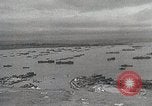
Allies in Britain prepare for D-Day invasion of Normandy, in World War II.
Allied invasion task force loading tanks, vehicles, troops and equipment on ships,at British ports, in readiness for the D-Day invasion of Normandy, in World war 2. Armored vehicle seen loaded onto USS Boone County (LST-389) at Falmouth in Cornwell, England on June 2, 1944, as troops load various ships. Troops near anchored craft USS LCI(L)-84 and another vessel (possibly marked 48 or 49). Tanks, bulldozers, and heavy equipement being loaded. View of Landing Ship Tank LST-621 and then LST-317 being loaded. DUKW vehicles in queue to load. A U.S. Army soldier is hoisted aboard a British Royal Navy ship in a special harness. British sailors around him and another U.S. Army soldier on the deck. Invasion troops from England and the United States spending their waiting time aboard ships. Three seen playing musical instruments: Accordion, guitar, and violin. Several play cards. Two practice gymnastics. Some prepare weapons and ammunition (view of LST-506 or LCI-506 in background). Navy sailors and U.S. Army troops huddled together in tight groups as they are briefed by their respective officers regarding the invasion mission.
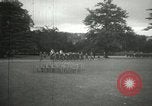
8th Air Force airmen assemble at Wycombe Abbey for a War Bond rally and Glenn Miller concert , during World War II.
Victory Squadron War Bond Rally at 8th Air Force Headquarters (Codenamed PINETREE) at Wycombe Abbey, High Wycombe, England, on July 29th 1944, during World War 2. U.S. Army military band plays the National Emblem March, as they march across a parade field lawn. They stop behind a parked flat bed tractor trailer on which Major Glenn Miller and his Army Air Forces band is seated. While the military band plays, U.S. 8th Air Force airmen march onto the field and take up positions in a large formation at its center. Spectators are gathered around the lawn, outside the airmens' formation, and military policemen are posted inside the circle of spectators.
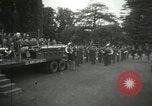
Lieutenant General Doolittle kicks off 8th Air Force War Bond Drive in England during World War II
Kickoff of U.S. 8th Air Force War Bond Drive at Wycombe Abbey, High Wycombe in England on July 29th 1944. Lieutenant General James Doolittle and several staff officers walk to a bandstand set up on a flatbed tractor trailer, where Major Glenn Miller and his Army Air Forces Band is seated. All come to attention as the General and staff ascend the platform. General Doolittle speaks about the good progress of the war and the need for supporting it with war bonds. He steps to a sales booth where he purchases a war bond from a Women's Army Corps (WAC) Corporal, in uniform .She asks him to sign their book of subscribers, which he does.General Doolittle then "sells" a bond to a Sergeant. Doolittle and his staff depart as the military band plays the Army Air Corps anthem.