


 Francais
 Deutsch
 Italiano
Refine Your Search
+"England United Kingdom" +1944 stock footage and images
- Showing 25 to 30 of 193 results more
more Hide
Hide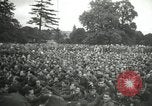
Glenn Miller and his Army Air Forces Band entertain airmen at 8th Air Force War Bond rally in England, during World War II
Major Glenn Miller and his Army Air Corps band play "In the Mood," for large gathering of airmen during 8th Air Force War Bond rally, at Wycombe Abbey, High Wycombe in England on July 29th 1944, during World War 2. The airmen and spectators applaud enthusiastically. The band then plays "Stardust. Glenn Miller introduces his string section that includes classical musicians, who have played with orchestras such as the New York Philharmonic, Boston Symphony, Cleveland Orchestra, and The Philadelphia Orchestra under Leopold Stokowski. The group is headed by Sergeant George Otners, whom Miller introduces, along with the String Section. Major Miller introduces the Saxaphone Section, headed by Sergeant Hank Freeman, who formerly played with the Artie Shaw band. Miller also introduces Sergeant Albert, his bass player.

Major Glenn Miller and his Army Air Corps band entertain airmen at War Bond rally in England, during World War II
Major Glenn Miller's Army Air forces band plays for airmen during concert at 8th Air Force War Bond rally on grounds of Wycombe Abbey, High Wycombe, England, on July 29th 1944, during World War 2. As they begin playing "What do you do in the Infantry," several airmen climb the stage and sing the song together with members of the band.(They also sing some lyrics written for the Air Forces.) An airman sings solo rendition of "I'll Get By (As Long as I Have You)," accompanied by the band. Views of the audience are seen throughout.
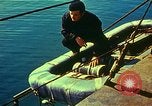
U.S. Coast Guard crews, in England, preparing their landing craft for the Normandy invasion of World War II
Landing craft being readied, in England, for the Normandy Invasion in World War 2. Sailors filling water cask on emergency life raft. LCI(L),U.S. Landing craft Infantry, Large, number 87. A small boat leaves that craft and another passes the camera boat. LCI(L) number 325 is seen (and a barrage balloon in far background). Coast Guard crew at work cleaning rust from craft 325. One is painting the deck. View of two LCI(L)s underway in water.
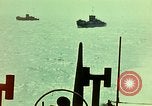
American landing craft in England, preparing for Normandy invasion, during World War II
Large Landing Craft Infantry, LCI(L) underway during training exercises in England, preparing for the Normandy invasion of World War 2. Glimpse from stern of craft, with American flag flying. LCI(L)s behind and British coastline in background. Several LCI(L)s moving in near formation. Gunners aboard camera craft ready their Oerlikon 20mm antiaircraft cannon. They open a locker and remove canisters of ammunition. Cluster of the landing craft moored in a bay. Camera craft moves past Landing Craft tank 644, run aground on a sand bar.
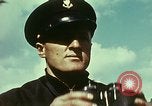
American landing craft gathered in England, preparing for Normandy invasion, during World War II
A Coast Guard crew member aboard a Large Landing Craft Infantry, LCI(L) moored in a bay in England, scans the skies with binoculars. LCI(L) 487 is one of a number of U.S. landing craft gathered in the bay. Two of the craft behind, display the American Union jack of white stars on a blue field. A barrage balloon is seen aloft. A town is nestled on a green hill in the background. Closeup of barrage balloon. View of the bay, in late afternoon, shadowed by the hill. Three barrage balloons are seen aloft. Crewmen on deck are sorting out and coiling lines, while another sharpens large compound shears with a file.
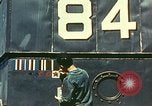
U.S. Landing Craft, in England, preparing for the Normandy invasion during World War II
U.S.Coast Guard crewmen painting battle star on superstructure of Landing Craft Infantry (Large), LCI(L) number 84, during World War 2, in France. (This craft was already a veteran of North African and Italian campaigns, and is preparing to take part in the Normandy invasion.) Another Guardsman questions whether it will be as good as other stars already painted. Others keep pestering the painter about this and he reassures them all. (View of perfect finished red star.) Landing craft Gunners display the landing craft's Oerlikon 20-millimeter Mk 4 automatic antiaircraft cannon. Views of LCI(L)s numbered 85, 89, 92,90, and 496, all tied together at a port in England. Sailors on LCI(L) 85, at their Oerlikon 20-millimeter cannon. U.S. Navy Union Jack displayed nearby. U.S. Coast Guard officers viewing sky with binoculars.