


 Francais
 Deutsch
 Italiano

Refine Your Search
+"Europe" +1944 stock footage and images
- Showing 31 to 36 of 234 results more
 Hide
United States 1st Infantry Division soldiers advance into French cities and fight for Aachen during World War II.
The role of United States 1st Infantry Division (Big Red One) in various campaigns in Europe during World War II. United States 1st Infantry Division men fight in France as they advance further inland into the country. Soldiers relax, get a haircut and write a letter back home to their families. On July 25th , 1944 German aircraft launch an air attack. Infantrymen fight in the streets of a city in France. Combat engineers plant land mines. 1st Infantry Division soldiers enter Coutance, Mortain, Etampes, Meaux and Soissons. Soldiers around a monument at the Belgium border. 1st Infantry soldiers advance towards Aachen. Tanks fire as soldiers fight against the Germans in Aachen. Men on a machine gun. On October 25th 1944 Aachen surrenders to the Allies. U.S. Army armored vehicle drives over Nazi flag lying in a street.
Allied troops aboard ships and gliders head for Normandy, France for the D-day invasion during World War II.
Allied invasion of Normandy, France during World War II. U.S. General Joseph McNarney, Deputy Chief of Staff at a desk as he outlines the importance of June 6, 1944 the day Allied forces attacked the Germans in Normandy. He speaks about the decision to knock down the Nazis first and then the Japanese during the World War. He says that the invasion of Normandy was planned in November 1943. He also states how General Dwight D. Eisenhower, Supreme Commander of the Allied forces in Europe, planned and executed the invasion. He also speaks about how the U.S. Army Air Forces and the Royal Air Forces aircraft bombarded the coasts of Normandy prior to the D Day invasion. Past events show American soldiers getting onto landing crafts in England as they leave for the invasion. The soldiers aboard the ships in the English Channel. The soldiers read the Bible and comics, sleep and cook aboard the ships. On June 5th , 1944 the ships head towards Normandy for the invasion. In England gliders carrying paratroopers take off from an airfield to bombard the German positions in Normandy. British soldiers receive ration and work on motorbikes. TNT (trinitrotoluene) charges being prepared by soldiers tasked with demolition duties. British soldiers check their guns and other weapons prior to the invasion. Jeep and artillery being loaded onto aircraft.
Allied soldiers prepare for D-Day invasion, and then land in France (WW2)
Allied campaign against Nazi Germany in 1944 during World War II. Tanks, artillery and supplies piled up in England for invasion of Europe. Allied soldiers from various Allied nations like Britain, America, New Zealand and South Africa gathered at docks. The soldiers loaded onto transport ships. Soldiers get into landing crafts. Supreme Commander of the Allied Expeditionary Force General Dwight D. Eisenhower at a map in Headquarters as he plans the invasion of France. The Allied invasion fleet underway in the English Channel to invade France. A map shows the location of Caen, France. Allied aircraft in flight and view at aircraft door as line of paratroopers jump. Massive group of parachutes in the sky as paratroopers descend. Explosions occur at a coast. Landing crafts beached and soldiers come ashore amidst heavy firing. Rockets and artillery being fired. Vehicles on the beach. A truck burns. A map depicts the area under Nazi German occupation before World War II and the recapture of those areas by Allied armies in 1944.
Allied forces fighting in naval battles, Normandy landing and aerial view of Normandy (WW2)
Soldiers form a human barricade to make way for important Allied military officials such as General Jacques Philippe Leclerc (Free France), United States General Omar Bradley and British Field Marshal Bernard Montgomery. United States General Omar Bradley walking during World War II. United States General George Patton uses a pair of binoculars. United States Army conducts mopping-up operations in a destroyed French town. United States infantry move through a forest. Soldiers walking on a street. Television host Alexander Scourby narrates while holding a book titled “Breakout and Pursuit” by Martin Blumenson. An excerpt of the book “Breakout and Pursuit”. United States, British and Canadian troops engage in a naval battle with German forces on the English Channel July 1, 1944. Gun turrets of battleship aiming and firing at German position. Battleships firing artillery. Thick smoke forms from heavy firing from naval artillery. Soldiers climbing down a marine rope ladder. Smoke covers the Normandy coast after Allied ships fired at German positions. Allied infantry wade through the waters after landing near a beachhead in Normandy on D-Day June 6, 1944. Famous shot of some soldiers collapsing after reaching the beachhead after landing. Some soldiers attempt to swim to reach the beach. Smoke forms away from the beach. A line of Allied infantry wade through the beach. A barrage balloon floats over a beach in Normandy. Alexander Scourby shows a map of Western Europe during World War 2 and points to the area of Northwestern France to demonstrate the goal of Operation Cobra. Aerial view of marshlands and hedgerows in Normandy. Tanks are seen on marshlands. German soldiers enter a French village. German soldier carries an MG42 machine gun. German troops sprinting near a berm. Explosion from bombing. German troops ducking in a berm alongside a hedgerow. A bomb explodes in field.

General Eisenhower as a World War II officer and as the U.S. President.
Scenes from life and career of Dwight D Eisenhower, 34th President of United States. U.S. Air Force plane lands and the President disembarks the plane in India, in 1959. He is greeted by the Indian President Dr Rajendra Prasad and other dignitaries. Emblem of 'Panama'. Sign of 'welcome Ike Crusader'. Large crowd welcomes Eisenhower. Motorcade goes through the city's street. Milestones in General Eisenhower's life and the international esteem with which he is held. Lt Col Eisenhower concerned about U.S. isolationism in 1940 as World War 2 is underway. Explosions in Europe due to bombing by German aircraft. Eisenhower and other officers in the General Staff study a map. Eisenhower plans the strategy as the commander of Operation Torch (he is shown talking to General George C. Marshall and Winston Churchill). President Eisenhower visits 4 continents and meets several leaders. Large crowds welcome him. General Eisenhower prepares for D-Day Invasion of France during World War 2. June 5, 1944: The Allied forces including troops, artillery, equipment, ammunition, aircraft and ships prepared. June 6, 1944: The Allies invade Normandy. Troops wade through the water during D-Day Normandy beach landings, while under enemy fire. German soldiers surrender. May 7, 1945: Nazi General Alfred Jodl signs the unconditional surrender of his government. General Eisenhower returns to the U.S. He receives a hero's welcome in New York during a parade. He visits his hometown in Kansas. Pictures of his family, childhood and college days. Eisenhower on his visits to various countries as President.
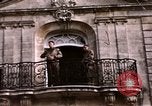
U.S. Army officers and war correspondents at the bombed, abandoned French Chateau de Pont-Rilly during World War II after D-Day
Uniformed U.S. war correspondents and U.S. Army officers explore the house and grounds of the French Chateau de Pont-Rilly, in Négreville near Normandy France, soon after the Invasion of Europe. (The chateau was designed in 1765 by architect Pierre-Raphaël de Lozon for the Marquis d'Ourville). U.S. Army officers in the balcony of the mansion overlooking the entrance. Exteriors of the palatial chateau. A large bomb hole is visible in the roof, right of the main entrance. A French boy points out something distant on the grounds of the Chateau. A swan in a pond. Exteriors of the mansion. At the end of July 1944, near the time this footage was shot, the chateau became the headquarters of Advance Section of Com Z, also known as "ADSEC" (Advance Section, Communications Zone).